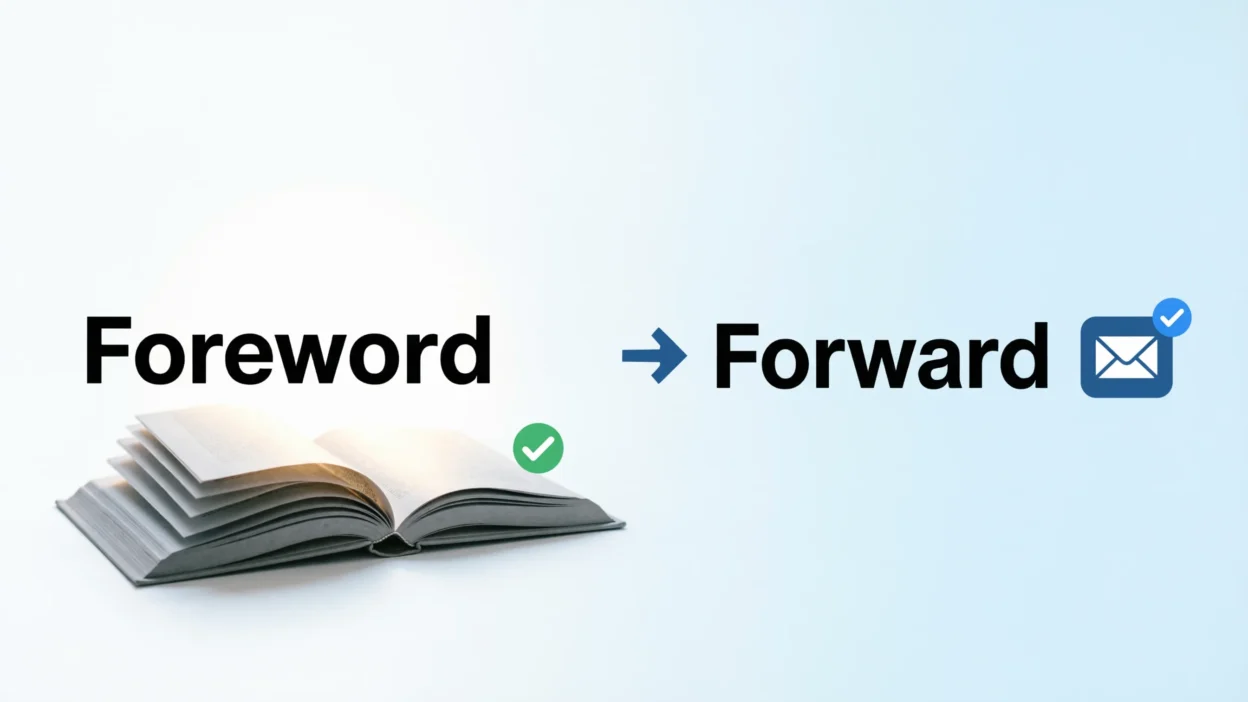
The difference between foreword vs forward often confuses writers because the two words sound exactly the same. Although they are pronounced alike, they have completely different meanings and are used in different situations.
Choosing the wrong one can make your writing look unprofessional and even change the meaning of your sentence.
If you’ve ever wondered whether to write foreword or forward, you’re not alone.
This guide explains the difference in simple terms, provides real-world examples, highlights common mistakes, and helps you remember the correct word every time.
Quick Answer
Both foreword and forward are correct English words, but they have different meanings.
- ✅ Foreword = An introductory section at the beginning of a book, usually written by someone other than the author.
- ✅ Forward = A direction, movement ahead, or the act of sending something to another person.
- ❌ They are not interchangeable.
A simple way to remember the difference is that foreword contains the word word, making it easy to associate with writing and books.
What Does “Foreword” Mean?
A foreword is a short introductory section that appears at the beginning of a book. It is usually written by someone other than the author, such as an expert, respected colleague, or well-known figure, to introduce the book and explain its significance.
A foreword often includes:
- Why the book is important.
- Information about the author.
- The writer’s connection to the book.
- Reasons readers should continue reading.
Examples:
- The famous historian wrote the foreword for the biography.
- Her latest novel includes a foreword by an award-winning author.
- I always read the foreword before starting a nonfiction book.
A foreword is part of a book’s front matter and should not be confused with a preface or introduction.
What Does “Forward” Mean?
Forward is a versatile word that can function as an adjective, adverb, verb, or noun. It generally means toward the front, ahead, or to send something onward.
Examples:
- Please move forward.
- She stepped forward to answer the question.
- Could you forward this email to the manager?
- The football team played a strong forward.
Unlike foreword, forward has nothing to do with books unless you’re referring to moving ahead or sending information.
Foreword vs Forward: The Key Difference
| Feature | Foreword | Forward |
|---|---|---|
| Meaning | Introductory section of a book | Ahead, onward, or send something |
| Part of Speech | Noun | Noun, verb, adjective, adverb |
| Related to Books | ✅ Yes | ❌ Not as a book section |
| Related to Movement | ❌ No | ✅ Yes |
| Related to Emails | ❌ No | ✅ Yes |
| Grammatically Correct | ✅ Yes | ✅ Yes |
Although the pronunciation is identical, the meanings are completely different.
Why Do People Confuse Foreword and Forward?
These words are commonly confused because they are homophones, meaning they sound the same but have different spellings and meanings.
Other reasons include:
- Their pronunciation is identical.
- Spell checkers may not catch the mistake because both words are correctly spelled.
- Many people rarely encounter the word foreword unless they read books.
- The spelling difference is only one letter.
Understanding the context is the easiest way to choose the correct word.
Examples of “Foreword” in Sentences
Use foreword when talking about books.
- The professor wrote the foreword to the new textbook.
- I enjoyed reading the foreword before beginning the novel.
- The foreword explains how the research was developed.
- A Nobel Prize winner contributed the foreword.
- The author’s mentor wrote the foreword for the memoir.
In each example, foreword refers to the introductory section of a book.
Examples of “Forward” in Sentences
Use forward when referring to direction, movement, or sending something.
- Please move forward in the line.
- She looked forward to the vacation.
- Can you forward this message to everyone?
- The company is moving forward with its plans.
- He plays as a forward on the soccer team.
Each sentence uses forward in one of its common meanings.
Common Mistakes to Avoid
Many writers accidentally substitute one word for the other.
Avoid these errors:
- ❌ I loved the forward of the novel.
- ✅ I loved the foreword of the novel.
- ❌ She wrote a beautiful forward for my book.
- ✅ She wrote a beautiful foreword for my book.
- ❌ Please foreword this email.
- ✅ Please forward this email.
- ❌ Step foreword and introduce yourself.
- ✅ Step forward and introduce yourself.
Always think about the context before choosing the word.
A Simple Memory Trick
An easy way to remember the difference is to focus on the spelling.
- Foreword contains the word word, and books are made of words.
- Forward ends with ward, which often relates to direction or movement, as in backward or toward.
Memory tip:
Word = Book = Foreword
Direction = Movement = Forward
Foreword vs Forward in Everyday Writing
You’ll usually see foreword in:
- Books
- Memoirs
- Academic publications
- Biographies
- Nonfiction works
You’ll commonly see forward in:
- Emails
- Business communication
- Navigation
- Sports
- Everyday conversations
- Workplace instructions
Choosing the right word depends entirely on what you’re describing.
American vs British English
There is no difference between American English and British English in the use of foreword and forward.
Both varieties of English follow the same spelling and grammar rules.
In both:
- ✅ Foreword refers to a book’s introductory section.
- ✅ Forward refers to movement, direction, or sending something.
- ❌ They should never be used interchangeably.
Related Words and Synonyms
Depending on the context, you may also encounter these related words.
For foreword:
- Introduction
- Preface
- Opening remarks
- Introductory note
- Prologue (in some contexts)
For forward:
- Ahead
- Onward
- Advance
- Send
- Progress
- Move ahead
Although some of these words are similar, they are not always interchangeable, so consider the context carefully.
Frequently Asked Questions
Is “foreword” the same as “forward”?
No. Foreword is the introductory section of a book, while forward refers to movement, direction, or sending something.
Why is “foreword” spelled with “word”?
Because a foreword is a written section at the beginning of a book. The spelling reflects its connection to written words.
Can I use “forward” in a book?
Yes, but only when referring to movement, direction, or sending information—not as the introductory section.
Is “foreword” always written by someone else?
Usually, yes. A foreword is commonly written by someone other than the author, although there are exceptions.
What is the difference between a foreword and a preface?
A foreword is generally written by someone other than the author, while a preface is written by the author to explain the purpose or background of the book.
Is there a difference between American and British English?
No. Both use foreword and forward in exactly the same way.
How can I remember which word to use?
Think of word inside foreword. If it relates to a book, choose foreword. If it relates to movement or sending something, choose forward.
Can spell check detect this mistake?
Not always. Since both are correctly spelled English words, you’ll need to choose the right one based on the context.
Summary
Understanding the difference between foreword vs forward is easier than it first appears. Foreword is a noun that refers to an introductory section of a book, while forward relates to movement, direction, progress, or sending something to another person. Although they are pronounced the same, they have completely different meanings and uses.
Whenever you’re writing, think about the context. If you’re talking about a book’s opening remarks, choose foreword. If you’re discussing moving ahead, advancing, or forwarding an email, choose forward. Remembering that foreword contains “word” is a simple trick that will help you avoid this common mistake.
Actionable Takeaway: Before publishing your writing, check whether you’re referring to a book introduction or movement and direction. Matching the word to the context will ensure your grammar is accurate and your writing remains clear and professional.

Shan Waston is a skilled writer at Symboliy.com, producing clear, engaging content on language, communication, and everyday expressions to help readers understand meaning and usage confidently in modern digital contexts.