Have you ever typed foward and wondered whether it was the correct spelling? You’re not alone. Many English speakers accidentally leave out the letter r when writing forward, making it one of the most common spelling mistakes in everyday communication.
Understanding the difference between foward vs forward is important for clear and professional writing. Whether you’re sending emails, writing academic papers, creating content, or communicating on social media, knowing the correct spelling can help you avoid embarrassing errors and improve your credibility.
Quick Answer
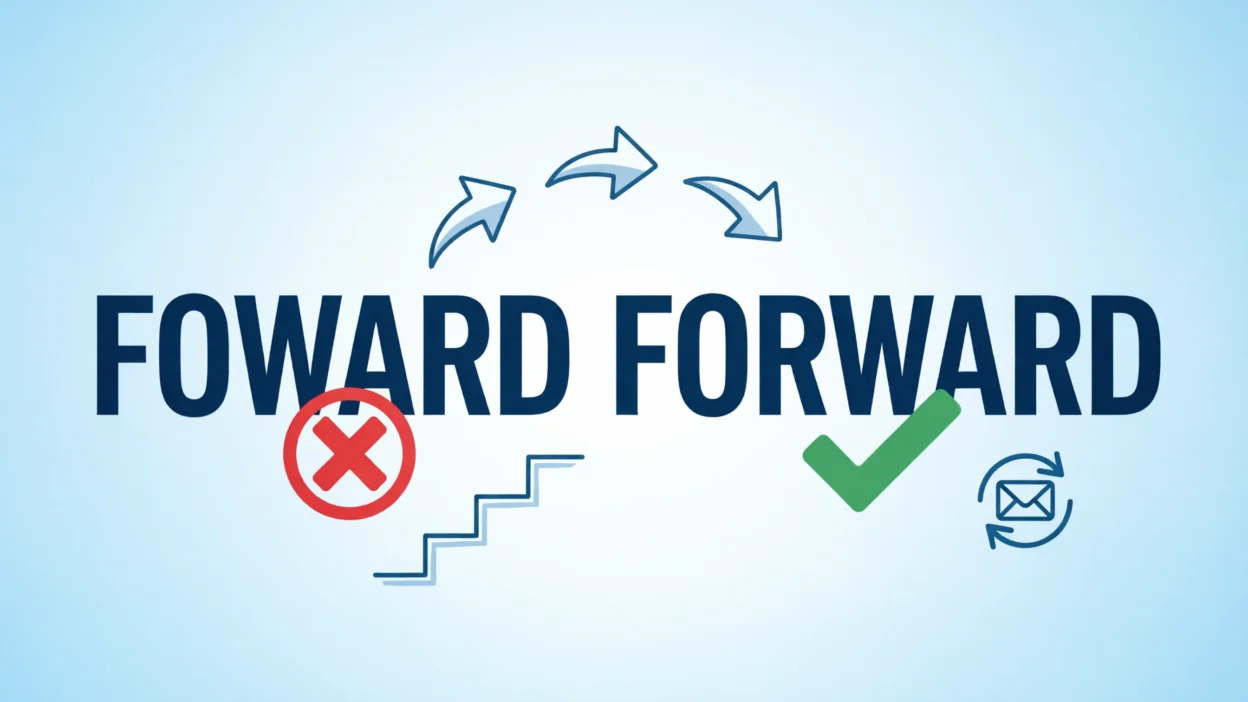
Forward is the correct spelling in standard English.
Foward is a misspelling and is not recognized as a proper English word in major dictionaries.
- ✅ Correct: Please forward the email to the team.
- ❌ Incorrect: Please foward the email to the team.
If you’re choosing between foward vs forward, always use forward.
What Does Forward Mean?
Forward is a common English word that can function as an adjective, adverb, verb, or noun depending on the context.
Definition of Forward
The word forward generally means:
- Moving ahead
- In the direction in front of you
- Advancing or progressing
- Sending something to another person
- Looking toward the future
Examples of Forward in Sentences
- She stepped forward to introduce herself.
- Please forward this message to your manager.
- The company is moving forward with its expansion plans.
- We look forward to hearing from you.
Because of its versatility, forward appears frequently in both spoken and written English.
What Does Foward Mean?
Foward does not have a recognized meaning in standard English.
It is simply a spelling error that occurs when people accidentally omit the second r in forward.
Why Does Foward Happen?
Common reasons include:
- Fast typing
- Autocorrect failures
- Pronunciation confusion
- Lack of familiarity with the correct spelling
Although many people write foward, dictionaries and grammar guides consider it incorrect.
Foward vs Forward: Side-by-Side Comparison
| Feature | Foward | Forward |
|---|---|---|
| Standard English Word | No | Yes |
| Found in Dictionaries | No | Yes |
| Correct Spelling | No | Yes |
| Professional Usage | No | Yes |
| Accepted Worldwide | No | Yes |
| Recommended for Writing | No | Yes |
The comparison clearly shows that forward is the only correct option.
Why Do People Confuse Foward and Forward?
The confusion often comes from pronunciation and typing habits.
1. Silent Letter Patterns
When spoken quickly, some people don’t clearly hear the second r in forward, leading them to spell it incorrectly.
2. Typographical Errors
Since forward is used frequently in emails and digital communication, accidental omissions are common.
3. Familiarity with Similar Words
Writers may subconsciously simplify the spelling because many English words don’t contain repeated consonant sounds.
Common Uses of Forward
Understanding how forward functions can make it easier to remember its correct spelling.
As an Adverb
Indicating movement ahead.
Examples:
- Move forward carefully.
- The vehicle rolled forward slowly.
As an Adjective
Describing something ahead or future-oriented.
Examples:
- The forward section of the ship sustained damage.
- They adopted a forward-thinking strategy.
As a Verb
Meaning to send something onward.
Examples:
- Please forward the report.
- She forwarded the invitation to everyone.
As a Noun
Commonly used in sports.
Examples:
- He plays as a forward on the soccer team.
- The team’s leading forward scored twice.
Common Mistakes When Using Forward
Many writers make avoidable errors with this word.
Mistake 1: Writing Foward
❌ Please foward the attachment.
✅ Please forward the attachment.
Mistake 2: Misspelling in Professional Emails
❌ I will foward your request to HR.
✅ I will forward your request to HR.
Mistake 3: Using Foward in Academic Writing
❌ The research moves foward significantly.
✅ The research moves forward significantly.
Because spell-checkers may occasionally miss errors in certain platforms, it’s wise to proofread carefully.
Examples of Forward in Everyday Language
Workplace Communication
- Please forward the invoice.
- I have forwarded your message to the department.
Personal Conversations
- Let’s move forward together.
- She stepped forward to help.
Business Context
- The project is moving forward as planned.
- Management approved the forward strategy.
Sports Context
- The forward scored the winning goal.
- Coaches praised the young forward’s performance.
These examples show how frequently the word appears across different situations.
American vs British English: Is There Any Difference?
When comparing foward vs forward, there is no difference between American and British English.
Both forms of English use:
✅ Forward
Both reject:
❌ Foward
Unlike words such as:
- Color vs Colour
- Organize vs Organise
- Traveling vs Travelling
the spelling of forward remains the same in both American and British English.
Forward vs Forwards
Another source of confusion involves forward and forwards.
Forward
Common in American English.
Example:
- Move forward.
Forwards
More common in British English as an adverb.
Example:
- Move forwards.
Both forms can be correct depending on context, but forward remains universally accepted and more common globally.
Synonyms and Related Terms
Learning related words can expand your vocabulary.
Synonyms for Forward
- Ahead
- Onward
- Progressing
- Advancing
- Moving
- Future-oriented
- Developing
- Proceeding
Related Terms
- Advancement
- Progress
- Future
- Growth
- Development
- Momentum
- Send
- Transfer
These related words often appear alongside forward in writing and conversation.
When Should You Use Forward?
Use forward whenever you’re referring to:
- Movement ahead
- Progress or advancement
- Sending information
- Looking toward the future
- A sports position
Examples:
- Forward the document to the client.
- The company is moving forward rapidly.
- We look forward to your response.
If your sentence fits one of these situations, forward is almost certainly the correct spelling.
Easy Memory Trick
A simple way to remember the correct spelling is:
Forward moves toward the future, and the future requires the extra “r” for the right spelling.
Another trick:
Think of “for” + “ward”.
Combining these two recognizable parts makes it easier to remember that forward contains two r letters.
FAQs About Foward vs Forward
Is foward a real word?
No. Foward is considered a spelling mistake and is not recognized in standard English dictionaries.
Which spelling is correct: foward or forward?
Forward is the correct spelling.
Why do people write foward?
Most often due to typing errors or forgetting the second r.
Is foward accepted in British English?
No. British English uses forward, just like American English.
Can I use foward in professional writing?
No. You should always use forward in formal and professional communication.
What does forward mean in email?
As a verb, it means sending a received email to another recipient.
Is forward a noun?
Yes. In sports, forward can refer to an attacking player.
How can I remember the correct spelling?
Remember the phrase “move forward, never foward.” The extra r is always required.
Summary
The comparison of foward vs forward is straightforward. Forward is the correct spelling recognized in dictionaries, educational materials, professional writing, and everyday communication. It can function as a noun, verb, adjective, or adverb and is widely used to describe movement, progress, future direction, or sending information.
On the other hand, foward is simply a misspelling that results from typing mistakes or spelling confusion. It has no accepted meaning in standard English and should be avoided in all forms of writing. Using forward consistently will help ensure your communication remains clear, professional, and grammatically correct.
Actionable Takeaway
Whenever you write the word, pause briefly and check that it contains both r letters: forward. Adding this quick proofreading habit to your writing process can help eliminate one of the most common spelling mistakes and improve your overall writing accuracy.

Mike Poop is a dedicated writer at Symboliy.com, creating clear, practical content about language, communication, and everyday expressions to help readers understand meaning and usage confidently in professional contexts worldwide.