Have you ever seen the words “absence” and “absense” and wondered which one is correct? You’re not alone. This is a common spelling confusion in English because both words sound very similar when spoken. However, only one spelling is accepted in standard English.
Understanding the difference between absence vs absense can help you avoid embarrassing spelling mistakes in school assignments, emails, business documents, and everyday writing.
In this guide, you’ll learn the correct spelling, meaning, examples, common mistakes, and simple tricks to remember the right form every time.
Quick Answer
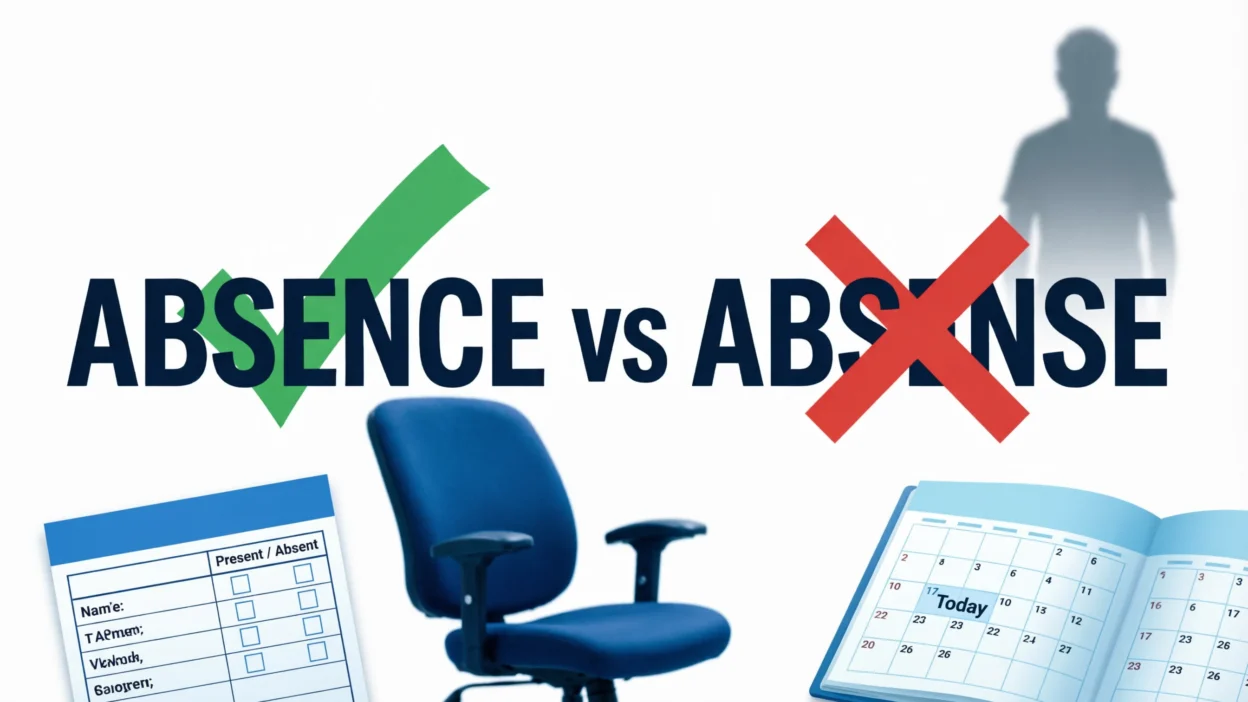
“Absence” is the correct spelling.
- ✅ Absence = Correct English word
- ❌ Absense = Incorrect spelling
Correct: Her absence was noticed during the meeting.
Incorrect: Her absense was noticed during the meeting.
If you’re referring to the state of being away or not present, always use absence.
What Does “Absence” Mean?
Absence is a noun that refers to the state of not being present in a place, situation, or event where someone or something is expected.
It can describe:
- Being away from school or work
- Lack of presence
- Missing attendance
- Nonappearance
- Unavailability
Examples of Absence
- His absence from class was unexpected.
- We noticed her absence during the conference.
- The manager explained his absence from work.
- Prolonged absence may affect performance.
The word is commonly used in education, business, healthcare, and everyday communication.
What Does “Absense” Mean?
Absense is not a correct spelling in modern English.
It is simply a misspelling of absence that occurs because many people spell the word based on how it sounds.
Incorrect Examples
- Your absense was noted.
- The teacher questioned her absense.
- His absense caused concern.
Correct Versions
- Your absence was noted.
- The teacher questioned her absence.
- His absence caused concern.
Whenever you write this word, use absence with a “c” rather than an “s” before the final letters.
Absence vs Absense: Key Differences
Although the words appear similar, only one is correct.
| Feature | Absence | Absense |
|---|---|---|
| Correct English Spelling | Yes | No |
| Found in Dictionaries | Yes | No |
| Accepted in Academic Writing | Yes | No |
| Professional Usage | Yes | No |
| Standard English | Yes | No |
Simple Rule
If you’re referring to someone or something not being present, always write absence.
Why Do People Spell It “Absense”?
This mistake is extremely common because of pronunciation.
Similar Sound
In everyday speech, the c in absence often sounds similar to an s, causing writers to spell the word incorrectly.
Phonetic Spelling
Many people spell words based on what they hear.
Since absence sounds close to “absense,” the incorrect spelling frequently appears in emails, essays, and online content.
Typing Errors
Fast typing can also contribute to accidental misspellings.
Common Uses of “Absence”
The word absence is useful in many contexts.
Education
- Student absence affects learning.
- The school requires an explanation for each absence.
Workplace
- Employee absence can impact productivity.
- Frequent absence may require management review.
Events
- Her absence from the wedding surprised everyone.
- The chairman’s absence delayed the meeting.
Relationships
- His long absence was difficult for the family.
- The absence of communication caused misunderstandings.
Examples of Correct Usage
Here are some examples showing how to use absence properly.
In Sentences
- The teacher recorded his absence.
- Her absence was immediately noticed.
- We apologized for our absence.
- Frequent absence may lead to penalties.
- The absence of evidence is not evidence of absence.
Common Phrases
- In the absence of
- Leave of absence
- Absence from work
- Absence from school
- Notice of absence
- Unexpected absence
These phrases are widely used in formal and informal English.
Common Mistakes With Absence vs Absense
Learning common mistakes can help you avoid them.
Mistake #1: Using Absense in Formal Writing
Incorrect: Please explain your absense.
Correct: Please explain your absence.
Mistake #2: Misspelling in Emails
Incorrect: I apologize for my absense yesterday.
Correct: I apologize for my absence yesterday.
Mistake #3: School Reports
Incorrect: Student absense has increased.
Correct: Student absence has increased.
Mistake #4: Workplace Documents
Incorrect: Employee absense policy.
Correct: Employee absence policy.
Synonyms of Absence
Using related words can improve your writing variety.
Common Synonyms
- Nonattendance
- Unavailability
- Missing presence
- Leave
- Nonappearance
- Vacancy
- Lack
- Omission
- Withdrawal
- Separation
Example
Instead of:
- His absence was noticeable.
You could write:
- His nonattendance was noticeable.
- His unavailability was noticeable.
Absence in Different Contexts
The meaning remains similar, but usage may vary.
| Context | Example |
|---|---|
| School | Absence may affect grades. |
| Workplace | Absence can impact workflow. |
| Healthcare | Absence from appointments may delay treatment. |
| Events | Absence may change schedules. |
| Family | Long absence can affect relationships. |
This flexibility makes absence an important word in everyday English.
American vs British English Differences
When comparing absence vs absense, there is no spelling difference between American and British English.
American English
- Correct: Absence
- Incorrect: Absense
British English
- Correct: Absence
- Incorrect: Absense
In both forms of English, absence is the only accepted spelling.
Memory Trick to Remember the Correct Spelling
A simple trick is:
Absence contains “C” just like “Correct.”
Think:
- Absence → Correct
- Absence → Class
- Absence → Certificate
The letter C can remind you that absence is the correct spelling.
Why Correct Spelling Matters
Using the correct spelling improves:
- Professional communication
- Academic writing
- Reader confidence
- Search engine optimization
- Personal credibility
A single spelling mistake can sometimes leave a negative impression, especially in formal settings.
Frequently Asked Questions
Is absence or absense correct?
Absence is the correct spelling.
Is absense a real word?
No. Absense is considered a misspelling of absence.
What does absence mean?
Absence refers to the state of being away, missing, or not present.
How do you use absence in a sentence?
Example: Her absence from work was unexpected.
Why do people spell absence as absense?
The mistake usually occurs because the word’s pronunciation makes the c sound similar to an s.
Is absence a noun?
Yes. Absence is a noun.
Example: His absence was noticed.
Do Americans and British people spell absence differently?
No. Both use absence.
What is the phrase “in the absence of” mean?
It means without the presence of someone or something.
Example: In the absence of evidence, no decision was made.
Summary
The difference between absence vs absense is straightforward. Absence is the correct spelling and is recognized in dictionaries, academic writing, professional communication, and everyday English. In contrast, absense is simply a spelling mistake that often occurs because the word sounds similar when spoken.
Whenever you need to describe someone or something not being present, always choose absence. Using the correct spelling will make your writing more professional, accurate, and trustworthy while helping you avoid a common English language error.
Actionable Takeaway
Before sending an email, submitting an assignment, or publishing content, quickly check whether you’ve written absence with a C. If you spot absense, correct it immediately.
A simple memory rule is: Absence contains the letter C for Correct. Following this tip can help you avoid one of the most common English spelling mistakes.

Here is a professional 30-word author biography including your site name Symboliy.com:
Martin Hood is a professional writer at Symboliy.com, creating clear, informative content focused on language, communication, and meaningful expressions for everyday and professional use.