Have you ever typed “compair” instead of “compare” and wondered if both spellings are acceptable? You’re not alone.
This is a common English spelling mistake because the pronunciation of compare can sometimes make people think it should be spelled with “air” rather than “are.”
Understanding the difference between compair vs compare is important for writing clearly and professionally. Whether you’re working on an essay, business report, email, or social media post, using the correct spelling helps build credibility and improves communication.
In this guide, you’ll learn the correct spelling, meaning, examples, common mistakes, and simple memory tricks to avoid this error.
Quick Answer
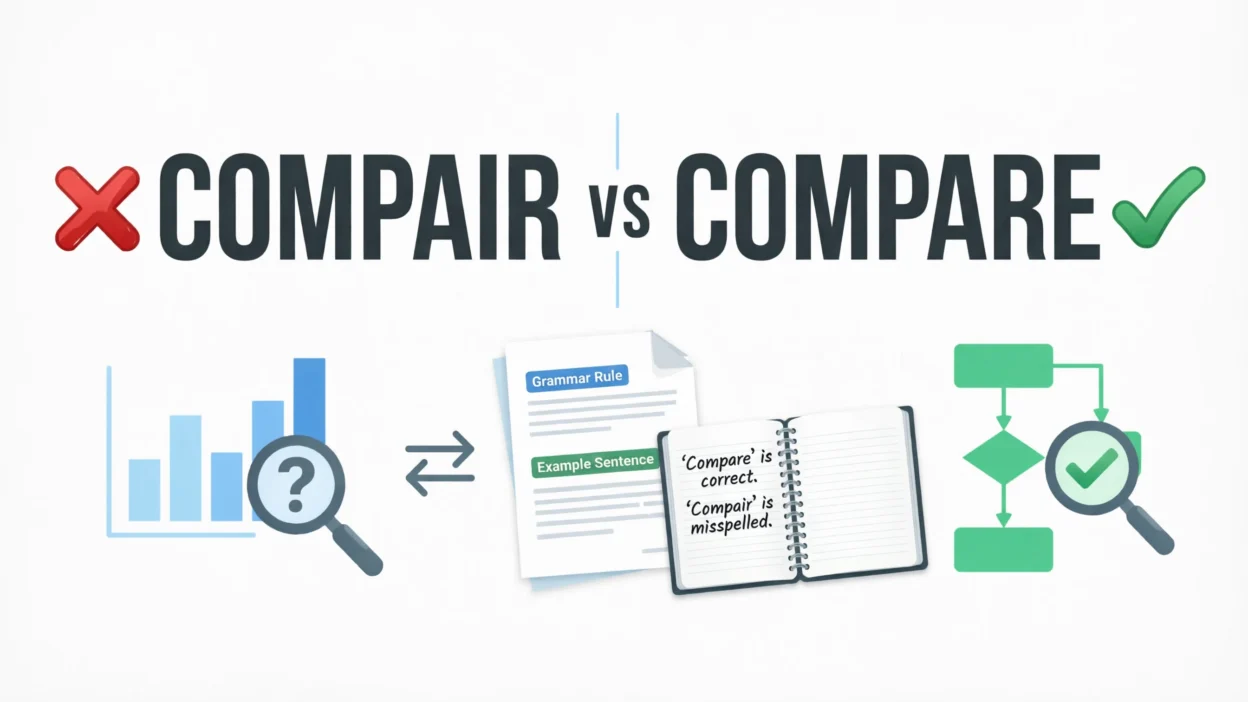
“Compare” is the correct spelling.
- ✅ Compare = Correct English word
- ❌ Compair = Incorrect spelling
Correct: Let’s compare the two products before buying one.
Incorrect: Let’s compair the two products before buying one.
Whenever you want to examine similarities or differences between two or more things, use compare.
What Does “Compare” Mean?
Compare is a verb that means to examine two or more things to identify their similarities, differences, advantages, or qualities.
It can be used when:
- Evaluating products
- Analyzing information
- Measuring performance
- Discussing similarities and differences
- Making decisions
Examples of Compare
- We should compare prices before making a purchase.
- The teacher asked students to compare the two stories.
- Analysts compare data from different years.
- It is helpful to compare multiple options before choosing one.
The word is widely used in education, business, science, technology, and everyday conversations.
What Does “Compair” Mean?
Compair is not a standard English word.
It is simply a misspelling of compare that occurs because some people spell the word based on how it sounds rather than its correct written form.
Incorrect Examples
- Please compair these reports.
- We need to compair both plans.
- Can you compair the results?
Correct Versions
- Please compare these reports.
- We need to compare both plans.
- Can you compare the results?
In modern English, compare is always the correct spelling.
Compair vs Compare: Key Differences
Although the words look similar, only one is correct.
| Feature | Compare | Compair |
|---|---|---|
| Correct English Spelling | Yes | No |
| Found in Dictionaries | Yes | No |
| Accepted in Academic Writing | Yes | No |
| Professional Usage | Yes | No |
| Standard English | Yes | No |
Simple Rule
If you’re talking about evaluating similarities or differences, always use compare.
Why Do People Write “Compair”?
This spelling mistake happens for several reasons.
Pronunciation Confusion
The ending of compare sounds similar to words that contain “air.”
As a result, some writers mistakenly assume the spelling should be compair.
Phonetic Spelling
Many English learners spell words exactly as they hear them.
Because English spelling is not always phonetic, this can lead to errors.
Typing Mistakes
Fast typing and autocorrect issues can occasionally produce the incorrect spelling.
Common Uses of “Compare”
The word compare appears in many situations.
Education
- Students compare historical events.
- Teachers ask learners to compare texts.
Business
- Companies compare market performance.
- Consumers compare prices and features.
Technology
- Reviewers compare smartphones and laptops.
- Experts compare software solutions.
Everyday Life
- People compare travel destinations.
- Families compare insurance plans.
Examples of Correct Usage
Here are some examples showing how compare is used correctly.
In Sentences
- Compare the benefits before making a decision.
- It is difficult to compare these two situations.
- Researchers compare findings from multiple studies.
- We compared several hotels before booking.
- The article compares different investment strategies.
Common Phrases
- Compare and contrast
- Compare prices
- Compare products
- Compare results
- Compare data
- Compare options
These expressions are common in both formal and informal English.
Common Mistakes With Compair vs Compare
Understanding common errors can help improve your writing.
Mistake #1: Using Compair in Professional Documents
Incorrect: Please compair the financial reports.
Correct: Please compare the financial reports.
Mistake #2: Misspelling in School Assignments
Incorrect: Students should compair both characters.
Correct: Students should compare both characters.
Mistake #3: Website Content Errors
Incorrect: Compair our plans today.
Correct: Compare our plans today.
Mistake #4: Email Writing Mistakes
Incorrect: Can you compair these proposals?
Correct: Can you compare these proposals?
Synonyms of Compare
Using synonyms can make your writing more engaging.
Common Synonyms
- Contrast
- Evaluate
- Examine
- Assess
- Analyze
- Measure
- Review
- Match
- Relate
- Differentiate
Example
Instead of:
- Compare the two products.
You could write:
- Evaluate the two products.
- Analyze the two products.
Keep in mind that some synonyms may slightly change the meaning depending on context.
Compare in Different Tenses
Learning different verb forms can improve grammar accuracy.
| Tense | Example |
|---|---|
| Present | I compare prices regularly. |
| Past | I compared several options yesterday. |
| Present Continuous | I am comparing the results now. |
| Present Perfect | I have compared all available choices. |
| Future | I will compare them tomorrow. |
Notice that all forms come from the base word compare.
American vs British English Differences
When comparing compair vs compare, there is no spelling difference between American and British English.
American English
- Correct: Compare
- Incorrect: Compair
British English
- Correct: Compare
- Incorrect: Compair
Both versions of English use compare exclusively.
Memory Trick to Remember the Correct Spelling
A simple trick is:
Compare contains the word “pare.”
Think of comparing two items side by side to see how they pair or relate.
You can also remember:
- Compare → Comparison
- Compare → Comparable
All related words use “pare,” not “pair.”
Why Correct Spelling Matters
Using the correct spelling helps:
- Improve professionalism
- Increase reader trust
- Strengthen academic writing
- Enhance communication
- Avoid confusion
Even a small spelling mistake can affect how your writing is perceived.
Frequently Asked Questions
Is compare or compair correct?
Compare is the correct spelling.
Is compair a real word?
No. Compair is considered a spelling mistake in standard English.
What does compare mean?
Compare means to examine similarities and differences between two or more things.
How do you use compare in a sentence?
Example: Compare the prices before making a purchase.
Why do people spell compare as compair?
The mistake usually occurs because people spell the word based on pronunciation.
Is compare a verb?
Yes. Compare is a verb.
Example: We compare options before deciding.
Do Americans and British people spell compare differently?
No. Both use compare.
What is the noun form of compare?
The noun form is comparison.
Example: The comparison revealed important differences.
Summary
The difference between compair vs compare is simple. Compare is the correct spelling and is recognized in dictionaries, academic writing, business communication, and everyday English. On the other hand, compair is a common spelling mistake that results from pronunciation confusion and phonetic spelling habits.
Whenever you want to examine similarities, differences, features, prices, or qualities, always use compare. Choosing the correct spelling improves clarity, professionalism, and credibility in all forms of communication.
Actionable Takeaway
Before sending an email, publishing content, or submitting an assignment, check whether you’ve written compare correctly. If you see compair, replace it immediately.
A helpful reminder is: Compare leads to comparison, and both use “pare,” not “pair.” Keeping this rule in mind will help you avoid this common spelling mistake.

Mike Poop is a dedicated writer at Symboliy.com, creating clear, practical content about language, communication, and everyday expressions to help readers understand meaning and usage confidently in professional contexts worldwide.