
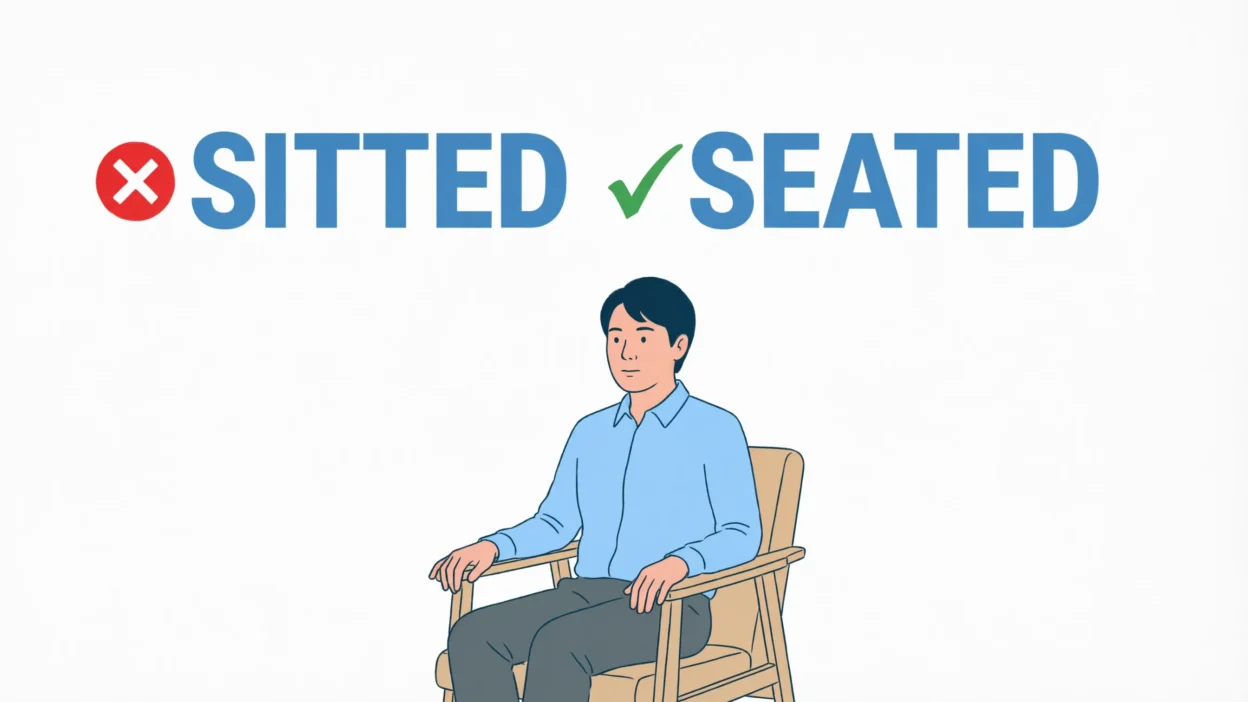
Have you ever wondered whether you should say “I was sitted” or “I was seated”? This is one of the most common grammar questions among English learners and even native speakers.
The confusion comes from the fact that both words seem related to the verb sit, yet they are not used in the same way.
Understanding the difference between sitted vs seated can instantly improve your writing, speaking, and overall confidence in English.
In this guide, you’ll learn the meaning of each word, correct usage, common mistakes, examples, and practical tips to help you choose the right word every time.
Quick Answer
“Seated” is the correct and widely accepted word in modern English.
- Seated means being in a sitting position or placed in a seat.
- Sitted is generally considered nonstandard, incorrect, or extremely rare in modern English.
- In most situations, use seated instead of sitted.
Correct: She was seated near the window.
Incorrect: She was sitted near the window.
What Does “Seated” Mean?
The word seated is the past participle of the verb seat, which means to place someone in a chair or sitting position.
It can also describe someone who is already sitting.
Examples of Seated
- The guests were seated before the ceremony began.
- She was seated in the front row.
- We remained seated throughout the presentation.
- The teacher seated the students according to their groups.
In modern English, seated sounds natural, professional, and grammatically correct.
What Does “Sitted” Mean?
The word sitted is technically an old or regional past form of sit, but it is rarely used in contemporary English.
Today, standard English uses:
- Sit (present)
- Sat (past)
- Sat (past participle)
Correct Forms of Sit
| Tense | Correct Form |
|---|---|
| Present | Sit |
| Past | Sat |
| Past Participle | Sat |
Examples
- I sit here every day.
- Yesterday, I sat by the fireplace.
- I have sat in that chair many times.
Because sat already serves as the past and past participle form, sitted is usually unnecessary and considered incorrect in standard grammar.
Sitted vs Seated: Key Differences
The easiest way to understand the difference is to look at how each word functions.
| Feature | Sitted | Seated |
|---|---|---|
| Common in Modern English | No | Yes |
| Grammatically Accepted | Rarely | Yes |
| Professional Writing | Avoid | Recommended |
| Everyday Conversation | Rarely Used | Frequently Used |
| Means Sitting in a Chair | Sometimes Intended | Yes |
Simple Rule
If you’re describing someone being in a chair or sitting position, use seated.
Correct: The audience was seated.
Incorrect: The audience was sitted.
Why Do People Confuse Sitted and Seated?
The confusion usually happens because many English verbs form their past tense by adding -ed.
Examples:
- Walk → Walked
- Talk → Talked
- Jump → Jumped
Many learners assume:
- Sit → Sitted
However, sit is an irregular verb.
Its correct past form is:
- Sit → Sat
Since irregular verbs do not follow standard patterns, sitted feels logical but is generally incorrect.
When Should You Use “Seated”?
Use seated whenever you want to indicate that someone is sitting or has been placed in a seat.
Formal Situations
- Guests were seated promptly.
- Please remain seated during the flight.
- The committee members were seated around the table.
Everyday Situations
- We were seated near the stage.
- She remained seated while speaking.
- Everyone was seated before the movie started.
Business and Professional Writing
- Attendees were seated according to registration order.
- Customers were seated immediately upon arrival.
In nearly every context, seated is the preferred choice.
Common Mistakes With Sitted vs Seated
Many English learners make similar errors when using these words.
Mistake #1: Using Sitted Instead of Sat
Incorrect: I sitted on the sofa.
Correct: I sat on the sofa.
Mistake #2: Using Sitted Instead of Seated
Incorrect: The guests were sitted.
Correct: The guests were seated.
Mistake #3: Mixing Sit and Seat
Incorrect: The waiter sat us at a table.
Better: The waiter seated us at a table.
Although some native speakers use “sat” in this way informally, seated is generally preferred in formal English.
Examples of Correct Usage
Here are practical examples showing how these words work in real-life situations.
Using Seated
- The bride’s family was seated on the left side.
- Please stay seated until the train stops.
- The students were seated quietly.
- We were seated next to each other.
Using Sat
- I sat by the window.
- They sat together during lunch.
- She sat in the same seat every day.
- We sat outside and enjoyed the weather.
Avoid These
- I sitted by the window.
- We were sitted at the restaurant.
- The students were sitted quietly.
American vs British English Differences
When comparing sitted vs seated, there is very little difference between American and British English.
American English
American English strongly favors:
- Sat
- Seated
Examples:
- I sat in the back row.
- The customers were seated immediately.
British English
British English also prefers:
- Sat
- Seated
Examples:
- She sat beside the fire.
- Guests were seated before dinner.
In both varieties of English, sitted is uncommon and generally avoided.
Grammar Tip: Sit vs Seat
Many people also confuse sit and seat.
Sit
Sit means to place yourself in a sitting position.
Examples:
- Sit down.
- I sit here every morning.
- He sat beside me.
Seat
Seat means to place someone else in a seat.
Examples:
- The host seated the guests.
- The usher seated us near the front.
- Staff members seated customers quickly.
Understanding this distinction makes it easier to remember why seated is correct.
Memory Trick to Remember the Difference
A simple trick is:
If you see a chair, audience, guest, customer, or passenger, “seated” is usually the right choice.
Think of these common phrases:
- Be seated
- Remain seated
- Seated guests
- Seated passengers
- Seated audience
You’ll rarely encounter sitted in professional or modern English.
Frequently Asked Questions
Is “sitted” a real word?
Historically, yes. However, it is considered nonstandard or extremely rare in modern English and should generally be avoided.
Which is correct: “I was seated” or “I was sitted”?
I was seated is correct.
Is “sitted” grammatically wrong?
In standard modern English, it is usually viewed as incorrect or outdated.
What is the past tense of sit?
The past tense of sit is sat.
Example: I sat on the bench.
Can I use “sitted” in academic writing?
No. Academic, professional, and formal writing should use sat or seated instead.
Why do people say “sitted”?
Many learners apply regular verb rules to the irregular verb sit, creating sitted by mistake.
Is “seated” formal or informal?
It works in both formal and informal contexts and is widely accepted.
Do native speakers use “sitted”?
Most native speakers rarely use it. They almost always prefer sat or seated.
Summary
The debate over sitted vs seated is actually quite simple once you understand how English verbs work. While sitted occasionally appears in historical texts, regional dialects, or learner mistakes, it is not considered standard English today. The correct past tense and past participle of sit is sat, and the preferred word for describing someone in a sitting position is seated.
Whenever you’re unsure, remember this rule: use sat when referring to the action of sitting and use seated when referring to being placed in or occupying a seat. Following this guideline will help your English sound natural, professional, and grammatically correct in both American and British English.
Actionable Takeaway
Before writing or speaking, ask yourself whether you’re describing an action or a position. If someone performed the action, use sat. If someone is in a chair, audience, classroom, vehicle, or designated place, use seated. Avoid sitted in modern English unless discussing historical language usage.
By consistently choosing sat and seated, you’ll communicate more clearly and avoid one of the most common English grammar mistakes.

Here is a professional 30-word author biography including your site name Symboliy.com:
Martin Hood is a professional writer at Symboliy.com, creating clear, informative content focused on language, communication, and meaningful expressions for everyday and professional use.