
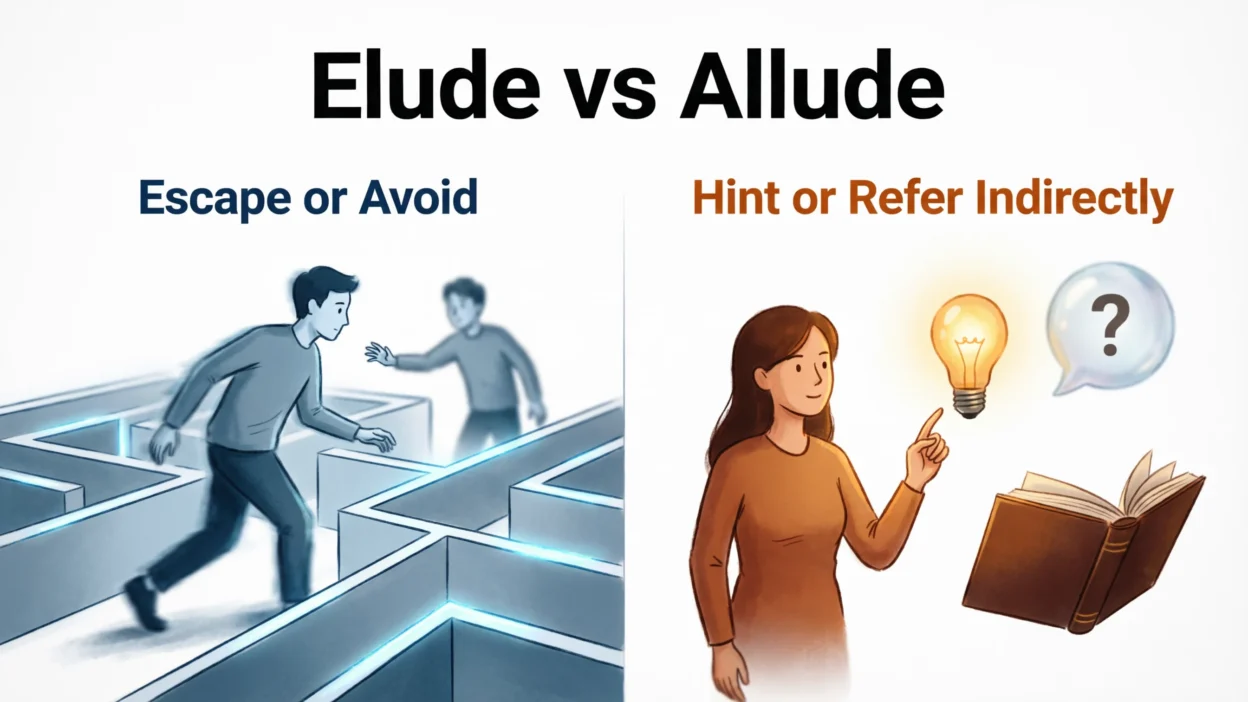
Have you ever come across elude and allude and wondered which one to use? These two words sound similar and differ by only one letter, making them easy to confuse.
However, they have completely different meanings, and using the wrong one can make your writing unclear or even change your intended message.
In this guide, you’ll learn the difference between elude vs allude, their meanings, practical examples, common mistakes, and simple memory tricks to help you use them correctly.
Whether you’re writing an essay, an email, or a blog post, this guide will help you choose the right word with confidence.
Quick Answer
The difference between elude and allude is simple:
- Elude means to escape, avoid, or remain difficult to catch, understand, or achieve.
- Allude means to refer to something indirectly without mentioning it explicitly.
Example:
- The thief managed to elude the police.
- The speaker alluded to recent events without naming anyone.
If you’re talking about escaping or avoiding something, use elude. If you’re making an indirect reference, use allude.
What Does Elude Mean?
Elude is a verb that means to escape from, avoid capture, or remain beyond someone’s understanding or reach. It often describes situations where a person, idea, answer, or object cannot be caught, found, or fully understood.
The word is commonly used in conversations about challenges, mysteries, investigations, and goals.
Examples of Elude
- The suspect managed to elude the authorities.
- Sleep continued to elude me all night.
- The answer eluded even the brightest students.
- Success may elude those who give up too early.
- The rare bird eluded photographers for weeks.
Common Synonyms of Elude
- Escape
- Evade
- Avoid
- Dodge
- Slip away from
- Bypass
What Does Allude Mean?
Allude is a verb that means to mention or refer to something indirectly. Instead of stating something openly, a person hints at it or suggests it through subtle references.
It is commonly used in speeches, literature, conversations, and formal writing.
Examples of Allude
- The author alluded to a famous historical event.
- She alluded to her childhood without sharing many details.
- During the interview, he alluded to future business plans.
- The teacher alluded to a topic that would appear on the exam.
- His speech alluded to several classic novels.
Common Synonyms of Allude
- Refer to
- Hint at
- Mention indirectly
- Suggest
- Imply
- Make reference to
Elude vs Allude: Key Differences
| Feature | Elude | Allude |
|---|---|---|
| Meaning | Escape or avoid | Refer indirectly |
| Part of Speech | Verb | Verb |
| Focus | Avoiding capture, understanding, or achievement | Hinting at something without directly stating it |
| Common Context | Police, goals, ideas, sleep, answers | Speeches, books, conversations, writing |
| Example | The solution eluded us. | She alluded to the solution. |
The easiest way to remember the difference is:
- Elude = Escape
- Allude = Hint
Elude vs Allude in Sentences
Here are some practical examples.
Using Elude
- The criminal continued to elude investigators.
- The perfect solution eluded the team.
- Happiness shouldn’t elude anyone forever.
- The meaning of the poem eluded many readers.
- The butterfly quickly eluded capture.
Using Allude
- The article alluded to recent political changes.
- He alluded to his promotion but never confirmed it.
- The comedian alluded to a popular movie.
- She alluded to a family secret during dinner.
- The professor alluded to several scientific theories.
Common Mistakes People Make
Because these words look and sound alike, they’re often confused.
Incorrect
- The speaker eluded the recent election during the speech.
Correct
- The speaker alluded to the recent election during the speech.
Reason: The speaker was making an indirect reference, not escaping anything.
Incorrect
- The answer alluded me during the exam.
Correct
- The answer eluded me during the exam.
Reason: The answer escaped your understanding, so eluded is correct.
Incorrect
- The suspect alluded the police.
Correct
- The suspect eluded the police.
The suspect escaped capture, making eluded the correct choice.
Easy Trick to Remember Elude vs Allude
Here’s a simple memory trick.
Elude = Escape
Both words begin with E, making it easy to remember that elude means to escape or evade.
Allude = Allusion
Allude is related to allusion, a literary device that makes an indirect reference. Think of allude whenever someone hints at something without saying it directly.
Whenever you’re talking about escaping, choose elude.
Whenever you’re talking about hinting or indirectly mentioning something, choose allude.
American vs British English
There is no major difference between American and British English in the use of these words.
In both varieties:
- Elude means to escape, evade, or remain difficult to understand.
- Allude means to refer to something indirectly.
Their meanings, spelling, and usage remain the same in modern English.
Related Words You Should Know
Learning these related words will make the distinction even clearer.
Allusion
An allusion is an indirect reference to a person, event, place, or literary work.
Example:
- The novel contains an allusion to Greek mythology.
Elusive
Elusive describes something difficult to find, catch, achieve, or understand.
Example:
- True happiness can sometimes feel elusive.
Evade
Evade means to avoid or escape deliberately.
Example:
- The driver tried to evade the police.
Remember:
- Elude = Escape
- Allude = Indirect Reference
- Allusion = The Indirect Reference Itself
Tips for Using Elude and Allude Correctly
Keep these simple tips in mind.
- Use elude when something escapes, avoids, or remains difficult to understand.
- Use allude when referring to something indirectly.
- If you can replace the word with escape, choose elude.
- If you can replace it with hint at or refer to, choose allude.
- Consider whether the sentence is about avoiding something or mentioning something indirectly.
Frequently Asked Questions (FAQs)
Is elude the same as allude?
No. Elude means to escape or avoid, while allude means to refer to something indirectly.
Can elude and allude be used interchangeably?
No. They have different meanings and should not be used in place of one another.
Which word means to hint at something?
Allude means to hint at or indirectly mention something.
Which word means to escape?
Elude means to escape, evade, or remain beyond someone’s understanding or reach.
What is an allusion?
An allusion is an indirect reference to a person, place, event, or literary work. It comes from the verb allude.
Is “the answer eluded me” correct?
Yes. It means you couldn’t remember or understand the answer.
Is “he alluded to the problem” correct?
Yes. It means he referred to the problem without discussing it directly.
Summary
Understanding the difference between elude vs allude can improve both your writing and speaking. Elude is used when something escapes, avoids capture, or remains difficult to understand, while allude is used when someone indirectly refers to a person, event, or idea. Although the words look and sound alike, their meanings are completely different.
Before choosing between these two words, think about the context. If the sentence is about escaping or avoiding, use elude. If it’s about hinting at or indirectly mentioning something, use allude. Keeping this distinction in mind will help you communicate more accurately and confidently.
Actionable Takeaway
Whenever you need to decide between these words, ask yourself one question:
“Am I talking about escaping something or referring to something indirectly?”
- If it’s about escaping, choose elude.
- If it’s about making an indirect reference, choose allude.
This simple habit will help you use elude and allude correctly every time.

Shan Waston is a skilled writer at Symboliy.com, producing clear, engaging content on language, communication, and everyday expressions to help readers understand meaning and usage confidently in modern digital contexts.