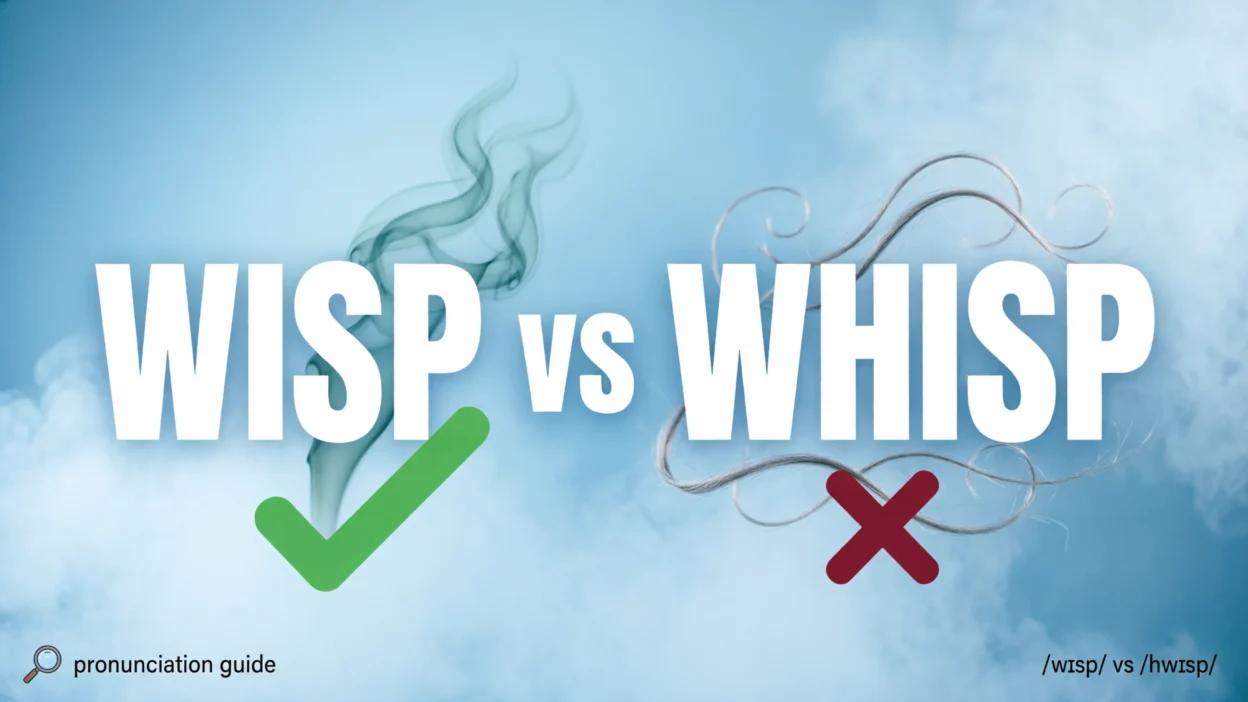
Have you ever come across the words wisp and whisp and wondered whether they mean the same thing? You’re not alone. Many English learners, writers, and even native speakers get confused when they encounter these similar-looking words. The confusion often arises because one of them is a legitimate English word, while the other is usually a spelling mistake.
Understanding the difference between wisp vs whisp can improve your writing accuracy and help you avoid common language errors. In this guide, you’ll learn the meaning of each term, see practical examples, discover common mistakes, and find out which spelling is correct in modern English.
Quick Answer
Wisp is the correct English word.
Whisp is generally considered a misspelling of wisp and is not recognized as a standard English word in major dictionaries.
- ✅ Correct: A wisp of smoke rose from the chimney.
- ❌ Incorrect: A whisp of smoke rose from the chimney.
If you’re deciding between wisp vs whisp, always choose wisp unless you’re referring to a brand name, username, or fictional term.
What Does Wisp Mean?
A wisp is a small, thin, delicate amount or piece of something. It is commonly used to describe smoke, hair, clouds, fog, or anything light and narrow.
Definition of Wisp
A wisp can refer to:
- A thin strand of hair
- A small curl of smoke
- A slight trace of something
- A small bundle of straw or grass
Examples of Wisp in Sentences
- A wisp of smoke drifted into the sky.
- She tucked a wisp of hair behind her ear.
- A wisp of fog covered the lake in the morning.
- There was only a wisp of evidence supporting the claim.
In all these examples, the word suggests something small, delicate, or barely noticeable.
What Does Whisp Mean?
In standard English, whisp has no accepted dictionary definition.
Most of the time, people write whisp when they actually mean wisp. The extra “h” is added because many English words beginning with a similar sound use “wh,” such as:
- Whisper
- Whistle
- Whirl
- White
This similarity causes writers to mistakenly assume that wisp should also begin with “wh.”
Is Whisp Ever Correct?
There are a few exceptions:
- Brand names
- Usernames
- Fictional character names
- Creative business names
Outside of these special cases, whisp is considered incorrect spelling.
Wisp vs Whisp: Side-by-Side Comparison
| Feature | Wisp | Whisp |
|---|---|---|
| Standard English Word | Yes | No |
| Found in Major Dictionaries | Yes | No |
| Correct for Formal Writing | Yes | No |
| Commonly Misspelled Version | No | Yes |
| Meaning | Thin strand or small amount | Usually none |
| Recommended Usage | Always | Avoid |
This comparison makes it clear that wisp is the correct and accepted spelling.
Why Do People Confuse Wisp and Whisp?
Several factors contribute to the confusion.
1. Similar Sound Patterns
English contains many words beginning with “wh.” Because of this pattern, some writers naturally assume that wisp follows the same rule.
2. Typing Errors
Fast typing often leads to accidental insertion of the letter “h.”
3. Influence of Related Words
Words like whisper and whispy can influence spelling choices.
Interestingly, many people also use the adjective wispy, which means thin or delicate.
Examples:
- Wispy clouds
- Wispy hair
- Wispy smoke
Because “wispy” contains an “s” followed by another letter, some writers mistakenly create “whisp” as a related form.
Common Mistakes When Using Wisp
Avoid these frequent errors.
Mistake 1: Adding an Extra “H”
❌ A whisp of smoke floated upward.
✅ A wisp of smoke floated upward.
Mistake 2: Assuming Whisp Is an Alternative Spelling
Unlike some words that have accepted spelling variations, whisp is not recognized as a standard alternative.
Mistake 3: Using Whisp in Professional Writing
Using whisp in:
- Blog posts
- Academic papers
- Business documents
- Marketing content
can make your writing appear less polished.
Examples of Wisp in Everyday Language
The word wisp appears frequently in literature, journalism, and daily conversation.
Describing Nature
- A wisp of cloud crossed the mountain peak.
- The wind carried a wisp of mist across the valley.
Describing Hair
- A wisp of hair fell across her forehead.
- He noticed a silver wisp in his beard.
Describing Smoke
- A wisp of smoke rose from the campfire.
- The candle released a faint wisp of smoke.
Describing Abstract Ideas
- There remained only a wisp of hope.
- A wisp of memory returned unexpectedly.
These examples show how flexible and expressive the word can be.
American vs British English: Is There Any Difference?
When comparing wisp vs whisp, there is no difference between American and British English.
Both varieties of English use:
✅ Wisp
Both varieties reject:
❌ Whisp
Unlike words such as:
- Color vs Colour
- Organize vs Organise
- Center vs Centre
the spelling of wisp remains the same worldwide.
Related Words and Synonyms
Understanding related vocabulary can strengthen your writing.
Synonyms for Wisp
Depending on context, you might use:
- Strand
- Thread
- Trace
- Curl
- Hint
- Tendril
- Fragment
- Sliver
Related Terms
- Wispy
- Smoke trail
- Thin strand
- Delicate trace
- Light curl
- Fine thread
These words help create vivid descriptions and improve readability.
When Should You Use Wisp?
Use wisp whenever you’re describing:
- Thin smoke
- Strands of hair
- Light fog
- Small traces
- Delicate amounts of something
Examples:
- A wisp of steam escaped from the cup.
- She smiled beneath a wisp of hair.
- Only a wisp of cloud remained in the sky.
If your sentence contains any of these meanings, wisp is almost certainly the correct choice.
Memory Trick to Remember the Correct Spelling
A simple way to remember the correct spelling is:
Wisp is a small word for a small thing.
Since a wisp represents something thin and minimal, its spelling is also short and simple.
- Wisp = 4 letters ✅
- Whisp = 5 letters ❌
Keeping it simple helps you remember the correct form.
FAQs About Wisp vs Whisp
Is whisp a real word?
No. In standard English, whisp is not recognized as a valid dictionary word.
Which spelling is correct: wisp or whisp?
Wisp is the correct spelling.
What does a wisp of smoke mean?
It refers to a thin, delicate stream or curl of smoke.
Is whisp accepted in British English?
No. British English uses wisp, just like American English.
Why do people write whisp?
People often confuse it with words that begin with “wh,” such as whisper or whistle.
Can I use whisp in formal writing?
No. Use wisp for academic, professional, and general writing.
What is the adjective form of wisp?
The adjective is wispy, meaning thin, delicate, or feathery.
Is wisp commonly used in literature?
Yes. Writers frequently use wisp to create imagery involving smoke, hair, clouds, fog, and delicate traces.
Summary
The debate over wisp vs whisp is actually quite simple once you understand the distinction. Wisp is the correct English word and is widely accepted in dictionaries, literature, journalism, and everyday communication. It refers to a thin strand, delicate trace, or small amount of something, such as smoke, hair, fog, or cloud.
On the other hand, whisp is generally a misspelling and should be avoided in professional, academic, and personal writing. If you’re ever unsure, remember that the shorter spelling—wisp—is the correct one. Using the proper form will make your writing clearer, more credible, and grammatically accurate.
Actionable Takeaway
Whenever you encounter wisp vs whisp, choose wisp. Before publishing or submitting your writing, quickly check for the common misspelling whisp and replace it with wisp. This simple habit will improve your spelling accuracy and help your content appear more professional.

Here is a professional 30-word author biography including your site name Symboliy.com:
Martin Hood is a professional writer at Symboliy.com, creating clear, informative content focused on language, communication, and meaningful expressions for everyday and professional use.