Have you ever wondered whether you should write indecisive or undecisive?
These two words look very similar, and many English learners assume they can be used interchangeably. However, only one of them is considered standard English in modern writing.
If you’re searching for the difference between indecisive vs undecisive, this guide explains everything in simple language.
You’ll learn the meaning of each word, see practical examples, understand why one is preferred over the other, discover common mistakes, and pick up an easy memory trick. By the end, you’ll know exactly which word to use with confidence.
Quick Answer
The difference between indecisive and undecisive is simple:
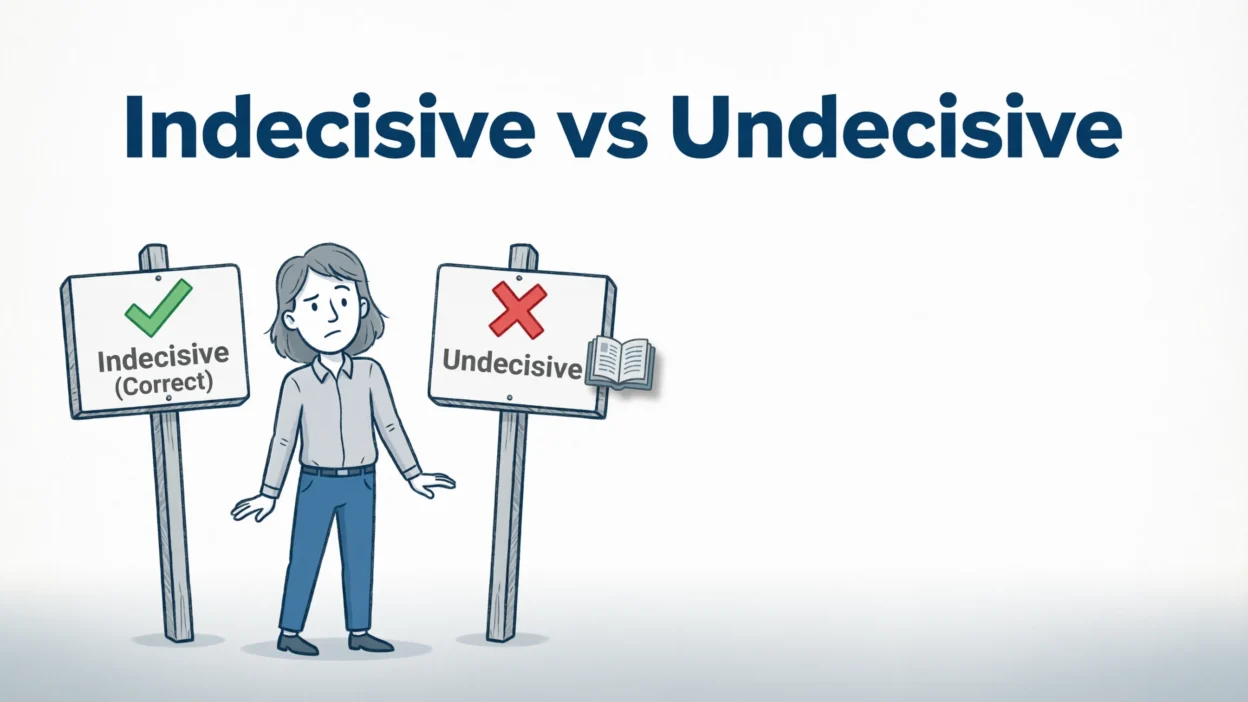
- Indecisive is the correct and widely accepted adjective that describes someone who has difficulty making decisions.
- Undecisive is generally considered incorrect or nonstandard in modern English and should usually be avoided.
Example:
- Emma is indecisive when choosing a restaurant.
- ❌ Emma is undecisive when choosing a restaurant.
Easy Memory Trick:
- Indecisive = Correct
- Undecisive = Usually Incorrect
What Does “Indecisive” Mean?
Indecisive is an adjective that describes someone who finds it difficult to make decisions or choose between options. An indecisive person may hesitate, change their mind often, or struggle to reach a conclusion.
Examples of Indecisive
- John is indecisive about which laptop to buy.
- She remained indecisive during the meeting.
- His indecisive nature often delays important decisions.
- The customer was too indecisive to choose a dessert.
- Being indecisive can sometimes lead to missed opportunities.
Synonyms of Indecisive
- Hesitant
- Uncertain
- Unsure
- Wavering
- Vacillating
- Irresolute
- Doubtful
These words have similar meanings, although each may carry a slightly different nuance.
What Does “Undecisive” Mean?
Undecisive is occasionally found in older texts or informal writing, but it is not considered standard English today. Most dictionaries either label it as nonstandard, rare, or omit it entirely.
In nearly every situation, indecisive is the correct word to use.
Example
❌ She is undecisive about her future.
✅ She is indecisive about her future.
Using undecisive in academic, professional, or formal writing may be viewed as a grammatical mistake.
Indecisive vs Undecisive Comparison Table
| Feature | Indecisive | Undecisive |
|---|---|---|
| Part of Speech | Adjective | Adjective (nonstandard) |
| Status | Standard English | Rare or nonstandard |
| Meaning | Unable to make decisions | Intended to mean the same, but not recommended |
| Recommended? | ✅ Yes | ❌ No |
| Example | She is indecisive. | She is undecisive. (Avoid) |
Examples of Indecisive in Sentences
Here are some examples of the correct word in everyday English.
- He is indecisive when shopping.
- My sister is indecisive about her career.
- The committee remained indecisive for several hours.
- She felt indecisive before accepting the job offer.
- Being indecisive can make simple tasks more stressful.
Each sentence correctly uses indecisive to describe uncertainty in making decisions.
Examples of Incorrect Use of Undecisive
These examples show why undecisive should generally be avoided.
❌ He is undecisive about buying a house.
✅ He is indecisive about buying a house.
❌ I became undecisive after hearing both opinions.
✅ I became indecisive after hearing both opinions.
❌ She sounds undecisive.
✅ She sounds indecisive.
In modern English, replacing undecisive with indecisive is almost always the correct choice.
Common Mistakes People Make
Many writers mistakenly believe both words are equally acceptable.
Mistake 1
❌ She is undecisive.
✅ She is indecisive.
Only indecisive is standard English.
Mistake 2
❌ His undecisive behavior frustrated everyone.
✅ His indecisive behavior frustrated everyone.
Mistake 3
❌ Undecisive people often struggle with choices.
✅ Indecisive people often struggle with choices.
Whenever you’re tempted to write undecisive, choose indecisive instead.
Easy Memory Trick
Here’s an easy way to remember the correct word.
Think of the word decision.
The adjective formed from it is:
Decision → Decisive → Indecisive
There is no standard word “undecisive” in modern English.
Think:
Indecisive = Inability to Decide
Whenever you describe someone who struggles to make choices, use indecisive.
American vs British English
Both American English and British English prefer indecisive.
There is no spelling difference between the two varieties.
Although undecisive occasionally appears in older publications or informal writing, it is generally regarded as nonstandard in both American and British English. Style guides, dictionaries, educators, and professional editors recommend using indecisive instead.
When Should You Use “Indecisive”?
Use indecisive when describing:
- Someone who struggles to make decisions
- Hesitation
- Uncertainty
- Difficulty choosing between options
- Lack of firmness in decision-making
Examples:
- She is indecisive about where to study.
- The manager remained indecisive during negotiations.
- His indecisive personality makes planning difficult.
Avoid using undecisive in formal writing, school assignments, business communication, or professional documents.
Why People Confuse Indecisive and Undecisive
These words are commonly confused because:
- They look almost identical.
- Both seem logical based on English prefixes.
- The prefixes in- and un- both often indicate negation.
- Some people mistakenly assume undecisive follows the same pattern as words like unhappy or uncertain.
However, English doesn’t always form opposites consistently. The accepted adjective is indecisive, not undecisive.
Related Words and LSI Keywords
When learning indecisive vs undecisive, you may also encounter these related terms:
- Decisive meaning
- Decision making
- Hesitant meaning
- Irresolute
- Wavering
- Unsure
- Uncertain
- English vocabulary
- Commonly confused words
- Grammar mistakes
- Correct English usage
- Adjective examples
These related words help expand your vocabulary while reinforcing the correct usage of indecisive.
FAQs
Is undecisive a real word?
Undecisive has appeared occasionally in historical or informal writing, but it is generally considered nonstandard. In modern English, indecisive is the recommended word.
Which is correct: indecisive or undecisive?
Indecisive is the correct and widely accepted form.
Why is undecisive considered incorrect?
Modern dictionaries and style guides prefer indecisive as the standard adjective. Undecisive is rarely used and is generally avoided in formal writing.
What does indecisive mean?
It describes someone who has difficulty making decisions or choosing between options.
Is indecisive a negative personality trait?
Not always. Being indecisive simply means someone takes longer to make decisions. Depending on the situation, it can be seen as cautious or uncertain.
Are there American and British spelling differences?
No. Both American and British English use indecisive.
What is the opposite of indecisive?
Common opposites include:
- Decisive
- Determined
- Resolute
- Confident
Summary
Understanding indecisive vs undecisive is quite simple once you know that only indecisive is considered standard English. It describes someone who struggles to make decisions or frequently hesitates before choosing. Although undecisive occasionally appears in older or informal writing, it is generally viewed as nonstandard and should be avoided in modern English.
A good way to remember the correct form is to think of the word decision. It naturally becomes decisive, and the opposite is indecisive. Whenever you’re writing for school, work, or everyday communication, choosing indecisive will ensure your English is accurate and professional.
Actionable Takeaway
Before using either word, remember this simple rule: Always choose “indecisive.” If you ever find yourself typing undecisive, replace it with indecisive to match standard English usage. This small habit will improve the clarity and correctness of your writing.

Mike Poop is a dedicated writer at Symboliy.com, creating clear, practical content about language, communication, and everyday expressions to help readers understand meaning and usage confidently in professional contexts worldwide.