Have you ever wondered whether you should use sitting or seating? These two words are related to the verb sit, but they have different meanings and are used in different situations.
Because they look and sound similar, many English learners—and even native speakers—sometimes confuse them.
If you’re searching for the difference between sitting vs seating, this guide explains everything in simple English.
You’ll learn what each word means, when to use it correctly, practical examples, common mistakes to avoid, and an easy memory trick. By the end, you’ll know exactly which word fits your sentence.
Quick Answer
The difference between sitting and seating is simple:
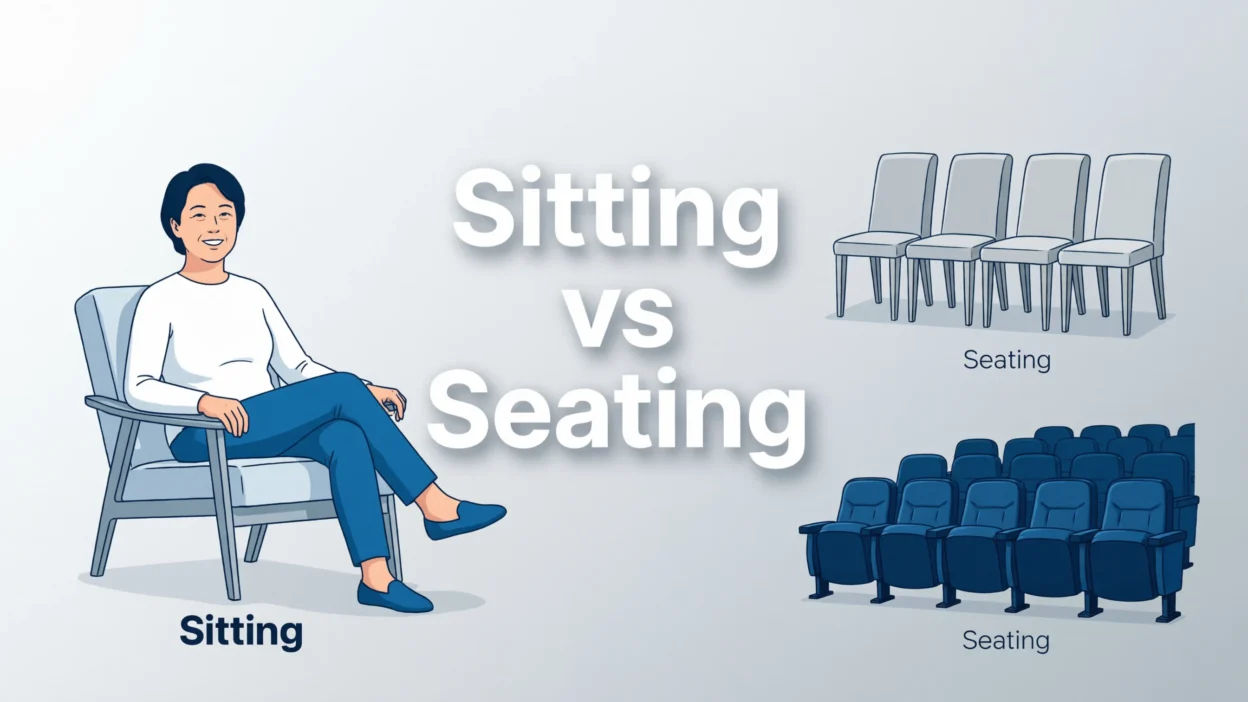
- Sitting refers to the act of being seated or remaining in a seated position.
- Seating refers to arranging seats, providing places to sit, or the total number of seats available.
Example:
- She is sitting by the window.
- The restaurant has seating for 100 guests.
Easy Memory Trick:
- Sitting = Person is seated
- Seating = Seats or placing people in seats
What Does “Sitting” Mean?
Sitting is the present participle and gerund form of the verb sit. It describes the action or state of being in a seated position.
It can also function as a noun in certain expressions, such as a sitting of Parliament or a photo sitting, although these uses are less common.
Examples of Sitting
- She is sitting on the sofa.
- They were sitting quietly in the library.
- I spent the afternoon sitting by the lake.
- He enjoys sitting outside in the morning.
- The children were sitting in a circle.
Synonyms of Sitting
- Seated
- Resting
- Perched
- Occupying a seat
- Remaining seated
What Does “Seating” Mean?
Seating usually refers to chairs, places to sit, or the process of arranging where people sit.
It can also describe the capacity of a room, theater, restaurant, or stadium.
Examples of Seating
- The restaurant offers seating for 80 people.
- Reserved seating is available for VIP guests.
- The staff is responsible for seating customers.
- Outdoor seating is available during the summer.
- The theater increased its seating capacity.
Synonyms of Seating
- Seats
- Capacity
- Accommodation
- Arrangement
- Placement
Sitting vs Seating Comparison Table
| Feature | Sitting | Seating |
|---|---|---|
| Part of Speech | Verb (present participle/gerund) or Noun | Noun or Verb (present participle) |
| Main Meaning | Being in a seated position | Seats, seating arrangement, or capacity |
| Common Context | Person’s action | Furniture, restaurants, theaters, events |
| Example | She is sitting outside. | The café has indoor seating. |
| Memory Trick | Person sits | Place to sit |
Examples of Sitting in Sentences
Here are more examples of sitting in everyday English.
- He is sitting beside his friend.
- We spent hours sitting on the beach.
- The dog was sitting patiently.
- I found her sitting near the fireplace.
- They are sitting together during the concert.
Each sentence describes someone being in a seated position.
Examples of Seating in Sentences
Now let’s look at seating.
- The stadium has seating for over 50,000 fans.
- Priority seating is available for older people.
- The host handled the seating arrangements.
- There is plenty of outdoor seating at the café.
- Wedding seating charts help guests find their tables.
Notice that seating refers to seats, capacity, or arranging where people sit.
Common Mistakes People Make
Because both words come from sit, they’re often confused.
Mistake 1
❌ The restaurant has comfortable sitting.
✅ The restaurant has comfortable seating.
The sentence refers to chairs or places to sit.
Mistake 2
❌ She is seating near the window.
✅ She is sitting near the window.
The sentence describes someone’s position.
Mistake 3
❌ The theater increased its sitting capacity.
✅ The theater increased its seating capacity.
Capacity refers to the number of available seats.
Easy Memory Trick
Here’s a simple way to remember the difference.
Think of the person first.
Sitting = Someone is sitting down.
Think of the place next.
Seating = The seats or where people sit.
Another easy trick:
- Sitting = Action
- Seating = Place or Arrangement
American vs British English
The meanings of sitting and seating are the same in both American English and British English.
There are no spelling differences between the two varieties.
However, there are a few usage differences:
- In American English, phrases like outdoor seating, reserved seating, and open seating are very common in restaurants, theaters, and event venues.
- In British English, these expressions are also widely understood, though people may sometimes refer simply to tables, places to sit, or available seats, depending on the context.
Overall, both words are used similarly in American and British English.
When Should You Use Each Word?
Use sitting when talking about:
- Someone being seated
- Remaining in a chair
- The action of sitting
- A person’s position
Examples:
- He is sitting quietly.
- They spent the afternoon sitting together.
Use seating when referring to:
- Chairs or seats
- Seating capacity
- Seating arrangements
- Reserved seats
- Indoor or outdoor seating
Examples:
- The restaurant has limited seating.
- Seating will begin 30 minutes before the show.
Why People Confuse Sitting and Seating
These words are commonly confused because:
- Both come from the verb sit.
- They look very similar.
- Both involve chairs or being seated.
- Some contexts, such as restaurants and events, use both words in different ways.
The easiest way to choose the correct word is to ask yourself whether you’re talking about a person’s action or the seats themselves.
Related Words and LSI Keywords
When learning sitting vs seating, you may also encounter these related terms:
- Sit vs seat
- Seated meaning
- Seating arrangement
- Seating capacity
- Reserved seating
- Outdoor seating
- Sit down
- Seat assignment
- Commonly confused words
- English grammar
- Verb vs noun
- English vocabulary
These related phrases naturally expand your vocabulary and help you understand the topic more thoroughly.
FAQs
Is sitting the same as seating?
No. Sitting refers to the action or state of being seated, while seating refers to seats, seating arrangements, or seating capacity.
Can seating be used as a noun?
Yes. It commonly refers to available seats or the number of seats in a place.
Which is correct: sitting area or seating area?
Both are correct, but they have different meanings.
- A sitting area is a space designed for people to sit and relax.
- A seating area emphasizes the chairs or seating provided in that space.
What does seating capacity mean?
Seating capacity is the maximum number of people who can be seated in a venue such as a theater, stadium, or restaurant.
Is seating a verb?
Yes. Seating is the present participle of seat, meaning to place someone in a seat.
Example:
- The hostess is seating guests.
Are there American and British spelling differences?
No. Both sitting and seating are spelled the same in American and British English.
Why do people confuse sitting and seating?
Because both words relate to sitting and seats, many people mistakenly use one in place of the other without considering whether the sentence describes an action or the seats themselves.
Summary
Understanding sitting vs seating is simple once you focus on what each word describes. Sitting refers to the action or state of being seated, while seating refers to seats, seating arrangements, or the capacity of a place. Although they are closely related, they are not interchangeable because each serves a different purpose in a sentence.
A helpful way to remember the difference is this: Sitting = Someone is sitting, while Seating = The seats or where people sit. By paying attention to whether you’re describing a person’s action or the available seats, you’ll choose the correct word every time.
Actionable Takeaway
Before writing sitting or seating, ask yourself one simple question: Am I talking about a person being seated or about the seats themselves?
If it’s the action, use sitting. If it’s the chairs, arrangement, or capacity, use seating. This quick check will help you avoid a common English vocabulary mistake.

Here is a professional 30-word author biography including your site name Symboliy.com:
Martin Hood is a professional writer at Symboliy.com, creating clear, informative content focused on language, communication, and meaningful expressions for everyday and professional use.