
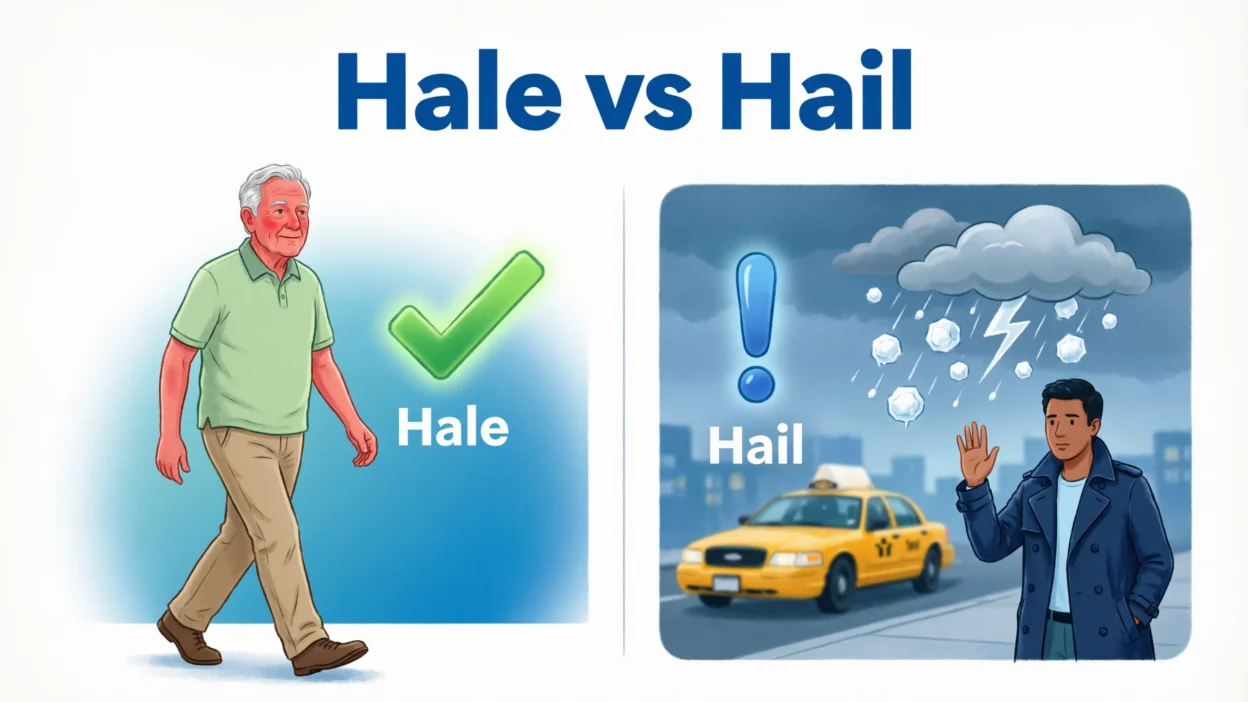
Have you ever paused while writing and wondered whether you should use hale or hail? You’re not alone. These two words sound exactly alike, making them one of the most commonly confused word pairs in English.
However, despite their similar pronunciation, they have completely different meanings and are used in entirely different contexts.
If you’re looking for a clear explanation of hale vs hail, you’ve come to the right place. This guide breaks down each word in simple language, provides practical examples, highlights common mistakes, and includes an easy memory trick to help you remember the difference. By the end, you’ll know exactly when to use hale and when to use hail.
Quick Answer
The difference between hale and hail is straightforward:
- Hale is an adjective that means healthy, strong, or in good physical condition, especially for older people.
- Hail is a noun or verb. It can refer to small balls of ice that fall from the sky, greet someone enthusiastically, call a taxi, or praise someone.
Example:
- Even at 80 years old, my grandfather is still hale and active.
- It started to hail during the afternoon storm.
Easy Memory Trick:
- Hale = Healthy
- Hail = Ice or Greeting
What Does “Hale” Mean?
The word hale is an adjective used to describe someone who is healthy, fit, strong, and energetic. It is most commonly used when talking about older adults who remain in excellent physical condition.
Examples of Hale
- Despite her age, she remains hale and cheerful.
- His grandfather is still hale enough to go hiking every weekend.
- The doctor said she was hale after recovering from her illness.
- They were surprised to see their ninety-year-old neighbor looking so hale.
Synonyms of Hale
- Healthy
- Strong
- Robust
- Fit
- Vigorous
- Energetic
- Well
Although hale isn’t used as often in everyday conversation as healthy, it frequently appears in books, news articles, and formal writing.
What Does “Hail” Mean?
The word hail has several meanings depending on how it’s used.
1. Hail as Frozen Rain
As a noun, hail refers to small balls of ice that fall during thunderstorms.
Examples:
- The storm brought heavy hail that damaged several cars.
- Large pieces of hail covered the streets.
2. Hail as a Verb (Weather)
As a verb, hail means that frozen ice pellets are falling.
Examples:
- It began to hail just before sunset.
- We stayed indoors because it was hailing.
3. Hail as a Greeting
Hail also means to greet someone enthusiastically or respectfully.
Examples:
- The crowd hailed the winning team.
- The soldiers were hailed as heroes.
4. Hail a Taxi
Another common meaning is to signal or call for a taxi or other vehicle.
Example:
- She hailed a taxi outside the hotel.
Synonyms of Hail
Depending on the meaning:
For weather:
- Ice pellets
- Ice storm
For greeting:
- Welcome
- Greet
- Salute
- Applaud
- Praise
Hale vs Hail Comparison Table
| Feature | Hale | Hail |
|---|---|---|
| Part of Speech | Adjective | Noun and Verb |
| Main Meaning | Healthy and strong | Frozen ice, greet, praise, or call |
| Common Context | Health and fitness | Weather, greetings, transportation |
| Example | She remains hale at 85. | It began to hail after lunch. |
| Memory Trick | Hale = Healthy | Hail = Ice or Greeting |
Examples of Hale in Sentences
Learning through examples makes the difference much easier.
- My grandmother is remarkably hale for her age.
- The athlete remained hale after years of training.
- He looked hale and full of energy.
- Even after surgery, she appeared surprisingly hale.
- Everyone admired the hale old farmer.
Each sentence describes someone’s physical health or strength.
Examples of Hail in Sentences
Now let’s look at different uses of hail.
- Heavy hail damaged the crops.
- It may hail later this evening.
- Fans hailed the singer after the performance.
- We hailed a cab outside the airport.
- Scientists hailed the discovery as a major breakthrough.
Notice that hail can refer to weather, greetings, praise, or calling transportation.
Common Mistakes People Make
Because hale and hail are perfect homophones, they are often mixed up in writing.
Mistake 1
❌ My grandfather is still hail at 82.
✅ My grandfather is still hale at 82.
The sentence talks about health.
Mistake 2
❌ It started to hale during the storm.
✅ It started to hail during the storm.
The sentence refers to frozen rain.
Mistake 3
❌ Everyone hailed her because she stayed hale.
✅ Everyone hailed her for her bravery.
Here, hailed means praised or honored.
Easy Memory Trick
Here’s a simple way to remember the difference.
Hale starts with H, just like Healthy.
Think:
Hale = Healthy
Hail contains “ai”, which you can associate with ice falling from the air.
Think:
Hail = Ice, Greeting, or Taxi
Whenever you’re unsure, ask yourself whether you’re talking about someone’s health or weather and greetings.
American vs British English
The meanings of hale and hail are the same in both American English and British English.
There are no spelling differences between the two varieties.
However, there are slight differences in usage:
- Hale is considered somewhat formal or literary in both American and British English. Most people simply say healthy, fit, or well in everyday conversation.
- Hail is commonly used in both varieties, especially when talking about weather. In American English, you’ll also frequently hear the phrase hail a cab, while in British English, people may more often say flag down a taxi, although hail a taxi is also widely understood.
When Should You Use Each Word?
Use hale when you’re talking about:
- Good health
- Physical strength
- Fitness
- Older people who remain active
- Strong physical condition
Use hail when discussing:
- Ice falling during storms
- Greeting someone
- Praising someone
- Calling a taxi
- Welcoming achievements
If the context involves weather or greeting, choose hail. If it describes health, choose hale.
Why People Confuse Hale and Hail
These two words are easy to confuse because:
- They have exactly the same pronunciation.
- They differ by only one letter.
- Both are valid English words, so spell-check may not identify the mistake.
- Many learners encounter hale less often than hail, making it easier to forget.
The best way to avoid confusion is to focus on the meaning rather than the pronunciation.
Related Words and LSI Keywords
When learning hale vs hail, you may also come across these related terms:
- Healthy vs fit
- Robust meaning
- Strong and vigorous
- Hailstorm
- Ice pellets
- Greet someone
- Praise someone
- Call a taxi
- Commonly confused English words
- Homophones in English
- Weather vocabulary
- English grammar tips
These related phrases help build a stronger understanding of the topic while naturally expanding your vocabulary.
FAQs
Is hale the same as healthy?
Yes, hale means healthy, strong, and vigorous. It is often used in more formal or literary contexts.
What does hail mean in weather?
Hail refers to small balls of ice that fall from clouds during thunderstorms.
Can hail be used as a verb?
Yes. It can mean frozen ice falling from the sky, greeting someone, praising someone, or calling a taxi.
Is hale commonly used today?
It is still correct but is less common in everyday speech. People usually say healthy, fit, or well instead.
Are hale and hail homophones?
Yes. They are true homophones because they are pronounced the same but have different meanings and spellings.
Can you hail a taxi?
Yes. Hail a taxi means to signal a taxi to stop so you can ride in it.
Is there a spelling difference in British and American English?
No. Both hale and hail are spelled the same in American and British English.
Summary
Understanding hale vs hail becomes simple once you connect each word with its primary meaning. Hale describes someone who is healthy, strong, and physically fit, while hail refers to frozen ice falling from the sky, greeting or praising someone, or signaling a taxi. Although they sound identical, their meanings are completely different, so choosing the right word depends entirely on the context.
A simple way to remember the difference is this: Hale = Healthy and Hail = Ice, Greeting, or Taxi. Whenever you write one of these words, think about what you’re trying to describe. If it’s a person’s health, choose hale. If it’s weather, praise, or calling a cab, choose hail.
Actionable Takeaway
Before using hale or hail, ask yourself whether you’re talking about health or weather/greetings.
This quick check will help you avoid one of the most common homophone mistakes in English. Reading your sentence aloud and considering its meaning is an easy way to ensure you’ve chosen the correct word every time.

Mike Poop is a dedicated writer at Symboliy.com, creating clear, practical content about language, communication, and everyday expressions to help readers understand meaning and usage confidently in professional contexts worldwide.