Have you ever hesitated while writing because you weren’t sure whether to use apologizes or apologies?
Although these two words are closely related, they have different grammatical roles and meanings. Mixing them up is a common mistake, especially for English learners and even native speakers.
If you’re searching for the difference between apologizes vs apologies, this guide explains everything in simple English.
You’ll learn what each word means, when to use it, see plenty of examples, discover common mistakes to avoid, and pick up an easy memory trick. By the end, you’ll be able to use both words confidently in everyday writing and conversation.
Quick Answer
The difference between apologizes and apologies is simple:
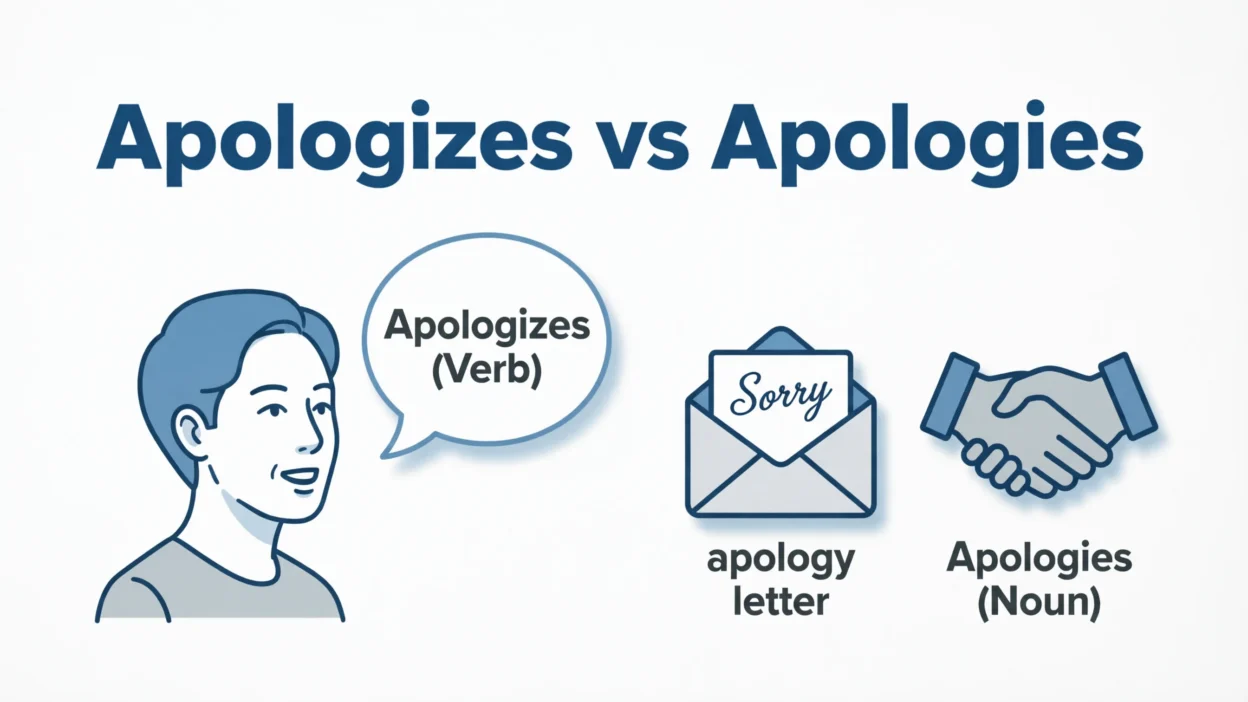
- Apologizes is a verb. It means to say sorry or express regret.
- Apologies is a noun. It refers to expressions of regret or saying sorry.
Example:
- Sarah apologizes for arriving late.
- Please accept my apologies for the delay.
Easy Memory Trick:
- Apologizes = Action (Verb)
- Apologies = Thing (Noun)
What Does “Apologizes” Mean?
Apologizes is the third-person singular form of the verb apologize. It describes the action of saying sorry or expressing regret for something.
Examples of Apologizes
- He apologizes whenever he makes a mistake.
- Maria apologizes for missing the meeting.
- The company apologizes for the inconvenience.
- She always apologizes sincerely.
In every sentence, apologizes shows someone performing the action of apologizing.
Synonyms of Apologizes
- Says sorry
- Expresses regret
- Begs pardon
- Seeks forgiveness
- Makes amends
What Does “Apologies” Mean?
Apologies is the plural form of the noun “apology.” It refers to statements or expressions of regret.
It is also commonly used in polite phrases such as “My apologies.”
Examples of Apologies
- Please accept my apologies.
- He offered his sincere apologies.
- Our apologies for the inconvenience.
- She sent written apologies after the event.
Unlike apologizes, this word names the apology itself rather than the action.
Synonyms of Apologies
- Regrets
- Expressions of regret
- Excuses
- Requests for forgiveness
- Statements of remorse
Apologizes vs Apologies Comparison Table
| Feature | Apologizes | Apologies |
|---|---|---|
| Part of Speech | Verb | Noun |
| Meaning | Says sorry | Expressions of regret |
| Function | Shows an action | Names a thing |
| Example | He apologizes often. | Please accept my apologies. |
| Memory Trick | Action = Verb | Thing = Noun |
Examples of Apologizes in Sentences
Here are more examples of apologizes in everyday English.
- My brother apologizes after every argument.
- The airline apologizes for the delayed flight.
- She apologizes whenever she interrupts someone.
- The teacher apologizes for the confusion.
- John apologizes sincerely for his mistake.
Each example shows someone performing the action of apologizing.
Examples of Apologies in Sentences
Now let’s see how apologies is used.
- Please accept my apologies.
- We extend our sincere apologies to our customers.
- His apologies were heartfelt.
- My apologies for the misunderstanding.
- She offered her apologies before leaving.
Notice that apologies refers to the apology itself.
Common Mistakes People Make
Since these words come from the same root, they’re often confused.
Mistake 1
❌ He apologies for being late.
✅ He apologizes for being late.
The sentence needs a verb.
Mistake 2
❌ Please accept my apologizes.
✅ Please accept my apologies.
The sentence requires a noun.
Mistake 3
❌ The manager sent apologizes to customers.
✅ The manager sent apologies to customers.
You send apologies, not apologizes.
Easy Memory Trick
Here’s an easy way to remember the difference.
Apologizes ends with -zes, reminding you of an action.
Think:
Apologizes = Someone does something.
Apologies ends with -ies, which often appears in plural nouns.
Think:
Apologies = The words of regret.
Whenever you see a sentence, ask yourself whether you need an action or a thing.
American vs British English
Both American English and British English use apologizes and apologies with the same meanings.
However, there is one spelling difference in the base verb:
- American English: apologize, apologizes
- British English: apologise, apologises
The noun remains the same in both varieties:
- apology
- apologies
Examples:
American English:
- The company apologizes for the error.
British English:
- The company apologises for the error.
In both varieties:
- Please accept our apologies.
When Should You Use Each Word?
Use apologizes when you’re describing someone performing the action of saying sorry.
Examples:
- He apologizes immediately.
- She apologizes politely.
Use apologies when referring to the apology itself.
Examples:
- My apologies for the delay.
- We offer our sincere apologies.
If the sentence needs a verb, choose apologizes. If it needs a noun, choose apologies.
Why People Confuse Apologizes and Apologies
These words are commonly confused because:
- They come from the same root word.
- They look very similar.
- Both relate to saying sorry.
- Learners often forget whether the sentence needs a noun or a verb.
The easiest way to avoid mistakes is to identify whether your sentence requires an action or a thing.
Related Words and LSI Keywords
While learning apologizes vs apologies, you may also encounter these related terms:
- Apology meaning
- Apologize meaning
- Say sorry
- Express regret
- Formal apology
- Written apology
- Verb vs noun
- Commonly confused words
- English grammar
- Parts of speech
- English vocabulary
- Grammar mistakes
These related phrases improve your understanding while naturally expanding your vocabulary.
FAQs
Is apologizes a verb?
Yes. Apologizes is the third-person singular form of the verb apologize, meaning to say sorry.
Is apologies a noun?
Yes. Apologies is the plural form of the noun apology.
Which is correct: “He apologies” or “He apologizes”?
He apologizes is correct because the sentence requires a verb.
Is “My apologies” grammatically correct?
Yes. My apologies is a common and polite way to express regret.
What is the British spelling of apologizes?
In British English, it is spelled apologises.
Can I say “Please accept my apologizes”?
No. The correct expression is Please accept my apologies.
Why do people confuse apologizes and apologies?
Because they have similar spellings and meanings, but one is a verb and the other is a noun.
Summary
Understanding apologizes vs apologies is easy once you know their grammatical roles. Apologizes is a verb that describes the action of saying sorry, while apologies is a noun that refers to the expressions of regret themselves. Although they share the same root word, they cannot be used interchangeably because they perform different functions in a sentence.
A simple way to remember the difference is this: Apologizes = Action and Apologies = Thing. Before choosing either word, ask yourself whether your sentence needs a verb or a noun. This quick check will help you avoid one of the most common English grammar mistakes.
Actionable Takeaway
Whenever you’re writing, identify whether you’re describing someone saying sorry or referring to the apology itself. If it’s an action, use apologizes. If it’s a noun, use apologies. This simple habit will make your writing clearer, more accurate, and more professional.

Shan Waston is a skilled writer at Symboliy.com, producing clear, engaging content on language, communication, and everyday expressions to help readers understand meaning and usage confidently in modern digital contexts.