If you’ve ever worked with numbers, statistics, or data analysis, you’ve likely come across the terms mean and median.
Although both measure the center of a dataset, they are calculated differently and can produce very different results—especially when there are unusually high or low values.
Understanding the difference between mean vs median is essential for students, researchers, business professionals, and anyone interpreting data.
In this guide, you’ll learn what each term means, when to use it, common mistakes to avoid, and practical examples that make the concepts easy to understand.
Quick Answer
The difference between mean and median is simple:
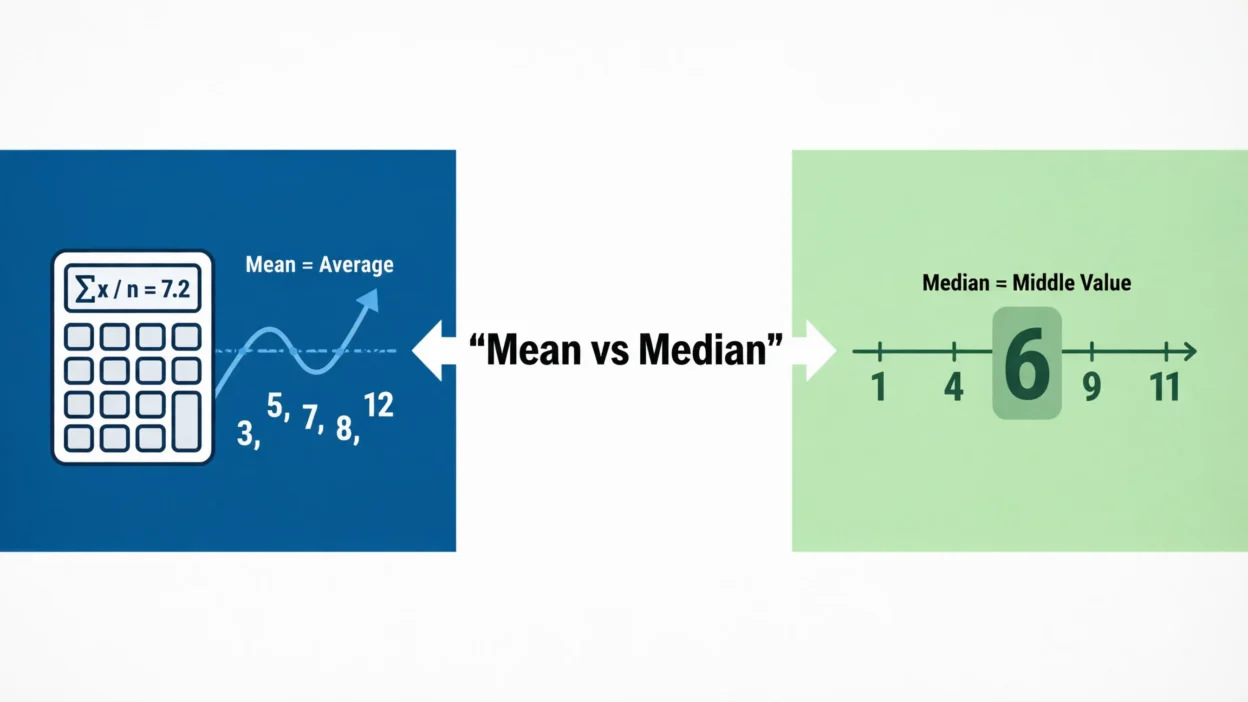
- Mean is the average of all numbers. You calculate it by adding all values together and dividing by the total number of values.
- Median is the middle value in an ordered list of numbers.
The mean is affected by extremely high or low numbers (outliers), while the median is more resistant to them.
What Is Mean?
The mean is the arithmetic average of a group of numbers. It represents the overall average value in a dataset.
To find the mean:
- Add all the numbers together.
- Divide the total by the number of values.
Example of Mean
Suppose five students scored:
70, 75, 80, 85, 90
Add them together:
70 + 75 + 80 + 85 + 90 = 400
Divide by 5:
400 ÷ 5 = 80
The mean score is 80.
Common Uses of Mean
- School test averages
- Business performance reports
- Scientific research
- Financial analysis
- Weather averages
What Is Median?
The median is the middle value in a list of numbers arranged from smallest to largest.
If there is an odd number of values, the median is the center number.
If there is an even number of values, the median is the average of the two middle numbers.
Example of Median
Numbers:
12, 18, 20, 25, 30
The middle number is 20.
So, the median is 20.
Another example with an even number of values:
10, 15, 20, 25
The two middle numbers are 15 and 20.
Median = (15 + 20) ÷ 2 = 17.5
Mean vs Median Comparison Table
| Feature | Mean | Median |
|---|---|---|
| Definition | Average of all values | Middle value in an ordered dataset |
| Calculation | Sum ÷ Number of values | Middle number after sorting |
| Affected by Outliers | Yes | No (or very little) |
| Best Used For | Symmetrical data | Skewed data or data with outliers |
| Also Known As | Arithmetic mean | Middle value |
Key Differences Between Mean and Median
| Mean | Median |
|---|---|
| Uses every value in the dataset | Uses only the middle position |
| Changes significantly with extreme values | Remains relatively stable |
| Better for evenly distributed data | Better for skewed distributions |
| Common in mathematics and science | Common in income and housing statistics |
How to Remember the Difference
A simple memory trick is:
- Mean = Average
- Median = Middle
Think of it this way:
- Mean measures the average of all numbers.
- Median simply identifies the middle number after sorting.
If you remember Average vs Middle, you’ll rarely confuse them.
Real-Life Examples
Student Grades
Scores:
75, 80, 82, 84, 100
Mean = 84.2
Median = 82
The perfect score raises the mean slightly.
House Prices
House prices:
$180,000
$200,000
$220,000
$240,000
$2,500,000
Mean = Much higher because of the luxury home.
Median = $220,000
This is why economists often report the median home price.
Salaries
Employee salaries:
$40,000
$45,000
$50,000
$55,000
$1,000,000
The CEO’s salary dramatically increases the mean.
The median better reflects what a typical employee earns.
When Should You Use Mean?
Use the mean when:
- Data is evenly distributed.
- There are few or no outliers.
- Every value is equally important.
- Calculating averages in mathematics or science.
Examples include:
- Average exam scores
- Average rainfall
- Average monthly sales
- Average temperatures
When Should You Use Median?
Use the median when:
- Data contains outliers.
- Income or salary data is involved.
- House prices vary greatly.
- The distribution is skewed.
Examples include:
- Median household income
- Median property price
- Median age
- Population statistics
Common Mistakes
Many learners confuse these two measures of central tendency.
Incorrect
“The average house price is the median.”
Correct
“The average house price is the mean, while the middle house price is the median.”
Incorrect
“The median changes a lot when one number becomes very large.”
Correct
The mean changes considerably, but the median often stays the same.
Incorrect
“Mean and median always have the same value.”
Correct
They are equal only in perfectly symmetrical datasets.
American vs British English
The terms mean and median have the same spelling, pronunciation, and meaning in both American English and British English.
Whether you’re studying in the United States, the United Kingdom, Canada, Australia, or another English-speaking country, these statistical terms are used consistently.
Related Terms and LSI Keywords
Understanding mean vs median becomes easier when you’re familiar with related statistical terms:
- arithmetic mean
- average
- middle value
- measures of central tendency
- mode
- data analysis
- statistics
- outliers
- skewed distribution
- numerical data
- statistical average
- dataset
- descriptive statistics
- central value
These keywords commonly appear in mathematics, economics, business, and research.
Frequently Asked Questions (FAQs)
1. What is the main difference between mean and median?
The mean is the average of all values, while the median is the middle value in an ordered dataset.
2. Which is better, mean or median?
Neither is always better. The best choice depends on the type of data you’re analyzing.
3. Why is the median less affected by outliers?
Because it depends only on the middle position rather than every value in the dataset.
4. Can the mean and median be the same?
Yes. They are often equal when the data is evenly distributed without extreme values.
5. Is median always one of the numbers in the dataset?
Not always. For datasets with an even number of values, the median is the average of the two middle numbers.
6. Why do economists often use the median income?
Median income better represents a typical person because it isn’t heavily influenced by extremely high incomes.
7. Is mean the same as average?
In most everyday situations, yes. The arithmetic mean is the average people usually refer to.
8. Which measure should I use for exam scores?
If the scores are fairly balanced, the mean is appropriate. If there are extreme scores, the median may provide a clearer picture.
Summary
Understanding mean vs median is fundamental in statistics and data analysis. The mean represents the arithmetic average of all values, making it useful for balanced datasets. The median, on the other hand, identifies the middle value and is often a better measure when data includes extreme values or is unevenly distributed.
Choosing the right measure depends on your data. If your dataset has no significant outliers, the mean provides an excellent overall average. However, when extreme values could distort the results, the median offers a more accurate representation of what’s typical.
Actionable Takeaway
Whenever you’re analyzing data, first check whether there are unusually high or low values. If the data is balanced, use the mean. If the dataset contains outliers or is heavily skewed, choose the median for a more reliable measure of the center.

Mike Poop is a dedicated writer at Symboliy.com, creating clear, practical content about language, communication, and everyday expressions to help readers understand meaning and usage confidently in professional contexts worldwide.