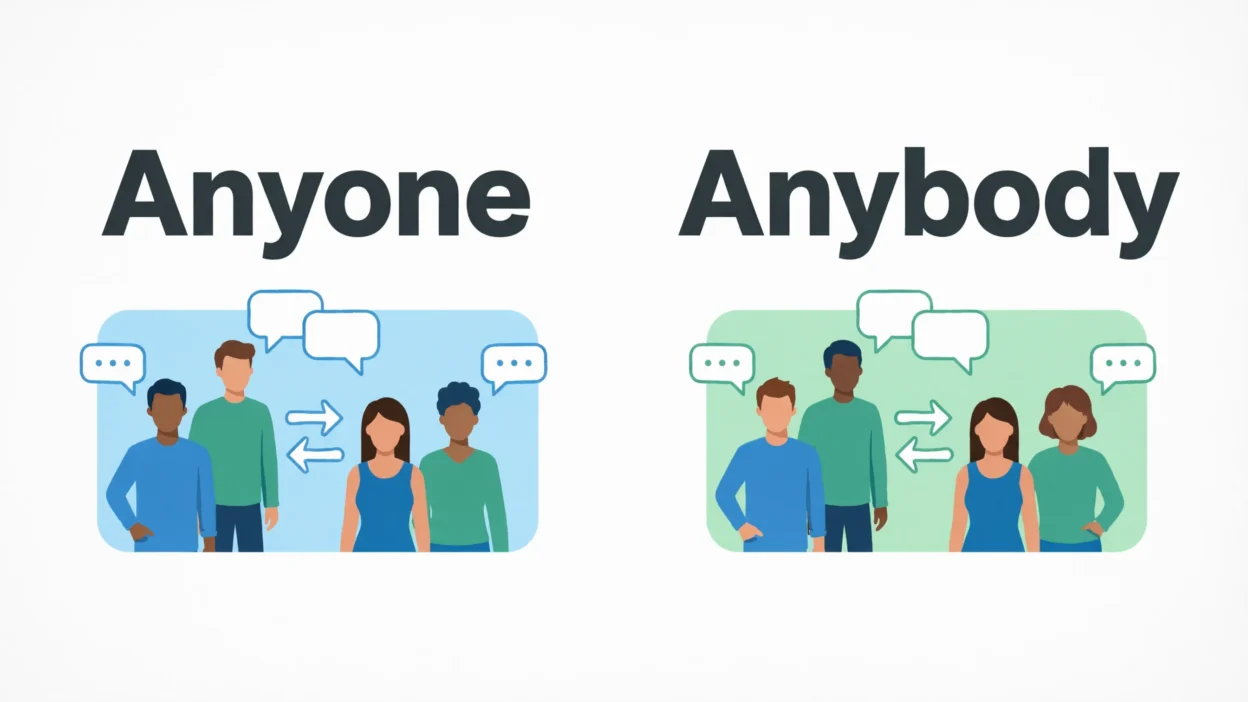
Many English learners wonder whether they should use anyone or anybody. The good news is that these two words have almost the same meaning, but there are slight differences in tone, style, and usage that can help you sound more natural in different situations.
In this guide, you’ll learn the difference between anyone vs anybody, their meanings, examples, common mistakes, grammar tips, and when to use each one. By the end, you’ll know exactly which word fits best in everyday conversations and formal writing.
Quick Answer
The difference between anyone and anybody is mostly one of style:
- Anyone is an indefinite pronoun meaning any person. It is slightly more common in formal writing.
- Anybody is also an indefinite pronoun meaning any person. It is slightly more common in informal speech and everyday conversations.
In most situations, anyone and anybody can be used interchangeably without changing the meaning.
What Does “Anyone” Mean?
Anyone is an indefinite pronoun that refers to any person, regardless of who they are. It is commonly used in questions, negative sentences, and statements where the specific person is unknown or unimportant.
Examples of Anyone
- Does anyone know the answer?
- I didn’t see anyone at the office.
- Anyone can learn a new language with practice.
- If anyone calls, please take a message.
Common Synonyms of Anyone
- Any person
- Whoever
- Someone (depending on context)
- Everybody (in some situations)
What Does “Anybody” Mean?
Anybody also means any person and functions as an indefinite pronoun. Its meaning is virtually identical to anyone, but it often sounds slightly more conversational.
Examples of Anybody
- Does anybody want some coffee?
- I couldn’t find anybody to help me.
- Anybody can join the club.
- If anybody has questions, feel free to ask.
Common Synonyms of Anybody
- Any person
- Whoever
- Someone (context-dependent)
- Everybody (in certain contexts)
Anyone vs Anybody Comparison Table
| Feature | Anyone | Anybody |
|---|---|---|
| Part of Speech | Indefinite pronoun | Indefinite pronoun |
| Meaning | Any person | Any person |
| Formality | Slightly more formal | Slightly more informal |
| Common in Speech | Yes | Very common |
| Common in Formal Writing | More common | Less common |
| Interchangeable? | Yes | Yes |
Key Differences Between Anyone and Anybody
| Anyone | Anybody |
|---|---|
| Slightly more formal | Slightly more conversational |
| Often preferred in academic and professional writing | Often preferred in casual speech |
| Means “any person” | Means “any person” |
| Can usually replace “anybody” | Can usually replace “anyone” |
How to Remember the Difference
A simple trick is:
- Anyone = Formal
- Anybody = Casual
However, remember that both words mean the same thing. The choice usually depends on your writing style or personal preference rather than grammar.
Examples in Everyday Situations
At School
- Has anyone finished the assignment?
- Did anybody bring a calculator?
At Work
- Can anyone explain the new policy?
- Has anybody contacted the client?
At Home
- Is anyone awake?
- Does anybody know where my keys are?
Public Announcements
- If anyone finds a lost wallet, please return it to reception.
- If anybody needs assistance, our staff is happy to help.
Common Mistakes
Although anyone and anybody are interchangeable in most cases, learners sometimes misuse them.
Incorrect
- Anyone are welcome.
Correct
- Anyone is welcome.
Incorrect
- I didn’t meet someone.
Correct
- I didn’t meet anyone.
- I didn’t meet anybody.
Incorrect
- Anybody have a question?
Correct
- Does anybody have a question?
Grammar Tips
Both anyone and anybody are singular indefinite pronouns and take singular verbs.
Correct Examples
- Anyone is allowed to participate.
- Anybody can apply.
- Has anyone called?
- Did anybody see my phone?
Although they refer to unspecified people, they are treated as singular in grammar.
American vs British English
Both American English and British English use anyone and anybody with the same meanings.
The only difference is style:
- Anyone is often preferred in formal documents, academic writing, and professional communication.
- Anybody appears more frequently in everyday conversation and informal writing.
Both are completely correct in either variety of English.
When Should You Use Anyone?
Use anyone when:
- Writing essays
- Sending professional emails
- Creating formal documents
- Writing business reports
- Preparing academic assignments
Examples:
- Anyone interested should register online.
- If anyone has concerns, please contact the manager.
When Should You Use Anybody?
Use anybody when:
- Having casual conversations
- Talking with friends or family
- Writing informal messages
- Speaking naturally in everyday situations
Examples:
- Is anybody hungry?
- Can anybody help me move this table?
Related Words and LSI Keywords
To better understand anyone vs anybody, it’s helpful to know related terms:
- indefinite pronouns
- any person
- someone
- somebody
- everyone
- everybody
- no one
- nobody
- anyone meaning
- anybody meaning
- English grammar
- pronoun usage
- formal vs informal English
- common English words
These related terms frequently appear in English grammar lessons and writing guides.
Frequently Asked Questions (FAQs)
1. Is there a difference between anyone and anybody?
Yes, but it’s very small. Both mean “any person.” Anyone is slightly more formal, while anybody is slightly more conversational.
2. Can anyone and anybody be used interchangeably?
Yes. In most situations, they can replace each other without changing the meaning.
3. Which is more formal, anyone or anybody?
Anyone is generally considered slightly more formal.
4. Which word is more common in everyday speech?
Anybody is often heard more frequently in casual conversations.
5. Are anyone and anybody singular or plural?
Both are singular indefinite pronouns and take singular verbs.
6. Can I use anybody in academic writing?
Yes, but many writers prefer anyone because it sounds slightly more formal.
7. Is there any difference in American and British English?
No. Both varieties use anyone and anybody in the same way.
8. Which word should I choose?
Choose anyone for formal writing and anybody for casual conversation. In most contexts, either choice is correct.
Summary
Understanding anyone vs anybody is easier than it first appears. Both words mean any person and function as singular indefinite pronouns. They are interchangeable in most sentences, with the primary difference being tone rather than meaning.
If you’re writing something formal, anyone is often the better choice. For everyday conversations and informal writing, anybody sounds slightly more natural. Since both are grammatically correct, choosing the one that best fits your style will help your English sound more fluent and confident.
Actionable Takeaway
Whenever you’re deciding between anyone and anybody, remember that the meaning stays the same. Use anyone for professional, academic, or formal writing, and choose anybody for relaxed, everyday conversations. With this simple guideline, you’ll make the right choice every time.

Mike Poop is a dedicated writer at Symboliy.com, creating clear, practical content about language, communication, and everyday expressions to help readers understand meaning and usage confidently in professional contexts worldwide.