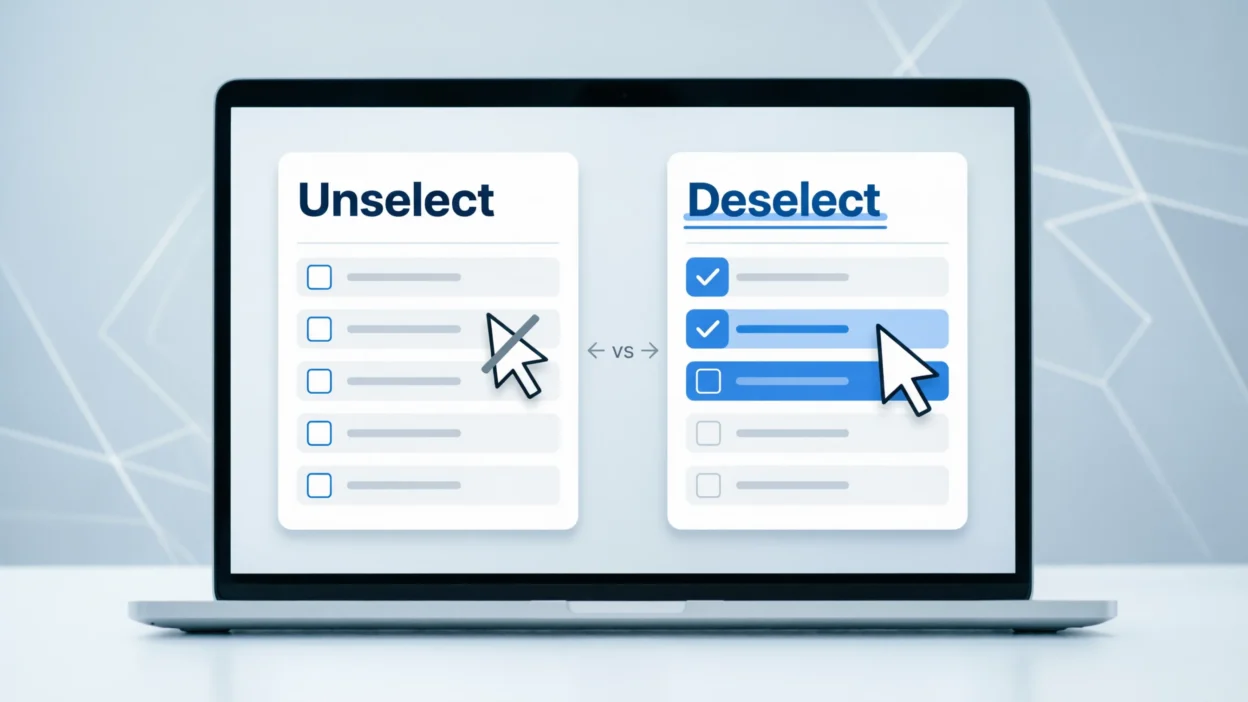
If you’ve ever worked with software, edited documents, or used design tools, you’ve probably come across the words unselect and deselect.
At first glance, they seem to mean exactly the same thing. That often leaves people wondering whether one is more correct than the other or if they should be used in different situations.
The good news is that both terms are widely understood, but they aren’t equally preferred.
Understanding the subtle differences between unselect vs deselect can improve your writing, make your UI terminology more consistent, and help you communicate more professionally.
This guide explains everything you need to know with simple definitions, practical examples, common mistakes, and expert tips.
Quick Answer
Deselect is the standard and more widely accepted term in modern English, especially in software, technology, and user interface (UI) design. It means to remove a selection from an item that was previously selected.
Unselect carries the same meaning and is understood by most people, but it is less common and is generally considered a non-standard or less preferred alternative in formal documentation.
In most cases, choose “deselect” unless you’re following a product’s existing terminology.
What Does “Deselect” Mean?
Deselect means to remove the active selection from an object, option, file, or piece of text.
In computing and digital interfaces, it is the opposite of select.
Examples
- Click outside the image to deselect it.
- Press Ctrl + D to deselect all selected objects.
- Tap the checkbox again to deselect the option.
- The user can deselect multiple files before moving them.
Because it is widely accepted, software manuals, tutorials, and technical writers almost always prefer deselect.
What Does “Unselect” Mean?
Unselect also means to remove something from a selected state.
Although many users naturally create the word by adding the prefix un- to select, it appears less frequently in professional documentation and dictionaries.
Examples
- Unselect the highlighted text before continuing.
- You can unselect the photo by tapping it again.
- The application lets users unselect multiple items.
These examples are understandable, but replacing unselect with deselect usually sounds more natural in professional English.
Unselect vs Deselect: Key Differences
| Feature | Unselect | Deselect |
|---|---|---|
| Meaning | Remove a selection | Remove a selection |
| Common usage | Less common | Very common |
| Technical documentation | Rare | Standard |
| Software interfaces | Occasionally used | Preferred |
| Dictionaries | Limited recognition | Widely recognized |
| Professional writing | Less recommended | Highly recommended |
The biggest difference is usage frequency, not meaning. Both words describe the same action, but deselect has become the industry standard.
Why Is “Deselect” More Common?
Language evolves based on usage. Software companies, operating systems, and technology documentation have consistently adopted deselect over the years.
You’ll frequently see instructions such as:
- Deselect all.
- Deselect the checkbox.
- Deselect the image.
- Deselect your current selection.
Because millions of users encounter this wording every day, it has become the expected choice.
When Should You Use “Deselect”?
Choose deselect when writing:
- Software documentation
- User guides
- Website tutorials
- Technical blogs
- App interfaces
- Help center articles
- Educational content
- Professional emails about software
Example Sentences
- Deselect the checkbox before saving your settings.
- Users can deselect files individually.
- Click anywhere outside the object to deselect it.
- Press Escape to deselect the current selection.
Using deselect makes your writing sound more polished and aligns with industry standards.
When Is “Unselect” Acceptable?
Although less common, unselect isn’t necessarily wrong.
It may appear in:
- Older software
- Internal company tools
- Informal conversations
- User-generated tutorials
- Legacy documentation
If a product consistently uses unselect, maintaining that wording helps keep the interface consistent.
Otherwise, deselect remains the better choice.
Real-Life Examples
Here are examples from everyday computing tasks.
Selecting Files
✅ Select three files.
✅ Deselect one file.
Editing Photos
Select the object.
Deselect it by clicking outside the canvas.
Filling Out Forms
Select your preferred language.
If you change your mind, deselect the option.
Spreadsheet Software
Select multiple cells.
Click elsewhere to deselect them.
These examples demonstrate that deselect sounds natural across nearly every digital environment.
Common Mistakes People Make
Many writers confuse these terms or use them inconsistently.
Avoid these common mistakes:
- Mixing unselect and deselect within the same document.
- Assuming unselect is always incorrect.
- Using different terminology across the same software guide.
- Replacing “remove selection” with awkward wording when deselect works perfectly.
For consistency, stick with one preferred term throughout your content.
American vs British English
Unlike many English words, there is no significant American vs British English difference between unselect and deselect.
Both American English and British English overwhelmingly favor deselect in:
- Computer software
- Technology documentation
- User interface text
- Technical writing
- Educational resources
While unselect is occasionally used in both varieties of English, it is not considered a regional preference. Instead, it is simply less common overall.
Related Words and LSI Keywords
Including related terminology helps readers understand the topic more clearly while improving topical relevance.
Some closely related terms include:
- select
- deselect all
- remove selection
- clear selection
- selection tool
- highlighted item
- checkbox
- toggle selection
- user interface terminology
- software documentation
- command button
- digital editing
- UI writing
- UX terminology
- technical English
These related phrases naturally fit discussions about selection behavior in software and applications.
Best Practices for Writers and Developers
If you’re creating software documentation or interface text, follow these recommendations:
- Use deselect consistently.
- Match your application’s existing terminology.
- Keep button labels short and clear.
- Avoid switching between similar terms unnecessarily.
- Test interface wording with real users whenever possible.
Consistency improves usability and reduces confusion.
Frequently Asked Questions
Is deselect the correct English word?
Yes. Deselect is a recognized English word and is the preferred term in software, technology, and professional writing.
Is unselect wrong?
No. Unselect is understandable and used by some people, but it is less common and generally not the preferred choice in formal documentation.
Which term should I use in UI design?
Use deselect unless your product already uses unselect consistently throughout its interface.
Do unselect and deselect mean the same thing?
Yes. Both words describe removing an existing selection from an item, object, or option.
Why do most software programs use “deselect”?
Because it has become the accepted industry standard through widespread use in operating systems, applications, and technical documentation.
Is there an American and British English difference?
No. Both American and British English strongly prefer deselect, making it the safer choice for international audiences.
Can I use unselect in casual writing?
Yes. Most readers will understand it, although deselect still sounds more natural and professional.
Which word is better for SEO articles about software?
Deselect is generally the better choice because it aligns with common search behavior, industry terminology, and user expectations. However, including unselect naturally helps cover related search queries.
Summary
The debate over unselect vs deselect is less about meaning and more about standard usage. Both words refer to removing a selection from an item, but deselect has become the preferred term in software development, technical documentation, user interfaces, and professional writing. It is widely recognized, sounds more natural, and creates consistency across digital products.
If you’re writing tutorials, designing interfaces, or creating technical content, choosing deselect is usually the best decision. You can still mention unselect when discussing alternative terminology or matching an application’s existing language, but for most situations, deselect remains the clearer and more professional option.
Actionable Takeaway: Whenever you’re unsure whether to use unselect or deselect, choose deselect. It is the standard term trusted by developers, technical writers, and software users worldwide, helping your content stay clear, consistent, and user-friendly.

Here is a professional 30-word author biography including your site name Symboliy.com:
Martin Hood is a professional writer at Symboliy.com, creating clear, informative content focused on language, communication, and meaningful expressions for everyday and professional use.