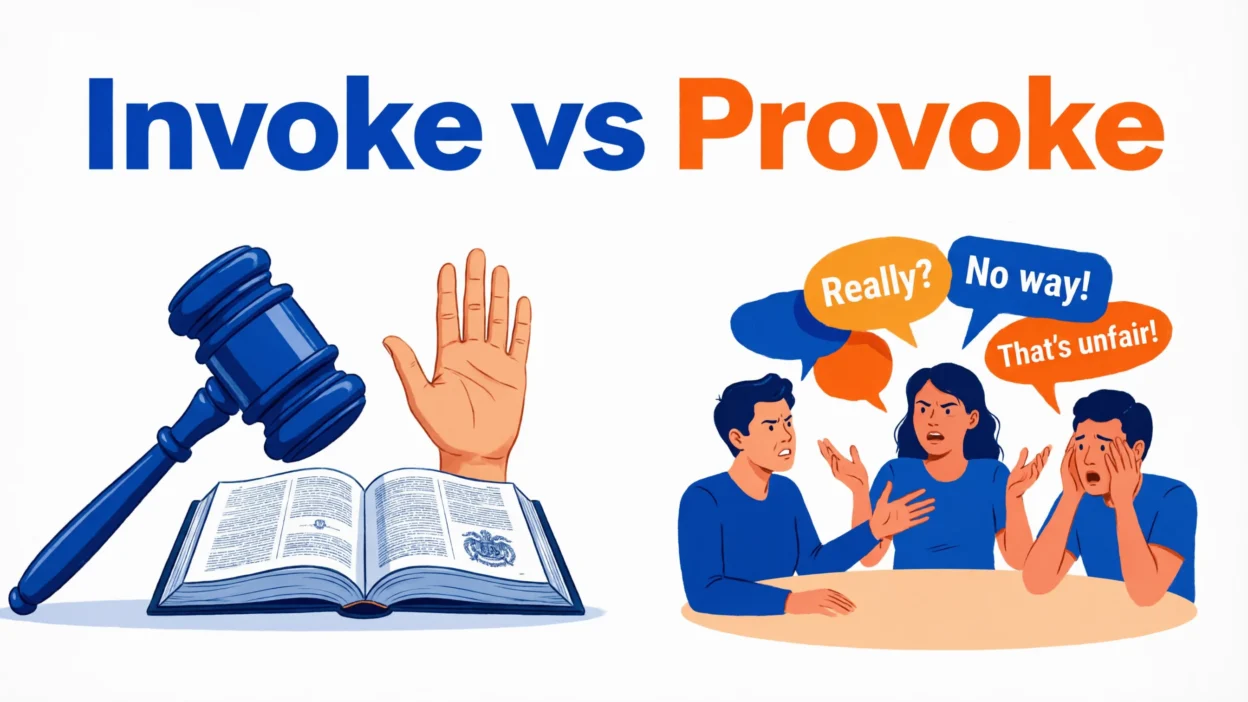
Choosing between invoke and provoke can be confusing because the two words sound somewhat similar and are often used in formal writing.
However, they have very different meanings and are used in completely different contexts. Mixing them up can change the meaning of your sentence and make your writing less accurate.
If you’ve ever wondered when to use invoke instead of provoke, you’re in the right place.
This guide explains the difference between invoke vs provoke in simple American English with clear definitions, practical examples, common mistakes, memory tips, and answers to frequently asked questions. By the end, you’ll know exactly which word fits your sentence.
Quick Answer
The difference between invoke and provoke is straightforward:
- Invoke means to call upon, appeal to, or bring something into effect, such as a law, right, authority, or emotion.
- Provoke means to cause a reaction, especially anger, emotion, or action.
Examples:
- The lawyer decided to invoke the Fifth Amendment.
- His rude comments continued to provoke an argument.
Although these verbs may seem similar, they are not interchangeable.
What Does “Invoke” Mean?
The verb invoke means to call upon something for help, support, authority, or effect. It is commonly used in legal, religious, formal, and literary contexts.
You can invoke:
- A law
- A legal right
- A rule
- An authority
- A memory
- A feeling
- A spirit (in religious or fictional contexts)
Examples of Invoke
- She decided to invoke her right to remain silent.
- The judge may invoke federal law.
- The speaker invoked the country’s founding principles.
- That song invokes childhood memories.
- The ceremony was held to invoke blessings.
Common Uses of Invoke
- Invoke a law
- Invoke a rule
- Invoke authority
- Invoke a right
- Invoke a memory
- Invoke sympathy
- Invoke tradition
What Does “Provoke” Mean?
The verb provoke means to cause someone to react, often emotionally. It usually suggests triggering anger, frustration, thought, laughter, discussion, or another response.
Unlike invoke, provoke focuses on creating or stimulating a reaction.
Examples of Provoke
- His behavior continued to provoke criticism.
- The article was written to provoke discussion.
- Don’t provoke the dog.
- Her comments provoked outrage.
- The decision provoked public debate.
Common Uses of Provoke
- Provoke anger
- Provoke laughter
- Provoke discussion
- Provoke violence
- Provoke fear
- Provoke thought
- Provoke a response
Invoke vs Provoke Comparison Table
| Feature | Invoke | Provoke |
|---|---|---|
| Meaning | To call upon or appeal to | To cause or trigger a reaction |
| Part of Speech | Verb | Verb |
| Common Context | Law, authority, rights, memories, traditions | Emotions, arguments, discussions, reactions |
| Typical Result | Bringing something into effect | Causing someone to respond |
| Example | She invoked her legal rights. | He provoked an angry response. |
Why People Confuse Invoke and Provoke
Many writers confuse these words because:
- Both are formal verbs.
- They sound somewhat alike.
- Both can involve emotions or actions.
- Both frequently appear in professional and academic writing.
The key difference is the direction of the action.
Invoke means calling upon something.
Provoke means causing something to happen.
Easy Memory Trick
Here’s an easy way to remember the difference.
Invoke = Invite
Think of invoke as inviting help, authority, or protection.
Provoke = Produce a Reaction
Think of provoke as producing an emotional or physical response.
If you’re asking for support or authority, use invoke.
If you’re causing someone to react, use provoke.
Example Sentences
Invoke
- The company chose to invoke its contractual rights.
- He invoked the protection of the Constitution.
- The speech invoked hope among the audience.
- The poem invokes images of nature.
- The witness refused to answer after invoking the Fifth Amendment.
Provoke
- His remarks provoked widespread criticism.
- The comedian tried to provoke laughter.
- The movie provoked deep reflection.
- Loud noises may provoke anxiety.
- The unfair decision provoked protests.
Common Mistakes
These words should never replace one another.
Incorrect
- The lawyer decided to provoke the Fifth Amendment.
Correct
- The lawyer decided to invoke the Fifth Amendment.
Incorrect
- His rude behavior invoked an argument.
Correct
- His rude behavior provoked an argument.
Incorrect
- The speech provoked the Constitution.
Correct
- The speech invoked the Constitution.
Always ask yourself whether you’re calling upon something or causing a reaction.
American vs. British English
There is no spelling difference between American English and British English for invoke and provoke.
Both forms use:
- Invoke
- Invoked
- Invoking
- Provoke
- Provoked
- Provoking
The meanings are also the same in both varieties of English. The only difference you may notice is that certain legal or cultural examples vary by country.
When Should You Use Invoke?
Use invoke when talking about:
- Laws
- Rights
- Rules
- Authority
- Traditions
- Religious blessings
- Memories
- Emotions brought to mind
When Should You Use Provoke?
Use provoke when referring to:
- Anger
- Fear
- Discussion
- Debate
- Violence
- Laughter
- Curiosity
- Emotional reactions
Related Words and Synonyms
Synonyms for Invoke
- Call upon
- Appeal to
- Cite
- Refer to
- Request
- Summon
- Evoke
- Apply
Synonyms for Provoke
- Trigger
- Cause
- Incite
- Stimulate
- Prompt
- Agitate
- Spark
- Encourage
Frequently Asked Questions
1. What is the difference between invoke and provoke?
Invoke means to call upon or appeal to something, while provoke means to cause a reaction or response.
2. Can invoke and provoke be used interchangeably?
No. They have different meanings and are used in different contexts.
3. What does it mean to invoke a law?
It means to formally rely on or apply a legal rule or right.
4. What does it mean to provoke someone?
It means to intentionally or unintentionally cause someone to react emotionally or physically.
5. Which word is commonly used in legal writing?
Invoke is much more common in legal writing because people invoke laws, rights, and constitutional protections.
6. Can a speech invoke emotions?
Yes. A speech can invoke memories, patriotism, hope, or inspiration by bringing those feelings to mind.
7. Can a speech provoke emotions?
Yes. A speech can also provoke anger, excitement, debate, or discussion by causing an emotional response. The distinction is that invoke emphasizes calling forth existing feelings or ideas, while provoke emphasizes triggering a reaction.
8. Is there a spelling difference between American and British English?
No. Both American and British English use the same spelling and meanings for invoke and provoke.
Summary
Understanding invoke vs provoke becomes much easier once you focus on their core meanings. Invoke is used when you call upon, appeal to, or bring something into effect, such as a law, right, authority, or memory. Provoke, on the other hand, means to trigger or cause a reaction, whether it’s anger, laughter, debate, or another emotional response.
Whenever you’re unsure which word to choose, think about the purpose of your sentence. If you’re calling on something for support or authority, use invoke. If you’re causing someone or something to react, use provoke. Mastering this distinction will make your writing clearer, more precise, and more professional.
Actionable Takeaway
Remember this simple rule:
- Invoke = Call upon or appeal to
- Provoke = Cause a reaction
Keeping this quick distinction in mind will help you use invoke and provoke correctly in everyday writing, academic work, and professional communication.

Here is a professional 30-word author biography including your site name Symboliy.com:
Martin Hood is a professional writer at Symboliy.com, creating clear, informative content focused on language, communication, and meaningful expressions for everyday and professional use.