If you’ve ever paused while writing because you weren’t sure whether to use laying vs lying, you’re far from alone.
These two words are among the most commonly confused verbs in English because they look and sound similar but have different meanings and grammar rules. Even native English speakers mix them up regularly.
The good news is that once you understand one simple distinction, choosing the correct word becomes much easier.
In this guide, you’ll learn the meaning of laying and lying, see practical examples, discover common mistakes to avoid, and pick up easy memory tricks to help you use them confidently in everyday conversations and writing.
Quick Answer
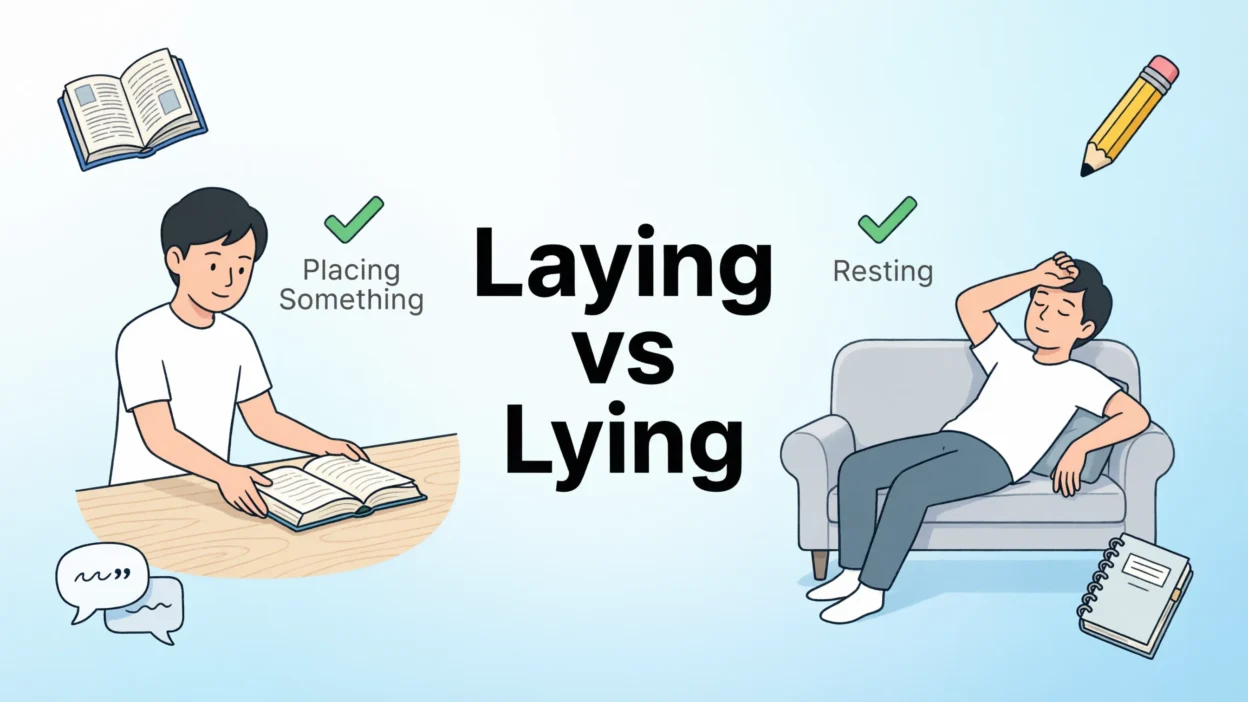
The difference between laying vs lying is simple:
- Laying is the present participle of lay, which means to put or place something down. It requires a direct object (something being placed).
- She is laying the books on the table.
- Lying is the present participle of lie, which means to recline, rest, or be in a horizontal position. It does not require a direct object.
- The cat is lying on the couch.
Easy rule: If you’re placing something, use laying. If someone or something is resting by itself, use lying.
What Does “Laying” Mean?
Laying comes from the verb lay, which means to put, place, or set something somewhere. Because it’s a transitive verb, it always needs an object—the thing being placed.
Examples of “Laying”
- She is laying the plates on the table.
- They are laying new carpet in the living room.
- The gardener is laying fresh soil around the plants.
- He is laying his phone on the desk.
- Workers are laying bricks for the new house.
Notice that each sentence answers the question: What is being laid?
What Does “Lying” Mean?
Lying comes from the verb lie, which means to recline, rest, or remain in a horizontal position. It is an intransitive verb, meaning it does not take a direct object.
Examples of “Lying”
- The baby is lying in the crib.
- My dog is lying under the table.
- She is lying on the beach.
- The keys are lying on the counter.
- He spent the afternoon lying in a hammock.
In these examples, no object is being placed by someone.
Laying vs Lying Comparison Table
| Feature | Laying | Lying |
|---|---|---|
| Base Verb | Lay | Lie |
| Meaning | Putting something down | Resting or reclining |
| Needs an Object? | Yes | No |
| Verb Type | Transitive | Intransitive |
| Example | She is laying the blanket down. | She is lying on the blanket. |
Understanding the Difference with Simple Examples
Compare these sentences:
- She is laying the baby in the crib.
- The baby is lying in the crib.
In the first sentence, someone places the baby into the crib. In the second sentence, the baby is already resting there.
Another example:
- He is laying the newspaper on the table.
- The newspaper is lying on the table.
The first sentence describes an action of placing the newspaper. The second describes its position.
Common Mistakes People Make
Because the present forms look similar, writers often substitute one for the other incorrectly.
Mistake 1
❌ I am laying on the sofa.
✅ I am lying on the sofa.
Reason: You are resting, not placing something.
Mistake 2
❌ She is lying the dishes on the counter.
✅ She is laying the dishes on the counter.
Reason: She is placing the dishes.
Mistake 3
❌ The blanket is laying on the bed.
✅ The blanket is lying on the bed.
Reason: The blanket is already resting there.
Mistake 4
❌ He spent the afternoon laying in the sun.
✅ He spent the afternoon lying in the sun.
Reason: He was reclining.
Easy Memory Trick
A simple trick can help you remember the difference.
Think About an Object
Ask yourself:
Is someone placing something?
- Yes → Use laying.
- No → Use lying.
For example:
- She is laying the book on the shelf.
- He is lying on the couch.
The first sentence has an object (the book). The second does not.
Present, Past, and Past Participle Forms
One reason this topic causes confusion is that the verb forms overlap.
| Verb | Present | Past | Past Participle | Present Participle |
|---|---|---|---|---|
| Lay (put something down) | Lay | Laid | Laid | Laying |
| Lie (recline) | Lie | Lay | Lain | Lying |
Notice that the past tense of “lie” is “lay,” which is why many learners become confused.
Examples:
- Today I lie down.
- Yesterday I lay down.
- I have lain here all afternoon.
Meanwhile:
- Today I lay the book down.
- Yesterday I laid the book down.
- I have laid the book on the table.
Real-Life Example Sentences
Using “Laying”
- The chef is laying slices of cheese on the bread.
- Workers are laying pavement outside.
- She is laying the baby in the crib.
- They are laying cables underground.
- He finished laying the tiles yesterday.
Using “Lying”
- The children are lying on the grass.
- A wallet is lying near the entrance.
- She enjoys lying by the pool on weekends.
- The cat has been lying by the fireplace all day.
- My glasses are lying on the bedside table.
Laying vs Lying in Everyday Conversation
These words frequently appear in everyday speech.
Correct examples include:
- I’m lying in bed.
- She’s laying the table for dinner.
- Your jacket is lying on the chair.
- He’s laying fresh paint on the wall.
- The documents are lying on my desk.
Whenever you hear or read these expressions, remember to identify whether something is being placed or simply resting.
American vs British English
There is no grammatical difference between American English and British English when it comes to laying and lying.
Both American and British English use the same verb forms and grammar rules:
- Laying means placing something somewhere.
- Lying means reclining or resting.
The confusion exists equally in both varieties of English, and the correct usage remains the same regardless of your audience.
Related Grammar Terms (LSI Keywords)
Understanding laying vs lying becomes easier when you’re also familiar with related grammar topics:
- Lay vs lie
- Laying or lying
- English verb forms
- Transitive verbs
- Intransitive verbs
- Common English grammar mistakes
- Present participles
- Past tense verbs
- Correct English usage
- English writing tips
- Grammar rules
- Verb conjugation
These related concepts strengthen your understanding of English grammar and improve your writing accuracy.
FAQs
1. What is the difference between laying and lying?
Laying means placing something down and requires an object. Lying means resting or reclining and does not require an object.
2. Is it “laying in bed” or “lying in bed”?
The correct phrase is lying in bed because you’re resting, not placing something.
3. Why do people confuse laying and lying?
The verbs have similar spellings, related meanings, and overlapping verb forms, especially because the past tense of lie is lay.
4. Does laying always need an object?
Yes. You must be laying something, such as a book, blanket, plate, or phone.
5. Is “the book is laying on the table” correct?
No. The correct sentence is The book is lying on the table because the book is resting there.
6. Do American and British English use these words differently?
No. Both follow the same grammar rules for laying and lying.
7. How can I quickly remember the difference?
Ask yourself whether something is being placed. If yes, use laying. If someone or something is simply resting, use lying.
8. Are laying and lying pronounced differently?
Yes, they have different pronunciations, although learners still confuse them because of their similar spellings and related meanings.
Summary
Understanding laying vs lying is easier once you remember the key difference: laying involves placing something somewhere, while lying describes someone or something resting in a horizontal position. The presence or absence of a direct object is the easiest way to choose the correct word. Mastering this distinction will make your writing clearer and help you avoid one of the most common English grammar mistakes.
Although the verb forms can seem confusing at first—especially since the past tense of lie is lay—regular practice with real-life examples makes the rules much easier to remember. Whether you’re writing an email, an academic paper, or a social media post, using laying and lying correctly demonstrates strong grammar skills and improves your communication.
Actionable Takeaway
Before using laying or lying, ask yourself these quick questions:
- Is someone placing something? → Use laying.
- Is someone or something simply resting? → Use lying.
- Look for a direct object. If there isn’t one, lying is usually the correct choice.
- Review your sentence before publishing to catch common grammar mistakes.

Here is a professional 30-word author biography including your site name Symboliy.com:
Martin Hood is a professional writer at Symboliy.com, creating clear, informative content focused on language, communication, and meaningful expressions for everyday and professional use.