
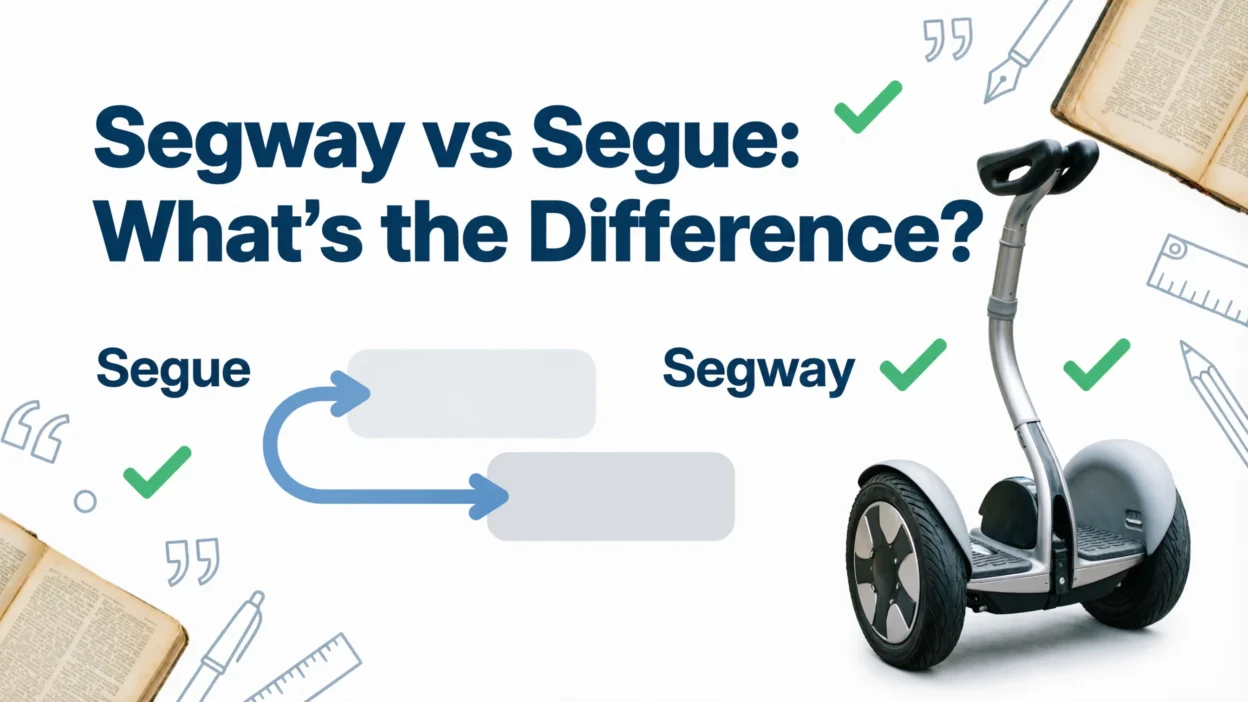
Have you ever wondered whether you should write Segway or segue? These two words sound exactly alike, which makes them one of the most commonly confused pairs in English. However, they have completely different meanings, spellings, and uses.
If you’re searching for Segway vs segue, you’re likely trying to figure out which word fits your sentence.
This guide explains the difference in simple terms, provides plenty of examples, highlights common mistakes, and shares an easy trick to remember the correct usage.
Quick Answer
Both words are correct—but they mean different things.
✅ Segue – A verb or noun meaning a smooth transition from one topic, idea, or section to another.
✅ Segway – A brand name for a two-wheeled self-balancing personal transportation device.
Use segue when talking about transitions.
Use Segway when referring to the personal transporter.
What Do “Segue” and “Segway” Mean?
Although they sound identical, segue and Segway have unrelated meanings.
Segue
Segue is both a verb and a noun.
As a verb, it means to move smoothly from one subject, activity, or part to another.
As a noun, it refers to the transition itself.
Examples:
- The speaker segued into the next topic without pausing.
- That was a perfect segue between the two chapters.
Segway
Segway is a proper noun and a registered brand name.
It refers to a self-balancing, battery-powered personal transporter with two wheels that riders control by shifting their weight.
Examples:
- We rented Segways during our city tour.
- She learned how to ride a Segway in just a few minutes.
Why Are “Segue” and “Segway” Confused?
The confusion happens because both words are pronounced almost exactly the same:
segue → “SEG-way”
Segway → “SEG-way”
Because English often has words with identical pronunciation but different spellings and meanings, many people mistakenly write Segway when they actually mean segue.
Examples of “Segue” in Sentences
Here are examples showing the correct use of segue.
- The teacher smoothly segued into the next lesson.
- I’d like to segue from marketing into sales.
- The documentary uses music as a natural segue between scenes.
- Her question provided the perfect segue to the next discussion.
- The host segued into the interview with a brief introduction.
In each sentence, segue refers to a smooth transition.
Examples of “Segway” in Sentences
Now let’s look at the transportation device.
- We explored the park on Segways.
- The company offered guided Segway tours.
- Riding a Segway requires a little balance.
- He bought a used Segway for commuting.
- Tourists enjoyed traveling through the city on Segways.
In these examples, Segway refers only to the vehicle.
Segway vs Segue Comparison Table
| Feature | Segue | Segway |
|---|---|---|
| Part of speech | Verb or noun | Proper noun (brand name) |
| Meaning | Smooth transition | Personal transportation device |
| Correct for transitions | ✅ Yes | ❌ No |
| Correct for the vehicle | ❌ No | ✅ Yes |
| Pronunciation | SEG-way | SEG-way |
| Commonly confused | ✅ Yes | ✅ Yes |
When Should You Use “Segue”?
Use segue whenever you’re describing a smooth movement from one topic, idea, section, or activity to another.
Common situations include:
- Public speaking
- Presentations
- Essays
- Meetings
- Podcasts
- Videos
- Conversations
- Books
- Articles
Example:
“The presenter segued into the final section of the seminar.”
When Should You Use “Segway”?
Use Segway only when referring to the famous self-balancing transporter or the brand itself.
Examples include:
- Segway tours
- Riding a Segway
- Buying a Segway
- Segway transportation
- Segway personal transporter
Never use Segway to describe a transition in writing or speech.
Common Mistakes People Make
Because both words sound the same, many writers accidentally substitute one for the other.
Incorrect:
❌ Let me Segway into my next point.
Correct:
✅ Let me segue into my next point.
Incorrect:
❌ We rented two segues for sightseeing.
Correct:
✅ We rented two Segways for sightseeing.
Incorrect:
❌ The speaker made a smooth Segway between topics.
Correct:
✅ The speaker made a smooth segue between topics.
Easy Trick to Remember
A simple memory trick can help.
Think of segue as containing “gue,” which is common in many English words related to language and writing. Since transitions usually happen in speaking or writing, segue is the correct choice.
Think of Segway as ending in “way.” A vehicle helps you travel from one place to another, making it easy to associate Segway with transportation.
American vs British English
There is no spelling difference between American English and British English.
Both varieties use:
- segue for a smooth transition.
- Segway for the transportation device and brand.
The meanings remain exactly the same in both forms of English.
Related Words and LSI Keywords
To better understand this topic, it’s helpful to know related terms commonly associated with these words.
Relevant LSI keywords include:
- segue meaning
- Segway meaning
- segue definition
- Segway scooter
- grammar mistakes
- commonly confused words
- English homophones
- transition word
- correct spelling
- writing tips
- English vocabulary
- proper noun
- language learning
- brand name
- word usage
These related phrases naturally support the topic while improving overall content relevance.
Why Correct Usage Matters
Using the right word improves the clarity and professionalism of your writing.
Choosing segue correctly shows a strong understanding of English vocabulary, especially in academic, business, and professional communication.
Using Segway correctly prevents confusion when discussing transportation, tourism, or the well-known personal mobility device.
Since these words have entirely different meanings, selecting the correct one helps readers understand your intended message immediately.
Frequently Asked Questions
Is “Segway” ever correct for a transition?
No. Segway refers only to the transportation device or the brand. Use segue for transitions.
What does “segue” mean?
Segue means a smooth transition from one topic, activity, or section to another.
Why do “segue” and “Segway” sound the same?
They are homophones, meaning they share the same pronunciation but have different spellings and meanings.
Is “Segway” a brand name?
Yes. Segway is a registered brand name for a self-balancing personal transporter.
Can “segue” be used as both a noun and a verb?
Yes. It can describe both the transition itself and the act of transitioning smoothly.
Is there a British or American spelling difference?
No. Both American and British English use segue and Segway in the same way.
Which word should I use in essays and presentations?
Use segue whenever you’re referring to moving smoothly between ideas, topics, or sections.
Summary
The difference between Segway vs segue is simple once you know what each word means. Segue refers to a smooth transition in writing, speaking, music, or conversation, while Segway is the name of a self-balancing personal transportation device. Although they sound identical, they are not interchangeable.
Whenever you’re introducing a new topic, changing subjects, or connecting ideas, choose segue. Reserve Segway only for discussions about the vehicle or brand. Understanding this distinction will help you write more accurately, avoid common grammar mistakes, and communicate with greater confidence.
Actionable Takeaway
Remember this simple rule: If you’re moving between ideas, use segue. If you’re riding on two wheels, use Segway. Keeping this quick distinction in mind will help you avoid one of the most common homophone mistakes in English.

Mike Poop is a dedicated writer at Symboliy.com, creating clear, practical content about language, communication, and everyday expressions to help readers understand meaning and usage confidently in professional contexts worldwide.