If you’ve ever typed per se vs per say, you’re not alone. This is one of the most common spelling mistakes in English because both expressions sound exactly the same when spoken.
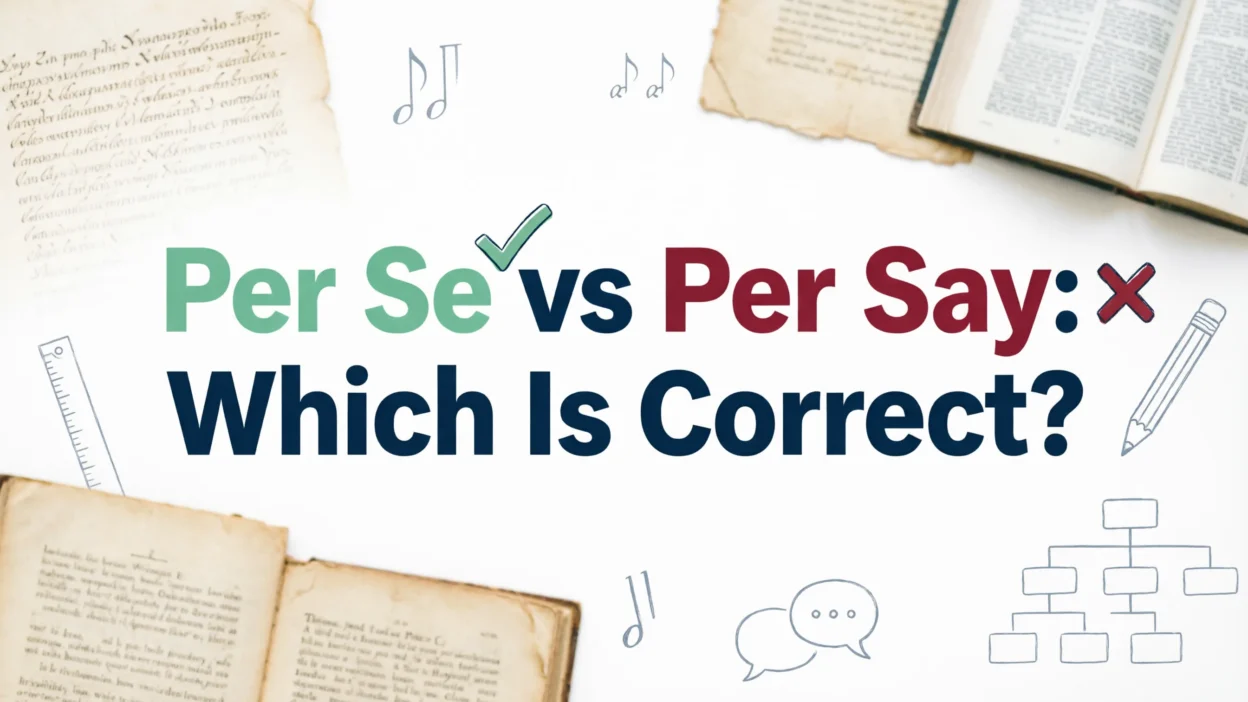
Many people mistakenly write per say, assuming it’s the correct phrase, when in fact the proper spelling is per se.
In this guide, you’ll learn the difference between per se and per say, what per se actually means, why the confusion happens, real-life examples, common mistakes to avoid, and whether American and British English use the phrase differently.
Quick Answer
The correct phrase is per se.
✅ Per se – Correct. A Latin phrase meaning “by itself,” “intrinsically,” or “in itself.”
❌ Per say – Incorrect. This is a common misspelling and is not considered standard English.
Whenever you mean “in itself” or “by itself,” always use per se.
What Does “Per Se” Mean?
Per se is a Latin phrase that has become a standard part of English vocabulary.
It means:
- By itself
- In itself
- Intrinsically
- As such
- Essentially
Writers and speakers use per se to clarify that they are referring to something in its own nature rather than its surrounding circumstances.
For example:
- Money isn’t bad per se; it depends on how it’s used.
- Working from home isn’t difficult per se, but it requires discipline.
In both examples, per se means “in itself.”
What Is “Per Say”?
Per say is simply a spelling mistake.
Because per se is pronounced like “per say,” many people assume the second word should be say instead of se.
However, per say has no recognized meaning in English and should never be used in formal or informal writing.
Why Are “Per Se” and “Per Say” Confused?
The confusion comes from pronunciation.
Both are spoken the same way:
Per se → “per say”
Since English contains many words that are spelled the way they sound, it’s easy to assume the phrase is written as per say.
The phrase actually comes from Latin, which explains its unusual spelling.
Examples of “Per Se” in Sentences
Here are several examples of the correct usage.
- The movie wasn’t bad per se; it was just too long.
- Success isn’t about talent per se.
- The policy isn’t unfair per se, but it needs improvement.
- Exercise isn’t enough per se without a healthy diet.
- Technology isn’t dangerous per se; how people use it matters.
- His comment wasn’t offensive per se, but it sounded insensitive.
In each sentence, per se means “in itself” or “by itself.”
Examples of Incorrect “Per Say”
These examples show the common mistake.
❌ The project isn’t difficult per say.
✅ The project isn’t difficult per se.
❌ I’m not tired per say.
✅ I’m not tired per se.
❌ The book isn’t boring per say.
✅ The book isn’t boring per se.
Remember, per say should always be replaced with per se.
Per Se vs Per Say Comparison Table
| Feature | Per Se | Per Say |
|---|---|---|
| Correct spelling | ✅ Yes | ❌ No |
| Standard English | ✅ Yes | ❌ No |
| Derived from Latin | ✅ Yes | ❌ No |
| Means “by itself” | ✅ Yes | ❌ No |
| Accepted in formal writing | ✅ Yes | ❌ No |
| Found in dictionaries | ✅ Yes | ❌ No |
When Should You Use “Per Se”?
Use per se when you want to emphasize that something is being considered in itself, rather than in relation to something else.
Common situations include:
- Academic writing
- Business communication
- Legal documents
- News articles
- Essays
- Everyday conversations
- Professional emails
Examples:
- The proposal isn’t flawed per se.
- Failure isn’t negative per se if you learn from it.
- Social media isn’t harmful per se.
Why “Per Say” Is Incorrect
Unlike per se, the expression per say has no historical or grammatical basis.
The mistake happens because people spell the phrase exactly as they hear it.
Since per se has been borrowed directly from Latin, its spelling remains unchanged in modern English.
For clear and professional writing, avoid per say entirely.
Common Mistakes People Make
Many writers accidentally replace per se with per say.
Incorrect:
❌ It’s not expensive per say.
Correct:
✅ It’s not expensive per se.
Incorrect:
❌ The software isn’t complicated per say.
Correct:
✅ The software isn’t complicated per se.
Incorrect:
❌ The decision wasn’t wrong per say.
Correct:
✅ The decision wasn’t wrong per se.
Using the correct spelling instantly improves the credibility of your writing.
Easy Trick to Remember
A simple memory trick is this:
Think of per se as a Latin expression. Since it’s borrowed directly from Latin, the unusual spelling se stays the same.
If you find yourself writing say, pause and ask yourself whether you’re using the Latin phrase meaning “in itself.” If the answer is yes, write per se.
American vs British English
There is no difference between American English and British English for this expression.
Both varieties use:
- Per se ✅
- Per say ❌
Whether you’re writing for readers in the United States, the United Kingdom, Canada, Australia, or elsewhere, per se is always the correct form.
Related Words and LSI Keywords
Using related vocabulary helps cover connected search intent while making the content more useful.
Relevant LSI keywords include:
- per se meaning
- per se definition
- per say mistake
- correct spelling
- Latin phrases in English
- English grammar
- commonly confused words
- writing mistakes
- English vocabulary
- grammar guide
- proper usage
- language learning
- word choice
- grammar tips
- spelling errors
These related phrases naturally support the topic without unnecessary repetition.
Why Correct Usage Matters
Using per se correctly makes your writing more polished and professional.
Since the phrase frequently appears in academic papers, business communication, journalism, and legal writing, spelling it correctly demonstrates attention to detail and a solid understanding of English.
Using per say instead can distract readers and reduce your credibility, especially in formal or professional settings.
Frequently Asked Questions
Is “per say” ever correct?
No. Per say is a misspelling and is not accepted in standard English.
What does “per se” mean?
Per se means “by itself,” “in itself,” or “intrinsically.”
Why do people write “per say”?
Because per se is pronounced like “per say,” many people spell it phonetically.
Is “per se” a Latin phrase?
Yes. It comes directly from Latin and has been adopted into English without changing its spelling.
Is there a British or American spelling difference?
No. Both American and British English use per se.
Can I use “per se” in formal writing?
Yes. It is widely accepted in academic, legal, business, and professional writing.
Should “per se” be italicized?
Not necessarily. Since per se is well established in English, most modern style guides do not require italics, though some publications may choose to use them for stylistic consistency.
Summary
The difference between per se vs per say is straightforward. Per se is the correct expression, meaning “by itself,” “in itself,” or “intrinsically.” It comes from Latin and has been part of English usage for centuries. Per say, on the other hand, is simply a phonetic misspelling and should be avoided in all forms of writing.
Whenever you want to express that something should be considered on its own merits, use per se. Remembering this small but important distinction will help you write more accurately, sound more professional, and avoid one of the most common spelling mistakes in English.
Actionable Takeaway
Whenever you’re tempted to write per say, remember that the correct phrase is per se. Think of it as a Latin expression meaning “in itself,” and you’ll avoid this common error every time.

Mike Poop is a dedicated writer at Symboliy.com, creating clear, practical content about language, communication, and everyday expressions to help readers understand meaning and usage confidently in professional contexts worldwide.