If you’ve ever been confused about breath vs breathe, you’re not alone. These two words look almost identical, but they have different meanings, pronunciations, and grammatical roles.
Because of their similar spelling, many writers accidentally use one when they mean the other.
The good news is that the difference is easy to remember. In this guide, you’ll learn when to use breath and breathe, their meanings, pronunciation tips, real-life examples, common mistakes, and a simple trick to ensure you never mix them up again.
Quick Answer
Both breath and breathe are correct, but they have different meanings.
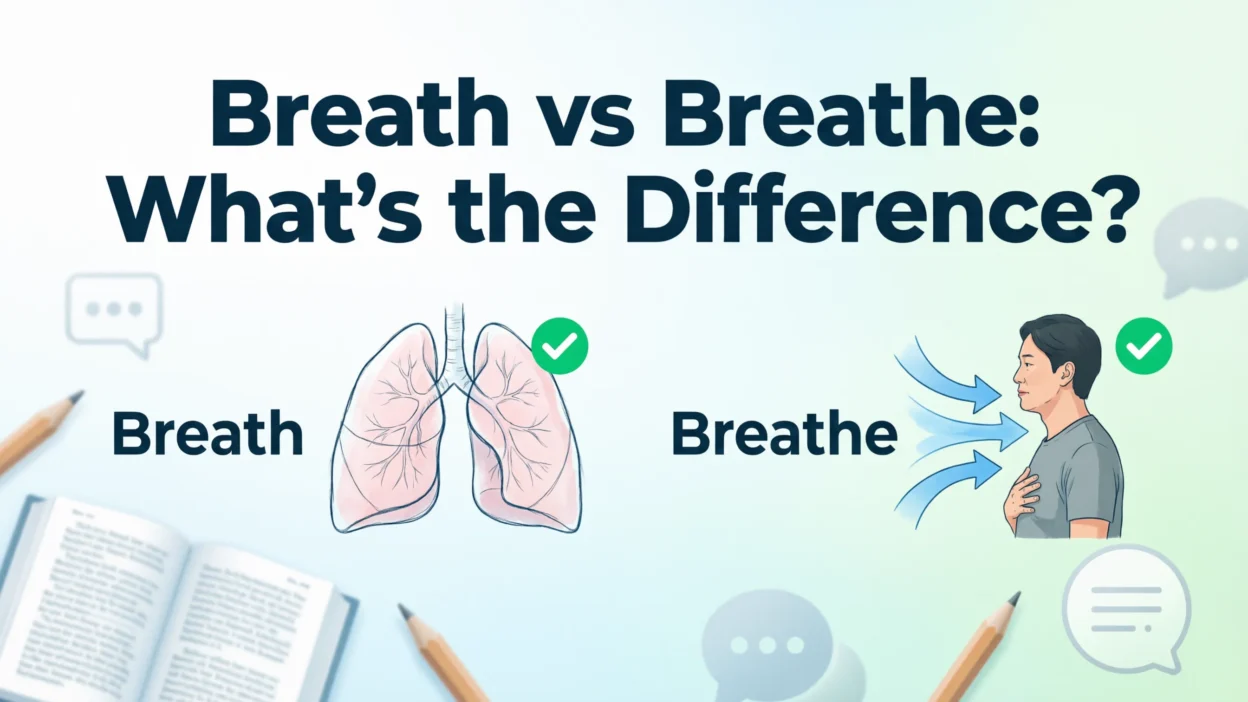
✅ Breath – A noun meaning the air you inhale and exhale.
✅ Breathe – A verb meaning to inhale and exhale air.
Think of it this way:
- You take a breath.
- You breathe in and out.
What Do “Breath” and “Breathe” Mean?
Although these words are closely related, they serve different purposes in English.
Breath
Breath is a noun. It refers to the air that moves into and out of your lungs or a single act of inhaling and exhaling.
Examples:
- Take a deep breath.
- His breath smelled like mint.
- She caught her breath after running.
Breathe
Breathe is a verb. It describes the action of taking air into and pushing it out of your lungs.
Examples:
- Please breathe slowly.
- I couldn’t breathe through my nose.
- Remember to breathe during the exercise.
Why Are “Breath” and “Breathe” Confused?
The confusion happens because the words differ by only one letter—e—and they are closely related in meaning.
However, they are pronounced differently:
- Breath → breth (short “e” sound)
- Breathe → breethe (long “ee” sound)
The extra e changes both the pronunciation and the grammatical function of the word.
Examples of “Breath” in Sentences
Use breath when referring to the air itself or a single inhalation or exhalation.
Examples:
- She took a deep breath before speaking.
- Hold your breath for ten seconds.
- His breath was visible in the cold air.
- I was out of breath after climbing the stairs.
- One deep breath helped calm my nerves.
In every example, breath functions as a noun.
Examples of “Breathe” in Sentences
Use breathe when describing the action of inhaling and exhaling.
Examples:
- Try to breathe through your nose.
- It’s easier to breathe after the rain.
- The doctor asked her to breathe deeply.
- He struggled to breathe because of the smoke.
- Always breathe steadily during yoga.
In these examples, breathe is the verb.
Breath vs Breathe Comparison Table
| Feature | Breath | Breathe |
|---|---|---|
| Part of speech | Noun | Verb |
| Meaning | Air taken in or out of the lungs | To inhale and exhale air |
| Correct pronunciation | Breth | Breethe |
| Refers to an action | ❌ No | ✅ Yes |
| Refers to a thing | ✅ Yes | ❌ No |
| Example | Take a breath | Breathe deeply |
Grammar Rule Behind “Breath” and “Breathe”
A simple grammar rule makes these words easy to distinguish.
- Breath is a noun, so it names a thing.
- Breathe is a verb, so it describes an action.
Compare these sentences:
- She took a breath before answering.
- She stopped to breathe before answering.
The first sentence names the breath itself, while the second describes the action.
Common Mistakes People Make
Because the words are so similar, writers often swap them.
Incorrect:
❌ Take a deep breathe.
Correct:
✅ Take a deep breath.
Incorrect:
❌ I can’t breath through my nose.
Correct:
✅ I can’t breathe through my nose.
Incorrect:
❌ Hold your breathe.
Correct:
✅ Hold your breath.
Using the correct form improves both grammar and clarity.
Easy Trick to Remember
Here’s a simple memory trick:
Breath is a thing, so it has no extra e.
Breathe is an action, and the extra e reminds you that it’s a verb.
Another easy way to remember:
- Take a breath.
- Breathe slowly.
If you can replace the word with an action, choose breathe.
American vs British English
There is no difference between American English and British English for these words.
Both varieties use:
- Breath as the noun.
- Breathe as the verb.
The spelling, pronunciation, and meanings remain the same in both forms of English.
Related Words and LSI Keywords
Understanding related vocabulary makes it easier to remember the difference.
Relevant LSI keywords include:
- breath meaning
- breathe meaning
- breath vs breathe difference
- noun and verb
- English grammar
- pronunciation guide
- commonly confused words
- correct spelling
- English vocabulary
- grammar rules
- language learning
- breathing exercises
- inhale and exhale
- writing tips
- English usage
These related phrases naturally support the topic while improving overall relevance.
Why Correct Usage Matters
Choosing the correct word helps your writing sound clear and professional.
Confusing breath and breathe can change the meaning of a sentence and distract readers. Whether you’re writing emails, essays, blog posts, or professional documents, using the right form demonstrates strong grammar skills and improves readability.
Mastering this small distinction also helps build confidence in everyday English communication.
Frequently Asked Questions
Is “breath” a noun or a verb?
Breath is always a noun. It refers to the air you inhale and exhale or one act of breathing.
Is “breathe” a verb?
Yes. Breathe is a verb meaning to inhale and exhale air.
Why are “breath” and “breathe” pronounced differently?
The extra e in breathe changes its pronunciation from breth to breethe.
Which is correct: “take a breath” or “take a breathe”?
The correct phrase is take a breath because breath is the noun.
Which is correct: “I can’t breath” or “I can’t breathe”?
The correct sentence is I can’t breathe because the sentence requires a verb.
Is there a British or American spelling difference?
No. Both American and British English use the same spellings and meanings.
What’s the easiest way to remember the difference?
Remember: Breath is the thing you take, while breathe is the action you do.
Summary
Understanding breath vs breathe is easier once you know their grammatical roles. Breath is a noun that refers to the air you inhale and exhale or a single inhalation, while breathe is the verb that describes the act of inhaling and exhaling. Although they differ by only one letter, they have different pronunciations and uses.
Whenever you’re referring to the action, use breathe. When you’re referring to the air itself or one inhalation, use breath. Remembering this simple distinction will help you write more accurately and avoid one of the most common English grammar mistakes.
Actionable Takeaway
Keep this rule in mind whenever you write: You take a breath, and you breathe in and out. If the word names a thing, choose breath. If it describes an action, choose breathe.

Here is a professional 30-word author biography including your site name Symboliy.com:
Martin Hood is a professional writer at Symboliy.com, creating clear, informative content focused on language, communication, and meaningful expressions for everyday and professional use.