If you’ve ever hesitated between sneaked vs snuck, you’re not alone. Both words appear in books, news articles, and everyday conversations, leaving many writers wondering which one is actually correct.
The confusion is understandable because both forms are accepted in modern English—but they aren’t always used in the same way.
In this guide, you’ll learn the difference between sneaked and snuck, when to use each one, examples in context, common mistakes to avoid, and whether American or British English prefers one form over the other.
Quick Answer
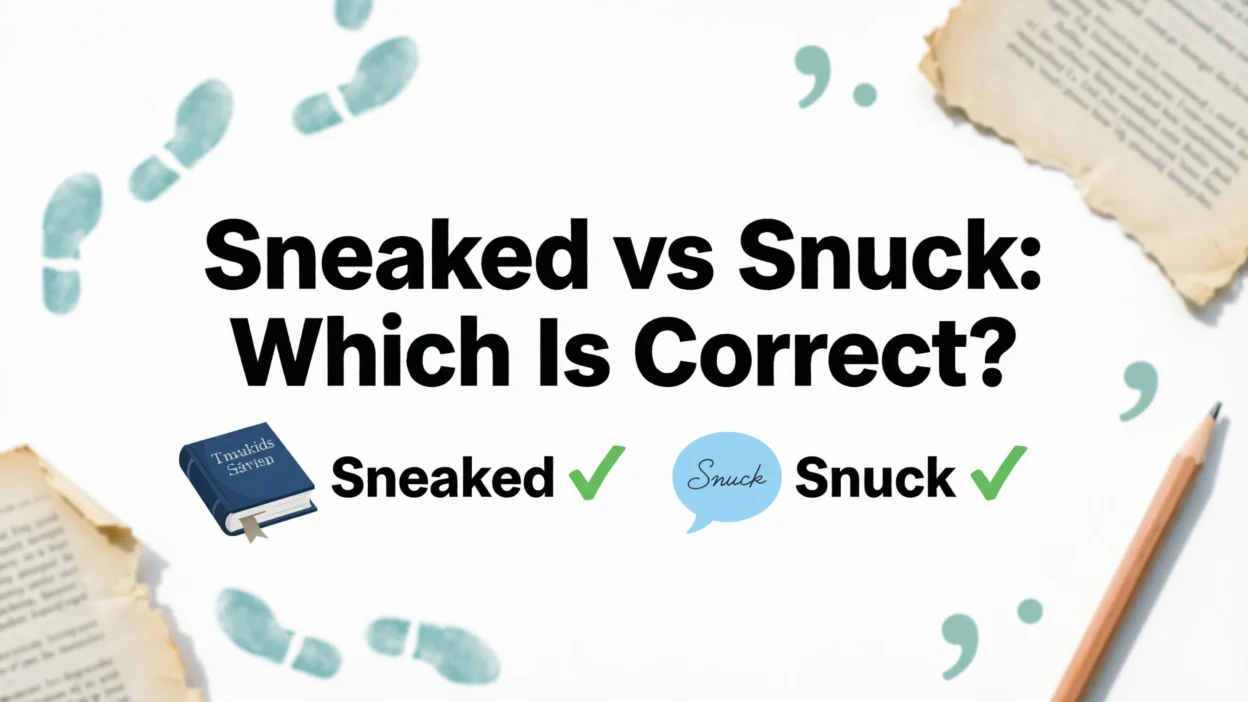
Both sneaked and snuck are correct past tense forms of sneak.
✅ Sneaked – The traditional and more widely accepted past tense and past participle.
✅ Snuck – An accepted alternative, especially common in American English.
American English: Both are correct, but snuck is more common in everyday speech.
British English: Sneaked is generally preferred.
What Do “Sneaked” and “Snuck” Mean?
Both sneaked and snuck are the past tense and past participle of the verb sneak, which means to move quietly or secretly without being noticed.
Examples:
- She sneaked into the room without making a sound.
- He snuck out before anyone noticed.
In both sentences, the meaning is exactly the same. The only difference is the form used.
Why Are “Sneaked” and “Snuck” Both Correct?
Originally, sneaked was the only accepted past tense of sneak. Over time, English speakers began using snuck by analogy with irregular verbs like:
- stick → stuck
- strike → struck
As snuck became more common in everyday speech, dictionaries gradually accepted it as a standard alternative, particularly in North American English.
Today, both forms are grammatically correct.
Examples of “Sneaked” in Sentences
Use sneaked in formal writing or whenever you prefer the traditional form.
Examples:
- She sneaked into the library before it opened.
- The children sneaked cookies before dinner.
- He sneaked a quick look at the answers.
- Someone had sneaked into the building overnight.
- They sneaked away without saying goodbye.
These examples sound natural in both American and British English.
Examples of “Snuck” in Sentences
Snuck is especially common in casual American English.
Examples:
- He snuck out after midnight.
- We snuck backstage before the concert.
- The cat snuck into the garage.
- She had snuck into the office unnoticed.
- They snuck a surprise gift into my suitcase.
These sentences are perfectly acceptable, particularly in American English.
Sneaked vs Snuck Comparison Table
| Feature | Sneaked | Snuck |
|---|---|---|
| Correct spelling | ✅ Yes | ✅ Yes |
| Past tense of “sneak” | ✅ Yes | ✅ Yes |
| Past participle | ✅ Yes | ✅ Yes |
| Traditional form | ✅ Yes | ❌ No |
| More common in American English | ✔️ Common | ✅ Very common |
| Preferred in British English | ✅ Yes | Less common |
| Suitable for formal writing | ✅ Preferred | Acceptable, but less common |
When Should You Use “Sneaked”?
Choose sneaked when:
- Writing academic papers.
- Preparing business documents.
- Writing formal reports.
- Following British English conventions.
- You prefer the traditional form.
Examples:
- The reporter sneaked into the restricted area.
- Someone had sneaked confidential files out of the office.
When Should You Use “Snuck”?
Choose snuck when:
- Writing conversational dialogue.
- Using American English.
- Creating informal blog posts.
- Writing fiction with natural speech.
- Matching everyday spoken language.
Examples:
- My brother snuck into the kitchen for a midnight snack.
- They snuck away before the meeting ended.
Common Mistakes People Make
Although both words are correct, writers sometimes misuse them.
Incorrect:
❌ He sneak into the room yesterday.
Correct:
✅ He sneaked into the room yesterday.
✅ He snuck into the room yesterday.
Incorrect:
❌ She has sneak out already.
Correct:
✅ She has sneaked out already.
✅ She has snuck out already.
Remember that the base verb sneak should not be used when the past tense is required.
Easy Trick to Remember
A simple memory trick can help you choose between the two.
Think of sneaked as the traditional grammar choice. It’s the safest option in formal writing and works well everywhere.
Think of snuck as the casual American choice. You’ll hear it frequently in everyday conversations, movies, TV shows, and novels.
If you’re ever unsure, sneaked is always a safe and widely accepted option.
American vs British English
This is where the biggest difference appears.
American English
Both sneaked and snuck are correct.
However, snuck has become extremely common in everyday speech and informal writing. Many Americans naturally prefer it in conversation.
Examples:
- He snuck into the movie theater.
- She snuck a cookie before dinner.
British English
British English generally prefers sneaked.
Although snuck is understood and occasionally used, it is much less common than in American English.
Example:
- The children sneaked out of the classroom quietly.
If you’re writing for an international audience, sneaked is usually the more neutral choice.
Related Words and LSI Keywords
Including related vocabulary helps reinforce the topic and answers closely related search queries.
Relevant LSI keywords include:
- sneaked meaning
- snuck meaning
- sneak past tense
- sneak past participle
- English grammar
- irregular verbs
- regular verbs
- American English grammar
- British English grammar
- grammar rules
- commonly confused words
- correct verb forms
- English vocabulary
- writing tips
- language learning
These related terms naturally support the topic while improving content relevance.
Why Correct Usage Matters
Using the appropriate past tense helps your writing sound natural and professional.
If you’re writing formal documents, academic papers, or content for an international audience, sneaked is often the preferred choice because it’s traditional and universally accepted.
If you’re writing conversational content aimed at an American audience, snuck can make your writing sound more authentic and natural. Understanding the audience and context helps you choose the most suitable form.
Frequently Asked Questions
Is “snuck” grammatically correct?
Yes. Snuck is a grammatically correct past tense and past participle of sneak, especially in American English.
Is “sneaked” still correct?
Absolutely. Sneaked is the original and traditional past tense of sneak and remains fully correct.
Which is more common in American English?
Snuck is more common in casual American English, although sneaked is also widely accepted.
Which form does British English prefer?
British English generally prefers sneaked, especially in formal writing.
Can I use “snuck” in formal writing?
You can, but sneaked is often the safer choice for academic, legal, or highly formal documents.
Are “sneaked” and “snuck” interchangeable?
Yes. Both express the same meaning, and the choice usually depends on style, audience, and regional preference.
Which should English learners use?
If you’re unsure, use sneaked. It’s accepted worldwide and fits both formal and informal contexts.
Summary
The debate over sneaked vs snuck doesn’t have a single winner because both forms are correct. Sneaked is the traditional past tense of sneak and remains the preferred choice in British English and formal writing. Snuck, on the other hand, has become widely accepted in American English and is especially common in everyday speech and informal writing.
Choosing between them depends on your audience and writing style. If you’re writing for an international or professional audience, sneaked is the safest option. If you’re writing conversational American English, snuck sounds perfectly natural. Understanding this difference will help you write with greater confidence and accuracy.
Actionable Takeaway
Remember this simple rule: Both are correct, but context matters. Use sneaked for formal writing and British English, and choose snuck when writing naturally for an American audience or in informal situations.

Shan Waston is a skilled writer at Symboliy.com, producing clear, engaging content on language, communication, and everyday expressions to help readers understand meaning and usage confidently in modern digital contexts.