
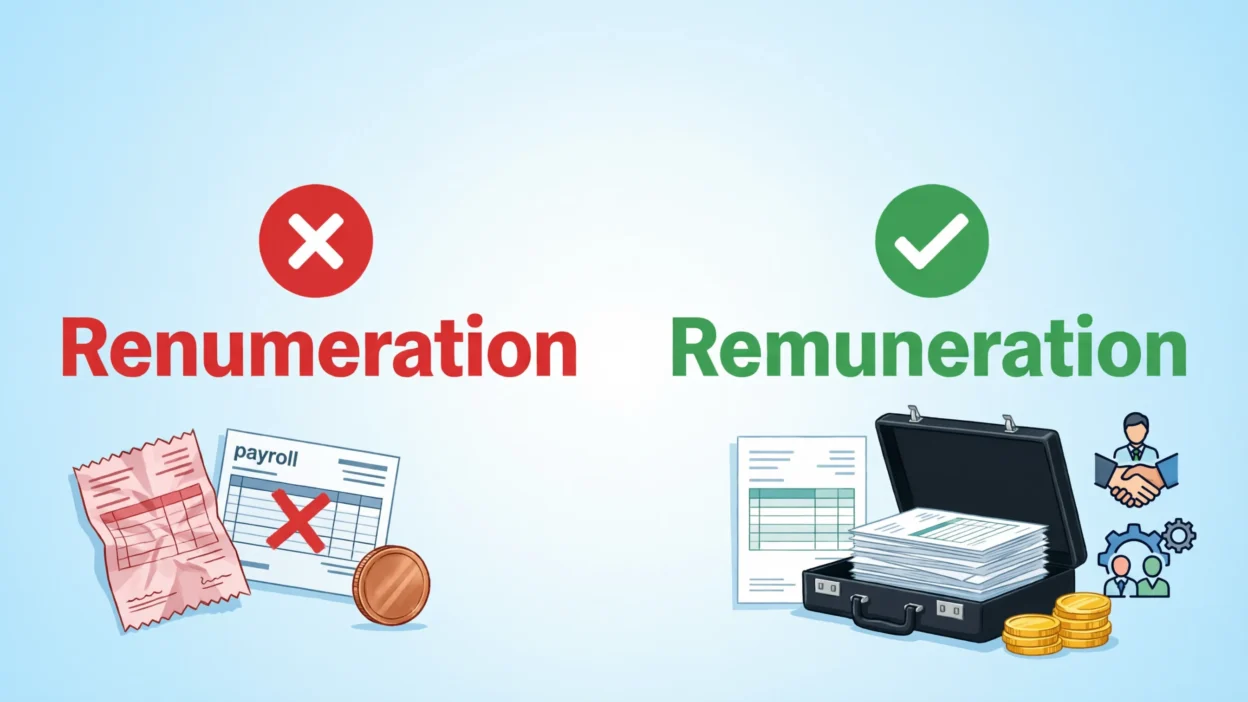
Many people search for renumeration vs remuneration because the two words look almost identical.
However, there’s an important difference: remuneration is the correct English word, while renumeration is usually a spelling mistake.
Confusing these terms is common, especially in business, payroll, and HR-related writing.
In this guide, you’ll learn the difference between renumeration vs remuneration, the correct spelling, meanings, examples, common mistakes, and practical tips to help you use the right word with confidence.
Quick Answer
The difference between renumeration and remuneration is straightforward:
- Remuneration is the correct spelling. It means payment, salary, wages, or compensation for work or services.
- Renumeration is not a standard English word and is generally considered a misspelling of remuneration.
Always use remuneration in professional, academic, and formal writing.
What Does “Remuneration” Mean?
Remuneration is a noun that refers to the money or benefits someone receives in exchange for work or services.
It can include:
- Salary
- Wages
- Bonuses
- Commissions
- Benefits
- Incentives
- Stock options
- Pension contributions
Examples of Remuneration
- The company offers competitive remuneration packages.
- Employees receive annual remuneration reviews.
- Her remuneration includes health insurance and bonuses.
- The contract clearly outlines the remuneration for the consultant.
Common Synonyms of Remuneration
- Compensation
- Salary
- Pay
- Wages
- Income
- Earnings
- Reward
- Fee
- Benefits
What Does “Renumeration” Mean?
In standard English, renumeration has no accepted dictionary meaning.
It is almost always a spelling error caused by accidentally replacing the “mu” sound in remuneration with “nu.”
When people write renumeration, they almost always intend to write remuneration.
Renumeration vs Remuneration Comparison Table
| Feature | Renumeration | Remuneration |
|---|---|---|
| Correct English Word | ❌ No | ✅ Yes |
| Part of Speech | Not recognized | Noun |
| Meaning | Misspelling | Payment or compensation for work |
| Appropriate in Formal Writing | No | Yes |
| Used in Employment Contracts | No | Yes |
Key Differences Between Renumeration and Remuneration
| Renumeration | Remuneration |
|---|---|
| Common spelling mistake | Correct spelling |
| Not accepted in standard dictionaries | Official English vocabulary |
| Should be avoided | Recommended in all professional writing |
| Appears due to typing errors | Used in HR, payroll, finance, and legal documents |
How to Remember the Correct Spelling
A simple trick is to remember that remuneration begins with “remu”, just like “reward” starts with “re.”
Think:
Remuneration = Reward for your work
If you see renumeration, check the spelling—it almost certainly needs to be corrected to remuneration.
Examples in Everyday Situations
Employment
- The company increased employee remuneration this year.
- The job advertisement included details about the remuneration package.
Freelancing
- Freelancers should agree on their remuneration before starting a project.
- The consultant negotiated higher remuneration based on experience.
Business
- Executive remuneration is discussed at the annual board meeting.
- The organization reviews staff remuneration every year.
Human Resources
- HR explained the company’s remuneration policy.
- Employees received updated remuneration statements.
Common Mistakes
Many writers accidentally spell remuneration incorrectly.
Incorrect
- The employee received excellent renumeration.
Correct
- The employee received excellent remuneration.
Incorrect
- The contract specifies the monthly renumeration.
Correct
- The contract specifies the monthly remuneration.
Incorrect
- We discussed executive renumeration.
Correct
- We discussed executive remuneration.
Always proofread business documents to ensure the correct spelling is used.
Grammar Tips
Remuneration is always a noun.
Examples:
- Fair remuneration motivates employees.
- His remuneration exceeds industry standards.
- The company reviewed executive remuneration.
It is commonly used after adjectives such as:
- Competitive remuneration
- Fair remuneration
- Annual remuneration
- Total remuneration
- Executive remuneration
- Financial remuneration
American vs British English
The spelling remuneration is the same in both American English and British English.
However, the word is generally more common in British English, especially in employment contracts, government documents, and corporate policies.
In American English, people often use simpler alternatives such as:
- Pay
- Salary
- Compensation
- Wages
Nevertheless, remuneration is still correct and widely understood in the United States.
When Should You Use Remuneration?
Use remuneration when discussing:
- Employee salaries
- Compensation packages
- Executive pay
- Consultant fees
- Employment contracts
- Payroll policies
- Financial rewards
- Professional services
It is especially appropriate in formal and legal contexts.
Related Words and LSI Keywords
To better understand renumeration vs remuneration, it’s helpful to know related terms:
- compensation
- salary
- wages
- employee benefits
- payroll
- executive pay
- income
- earnings
- financial compensation
- total rewards
- employee compensation
- pay package
- incentive payments
- bonuses
These related terms naturally appear in HR, finance, and business discussions.
Frequently Asked Questions (FAQs)
1. Is renumeration a real word?
No. Renumeration is generally considered a misspelling of remuneration.
2. What does remuneration mean?
Remuneration means payment, salary, wages, or other compensation received for work or services.
3. Why do people write renumeration?
People often confuse the spelling because remuneration is a long word and easy to mistype.
4. Is remuneration formal English?
Yes. It is commonly used in legal, financial, corporate, and HR documents.
5. Can remuneration include benefits?
Yes. Remuneration may include salary, bonuses, commissions, insurance, retirement benefits, and other employee perks.
6. Which spelling should I use on my resume or contract?
Always use remuneration.
7. Is remuneration the same as salary?
Not exactly. Salary is one part of remuneration. Remuneration may also include bonuses, allowances, and benefits.
8. Is remuneration used in both American and British English?
Yes. Both varieties use remuneration, although American English often prefers simpler words like compensation or pay.
Summary
Understanding renumeration vs remuneration is easy once you know that remuneration is the correct English word and renumeration is simply a common misspelling. In professional writing, using the correct spelling is important because it reflects attention to detail and credibility.
Whenever you’re referring to payment, salary, wages, or employee benefits, choose remuneration. Avoid renumeration in resumes, contracts, business emails, academic writing, and official documents to ensure clear and accurate communication.
Actionable Takeaway
If you ever type renumeration, pause and check your spelling. Replace it with remuneration before sending emails, submitting documents, or publishing content. Remember: remuneration is the correct word for compensation or payment for work, while renumeration should be avoided.

Shan Waston is a skilled writer at Symboliy.com, producing clear, engaging content on language, communication, and everyday expressions to help readers understand meaning and usage confidently in modern digital contexts.