Have you ever paused while writing because you couldn’t decide between sole or soul? You’re not alone.
These two words sound exactly the same, making them classic English homophones that often confuse students, writers, and even native speakers. Although their pronunciation is identical, their meanings are completely different.
In this guide, you’ll learn the difference between sole or soul, understand when to use each word, explore real-life examples, avoid common mistakes, and discover easy memory tricks. By the end, you’ll know exactly which word fits your sentence.
Quick Answer
The difference between sole and soul is simple:
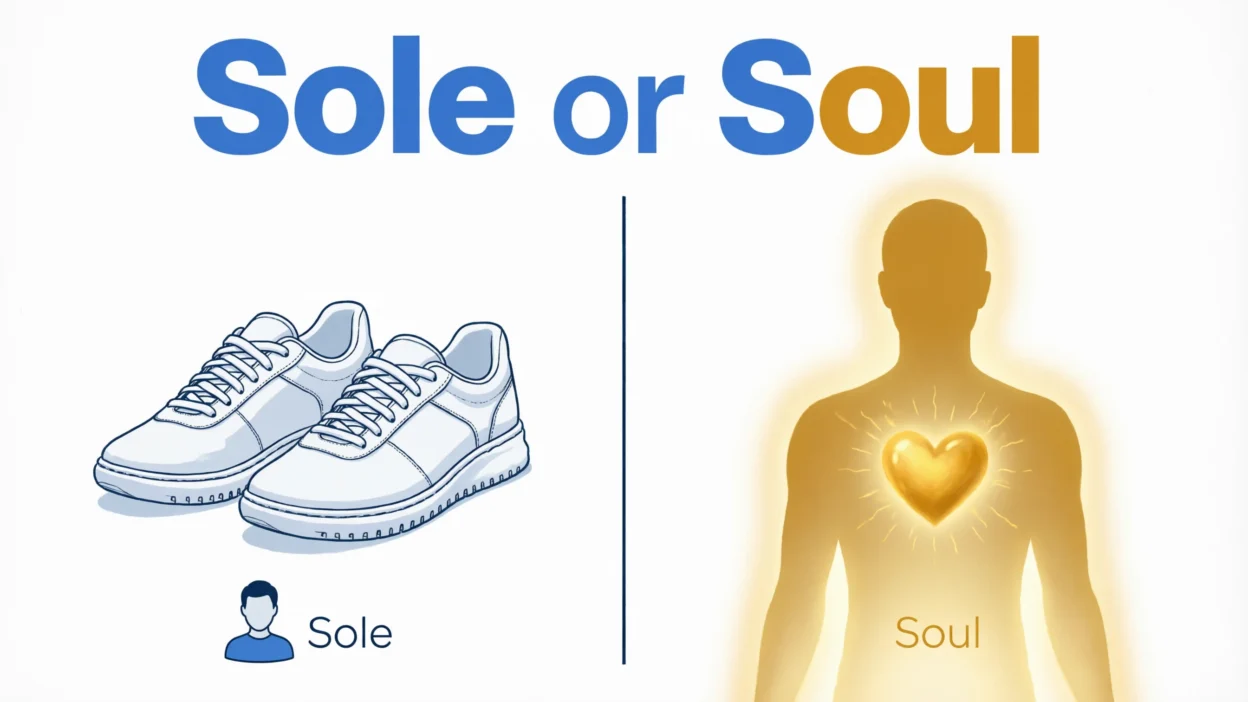
- Sole means only, single, or the bottom of a foot or shoe.
- Soul refers to the spiritual part of a person, or someone’s deepest emotions and character.
In short:
- Sole = Only or Bottom of a Foot/Shoe
- Soul = Spirit or Inner Self
What Does Sole Mean?
Sole has several meanings, but the most common are:
- The only one.
- The bottom part of a foot.
- The bottom of a shoe.
- A type of flatfish (less common in everyday conversation).
It is often used to emphasize uniqueness or exclusivity.
Examples of Sole
- She was the sole winner of the competition.
- He is the sole owner of the company.
- The sole of my shoe is worn out.
- I stepped on a sharp rock with the sole of my foot.
Common Uses of Sole
- Sole proprietor
- Sole responsibility
- Sole owner
- Sole survivor
- Sole purpose
- Sole of the shoe
What Does Soul Mean?
Soul refers to the spiritual or immaterial part of a person. It is often associated with emotions, personality, morality, and religious beliefs.
The word is also used figuratively to describe passion, sincerity, or the essence of something.
Examples of Soul
- She has a kind soul.
- Music feeds my soul.
- Many religions believe the soul lives on after death.
- He poured his heart and soul into the project.
Common Uses of Soul
- Heart and soul
- Lost soul
- Beautiful soul
- Soul searching
- Soul music
- Soul mate
Sole vs Soul: Key Differences
| Feature | Sole | Soul |
|---|---|---|
| Meaning | Only one; bottom of a foot or shoe | Spiritual part of a person |
| Part of Speech | Noun or adjective | Noun |
| Common Context | Ownership, feet, shoes, uniqueness | Religion, emotions, personality |
| Everyday Usage | Very common | Very common |
| Figurative Meaning | Exclusive or only | Inner self or essence |
Simple Way to Remember the Difference
Here’s an easy memory trick:
- Sole is found on your shoe or means the only one.
- Soul relates to your spirit or heart.
Remember:
- Sole = Shoe or Only
- Soul = Spirit
Real-Life Examples of Sole vs Soul
Example 1: Business
- She is the sole owner of the company.
Not:
- She is the soul owner of the company.
Example 2: Spirituality
- Many people believe the soul is eternal.
Not:
- Many people believe the sole is eternal.
Example 3: Footwear
- The sole of my boot needs replacing.
Example 4: Expression
- He put his heart and soul into writing the novel.
Common Mistakes People Make
Because sole and soul are pronounced exactly the same, writers often choose the wrong spelling.
Here are some common mistakes:
- Writing soul owner instead of sole owner.
- Using sole mate instead of soul mate.
- Confusing the sole of a shoe with the soul of a person.
- Relying on pronunciation instead of context.
Incorrect
- She is the soul proprietor.
Correct
- She is the sole proprietor.
Incorrect
- The soul of my shoe is damaged.
Correct
- The sole of my shoe is damaged.
American vs British English
There is no difference between American English and British English in the meanings of sole and soul.
Both varieties use:
- Sole to mean “only” or the bottom of a foot or shoe.
- Soul to refer to the spiritual or emotional part of a person.
The spellings and meanings remain the same in both forms of English.
Related LSI Keywords and Synonyms
Using related terms naturally helps improve understanding and supports SEO.
Relevant keywords include:
- sole meaning
- soul meaning
- sole definition
- soul definition
- sole vs soul
- only one
- sole proprietor
- sole owner
- soul mate
- heart and soul
- spiritual meaning
- confusing English words
- English homophones
- spelling differences
- common grammar mistakes
When Should You Use Each Word?
Use sole when talking about:
- The only one
- Ownership
- Responsibility
- The bottom of a foot
- The bottom of a shoe
- Business terms like sole proprietor
Use soul when talking about:
- Spiritual beliefs
- Emotions
- Character
- Love and relationships
- Religion
- Music and creativity
Why Are Sole and Soul So Often Confused?
Sole and soul are homophones, meaning they sound exactly alike but have different spellings and meanings. Since spoken English doesn’t distinguish between them, many writers accidentally choose the wrong word.
The best way to avoid confusion is to think about the context. If you’re referring to something unique, ownership, or the bottom of a shoe or foot, use sole. If you’re discussing spirituality, emotions, or someone’s inner being, use soul.
Frequently Asked Questions
1. What is the difference between sole and soul?
Sole means “only” or the bottom of a foot or shoe, while soul refers to the spiritual or emotional part of a person.
2. Is it “sole owner” or “soul owner”?
The correct phrase is sole owner because it means the only owner.
3. Is it “soul mate” or “sole mate”?
The correct expression is soul mate, referring to a person with whom you share a deep emotional or spiritual connection.
4. Can sole be used as an adjective?
Yes. Sole often functions as an adjective meaning “only” or “single.”
5. Is soul always related to religion?
No. While soul is commonly used in religious contexts, it can also describe emotions, personality, creativity, or the essence of a person.
6. Are sole and soul pronounced the same?
Yes. They are perfect homophones and have identical pronunciation.
7. How can I remember the difference?
Think of Sole = Shoe or Only and Soul = Spirit or Heart. This simple association makes choosing the correct spelling much easier.
Summary
Understanding sole or soul is simple once you focus on the meaning rather than the pronunciation. Sole refers to being the only one or the bottom of a foot or shoe, while soul represents a person’s spirit, emotions, or inner self. Although the words sound identical, they are used in completely different contexts and should never be interchanged.
Using the correct word makes your writing clearer and more professional. Whether you’re describing a sole proprietor, the sole of a shoe, or someone’s beautiful soul, choosing the right spelling ensures your message is accurate and easy to understand.
Actionable Takeaway
Whenever you’re unsure which word to use, remember this simple rule:
- Sole = Only or Bottom of a Shoe
- Soul = Spirit or Inner Self
Keeping this distinction in mind will help you avoid one of the most common homophone mistakes in English.

Shan Waston is a skilled writer at Symboliy.com, producing clear, engaging content on language, communication, and everyday expressions to help readers understand meaning and usage confidently in modern digital contexts.