Have you ever wondered whether you should use immigrated or migrated? These two words are closely related and often appear in discussions about people, animals, work, and relocation.
Because both involve moving from one place to another, many English learners use them interchangeably. However, they have distinct meanings and are used in different contexts.
In this guide, you’ll learn the difference between immigrated vs migrated, understand when to use each term, explore real-life examples, avoid common mistakes, and discover easy memory tricks. By the end, you’ll know exactly which word fits your sentence.
Quick Answer
The difference between immigrated and migrated is simple:
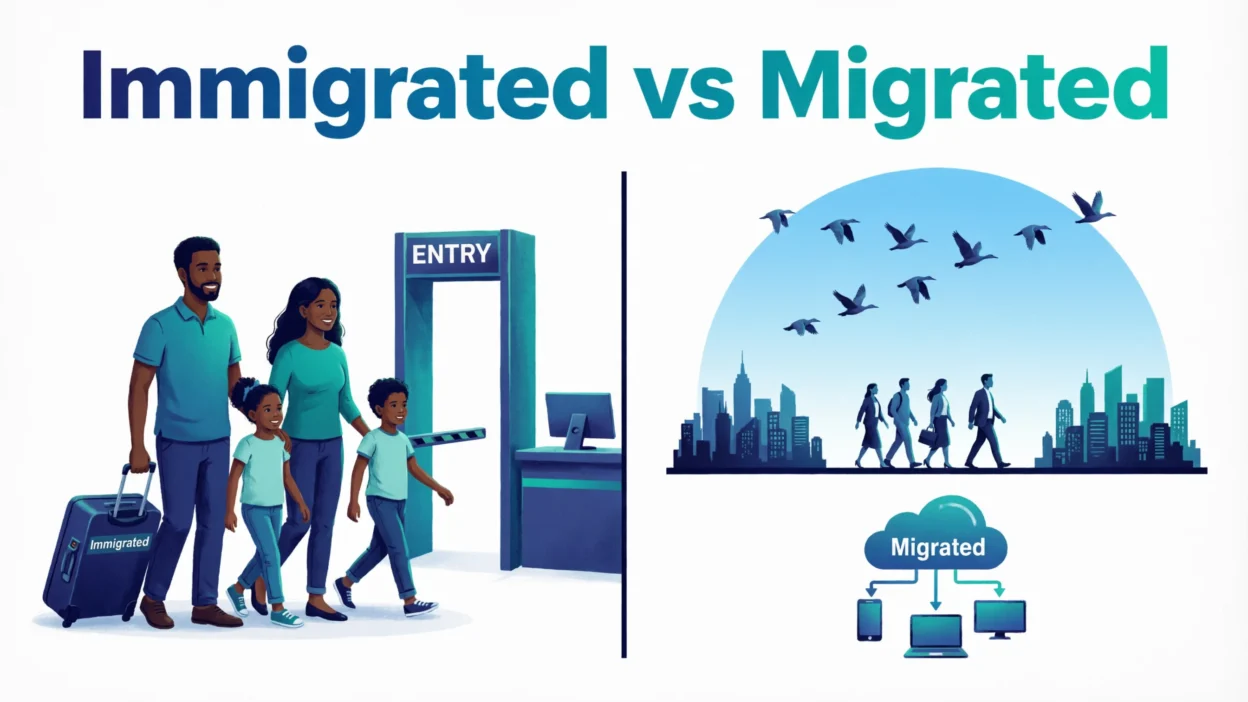
- Immigrated means entered another country to live there permanently or for a long period.
- Migrated means moved from one place to another, either temporarily or permanently, and can refer to people, animals, birds, or even data and technology.
In short:
- Immigrated = Moved into another country
- Migrated = Moved from one place to another
What Does Immigrated Mean?
Immigrated is the past tense of immigrate, which means to enter a foreign country with the intention of living there permanently or for an extended period.
The focus is always on arriving in a new country.
Examples of Immigrated
- Her family immigrated to Canada in 2015.
- Thousands of people immigrated to the United States during the 20th century.
- He immigrated to Australia for better career opportunities.
- They immigrated after receiving permanent residency.
Common Uses of Immigrated
- Immigrated to Canada
- Immigrated to the United States
- Immigrated legally
- Recently immigrated
- Family immigrated abroad
What Does Migrated Mean?
Migrated is the past tense of migrate, which means moving from one place to another.
Unlike immigrated, migrated is much broader and can refer to:
- People moving for work or lifestyle
- Birds and animals following seasonal patterns
- Computer data moving between systems
- Businesses relocating
- Populations moving within the same country
Examples of Migrated
- Many birds migrated south for the winter.
- The company migrated its data to the cloud.
- Thousands of workers migrated to major cities.
- Early humans migrated across continents.
Common Uses of Migrated
- Migrated to another region
- Migrated for work
- Migrated south
- Data migrated successfully
- Seasonal migration
Immigrated vs Migrated: Key Differences
| Feature | Immigrated | Migrated |
|---|---|---|
| Meaning | Entered another country to live | Moved from one place to another |
| Focus | Arrival in a new country | Movement between places |
| Used for People | Yes | Yes |
| Used for Animals | No | Yes |
| Used for Technology | No | Yes |
| Used for Internal Movement | No | Yes |
| Immigration Context | Yes | Sometimes |
Simple Way to Remember the Difference
A quick memory trick can help:
- Immigrated starts with “Im,” which you can associate with “into” a country.
- Migrated simply means moved, regardless of destination.
Remember:
- Immigrated = Into a New Country
- Migrated = Moved Anywhere
Real-Life Examples of Immigrated vs Migrated
Example 1: Moving to Another Country
- She immigrated to Germany after graduating.
Not:
- She migrated to Germany. (Possible, but less specific when discussing immigration.)
Example 2: Birds
- The birds migrated north in spring.
Not:
- The birds immigrated north.
Example 3: Technology
- The company migrated its website to a new server.
Not:
- The company immigrated its website.
Example 4: Internal Movement
- Many families migrated from rural areas to cities.
Using immigrated would not be correct because the movement happened within the same country.
Common Mistakes People Make
Since both words involve movement, they are often confused.
Here are the most common mistakes:
- Using immigrated for animals.
- Using immigrated for moving within the same country.
- Using immigrated when referring to data or technology.
- Forgetting that immigrated focuses on entering a new country.
Incorrect
- The birds immigrated south for winter.
Correct
- The birds migrated south for winter.
Incorrect
- The company immigrated its database.
Correct
- The company migrated its database.
American vs British English
There is no significant difference between American English and British English in the meanings of immigrated and migrated.
Both varieties use:
- Immigrated for entering another country to live.
- Migrated for movement of people, animals, technology, or populations.
The spellings and meanings remain the same in both forms of English.
Related LSI Keywords and Synonyms
Using related terms naturally helps improve understanding and supports SEO.
Relevant keywords include:
- immigrated meaning
- migrated meaning
- immigrated vs migrated
- immigration definition
- migration definition
- immigrant vs migrant
- internal migration
- international migration
- seasonal migration
- human migration
- bird migration
- migration patterns
- move to another country
- immigration terminology
- English vocabulary differences
When Should You Use Each Word?
Use immigrated when talking about:
- Moving into another country
- Permanent relocation abroad
- Immigration
- Citizenship
- Residency
- International relocation
Use migrated when talking about:
- Birds and animals
- Internal movement
- Human populations
- Seasonal travel
- Computer systems
- Business relocation
- Data transfer
Why Are Immigrated and Migrated So Often Confused?
These words are often confused because immigration is a type of migration. Every person who immigrates has migrated, but not every person who migrates has immigrated. For example, someone who moves from one state to another has migrated but has not immigrated because they did not enter a new country.
The easiest way to choose the correct word is to ask yourself whether the movement involves entering a different country. If it does, immigrated is usually the right choice. If the movement could involve regions, cities, animals, or technology, migrated is generally the better term.
Frequently Asked Questions
1. What is the difference between immigrated and migrated?
Immigrated means entering another country to live there, while migrated means moving from one place to another for any reason.
2. Can animals immigrate?
No. Animals migrate, but they do not immigrate.
3. Is immigration a type of migration?
Yes. Immigration is a specific form of migration that involves entering a foreign country to live.
4. Can people migrate within the same country?
Yes. Moving from one city or state to another is called migration, not immigration.
5. Is “migrated to Canada” correct?
Yes, it is grammatically correct. However, immigrated to Canada is more precise when referring to someone who moved there to live permanently.
6. Can computers or data immigrate?
No. Data, software, and systems are migrated, not immigrated.
7. How can I remember the difference?
Think of Immigrated = Into a new country and Migrated = Moved anywhere. This simple rule makes the distinction easy to remember.
Summary
Understanding immigrated vs migrated becomes much easier once you recognize the scope of each word. Immigrated specifically refers to entering another country to live permanently or for a long period, while migrated is a broader term that describes movement from one place to another, whether it involves people, animals, populations, businesses, or technology.
Choosing the correct word improves the accuracy of your writing and communication. Whenever you’re discussing someone moving into a new country, use immigrated. For broader movement—including internal relocation, wildlife, or data transfers—migrated is the appropriate choice.
Actionable Takeaway
Whenever you’re unsure which word to use, remember this simple rule:
- Immigrated = Entered a New Country
- Migrated = Moved from One Place to Another
Keeping this distinction in mind will help you use both words correctly in everyday English, academic writing, and professional communication.

Here is a professional 30-word author biography including your site name Symboliy.com:
Martin Hood is a professional writer at Symboliy.com, creating clear, informative content focused on language, communication, and meaningful expressions for everyday and professional use.