Have you ever seen the words gummy and gummie and wondered which one is correct? This question is surprisingly common, especially with the growing popularity of gummy candies, gummy vitamins, and dietary supplements.
Since both spellings appear online, many people become confused about which version is accepted in standard English.
The good news is that the answer is straightforward. In this guide, you’ll learn the correct spelling, meanings, examples, common mistakes, usage differences, and practical tips to help you use the right word confidently in everyday writing.
Quick Answer
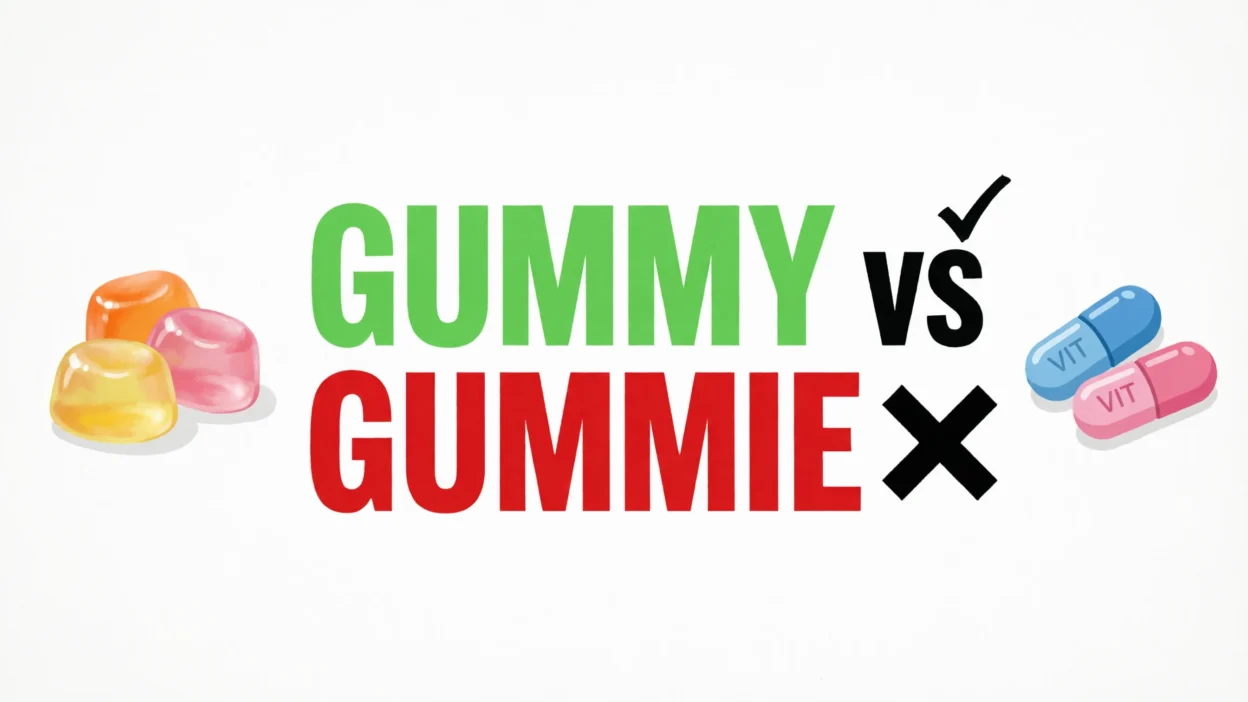
Gummy is the standard and correct English spelling.
Gummie is generally considered a nonstandard spelling, a variant used in some brand names, usernames, or informal contexts, but it is not the preferred dictionary spelling.
✔ Correct: I took a gummy vitamin this morning.
✔ Correct: The candy has a soft, gummy texture.
✘ Usually Incorrect: I took a gummie vitamin this morning.
What Does “Gummy” Mean?
The word gummy is an adjective and noun commonly used to describe something that has a soft, chewy, or gum-like texture.
It is most often associated with candies, vitamins, supplements, and certain food textures.
Common Definitions of Gummy
- Soft and chewy like gum
- Sticky or elastic in texture
- A gummy candy or supplement
- Something containing a gelatin-like consistency
Examples
- These gummy bears are my favorite snack.
- I take a gummy multivitamin every day.
- The rice became gummy after overcooking.
- The candy has a pleasantly gummy texture.
- Many adults prefer gummy supplements over tablets.
Is “Gummie” a Real Word?
Gummie occasionally appears online, but it is not the standard dictionary spelling.
In most situations, writers, publishers, educators, and businesses use gummy instead.
Why People Use Gummie
Common reasons include:
- Alternative spelling preferences
- Brand names or product names
- Social media usernames
- Typing habits
- Informal online communication
For standard English writing, gummy is the preferred choice.
Gummy vs Gummie: Key Differences
| Feature | Gummy | Gummie |
|---|---|---|
| Standard English Spelling | Yes | No |
| Found in Major Dictionaries | Yes | Rarely |
| Common in Professional Writing | Yes | No |
| Accepted in Academic Writing | Yes | No |
| Used for Candy and Vitamins | Yes | Sometimes |
| Recommended for SEO Content | Yes | No |
The table clearly shows that gummy is the standard spelling for most writing situations.
Different Uses of the Word “Gummy”
The word gummy appears in several contexts.
1. Gummy Candy
This is the most common use.
Examples:
- Gummy bears
- Gummy worms
- Gummy rings
- Fruit gummies
2. Gummy Vitamins
Many health supplements now come in gummy form.
Examples:
- Gummy multivitamins
- Gummy probiotics
- Gummy melatonin supplements
- Children’s gummy vitamins
3. Food Texture
The word can describe food that has become sticky or overly chewy.
Examples:
- Gummy rice
- Gummy pasta
- Gummy bread
4. Dental Usage
In some contexts, gummy may refer to gums.
Examples:
- Gummy smile
- Gummy appearance of the gums
Common Mistakes People Make with Gummy
Because both spellings appear online, confusion is understandable.
Mistake #1: Using Gummie in Formal Writing
Incorrect:
- I purchased gummie vitamins.
Preferred:
- I purchased gummy vitamins.
Mistake #2: Assuming Both Spellings Are Equally Accepted
While both may appear online, gummy is overwhelmingly preferred in standard English.
Mistake #3: Following Brand Spellings
Some brands intentionally use unusual spellings for marketing purposes. That doesn’t necessarily make them standard English.
Mistake #4: Using Gummie for SEO Content
Most search engines and readers recognize gummy as the primary spelling.
How to Remember the Correct Spelling
A simple trick can help.
Think of familiar products:
- Gummy bears
- Gummy vitamins
- Gummy candy
Notice that major product categories almost always use gummy.
Memory Tip
Remember:
“Gummy candy uses a Y.”
This simple phrase makes the correct spelling easy to recall.
Synonyms and Related Terms
Depending on the context, several related words can be used.
For Texture
- Chewy
- Sticky
- Soft
- Elastic
- Gelatinous
For Candy
- Jelly candy
- Fruit chew
- Soft candy
- Gel candy
- Chewable treat
Related Terms
- Gummies
- Gelatin
- Chewy candy
- Supplement chew
- Soft confectionery
Using related terms can improve readability and keyword relevance.
American vs British English Differences
There is generally no spelling difference between American English and British English.
American English
- Gummy bears
- Gummy vitamins
- Gummy candy
British English
- Gummy sweets
- Gummy vitamins
- Gummy confectionery
Both varieties primarily use the spelling gummy.
Why Understanding the Correct Spelling Matters
Choosing the correct spelling offers several benefits.
Improved Professionalism
Correct spelling makes your writing look polished and credible.
Better SEO Results
Search engines recognize gummy as the dominant keyword.
Enhanced Reader Trust
Readers expect standard spelling in professional content.
Stronger Academic Writing
Schools and universities typically prefer dictionary-standard spellings.
Clearer Communication
Using common spelling avoids confusion.
Practical Examples in Sentences
Food and Candy
- The gummy bears were soft and flavorful.
- My children love gummy worms.
Health and Wellness
- She takes gummy vitamins every morning.
- Many adults prefer gummy supplements.
Cooking
- The pasta became gummy after being overcooked.
- Excess moisture can make bread gummy.
Dental Context
- The dentist discussed treatment for a gummy smile.
- Some people are concerned about excessive gum visibility.
FAQs
1. Is gummy or gummie correct?
Gummy is the standard and preferred English spelling.
2. What does gummy mean?
Gummy refers to something soft, chewy, sticky, or gum-like in texture.
3. Is gummie a dictionary word?
It is generally not recognized as the standard spelling in major dictionaries.
4. Why do some people use gummie?
Some brands, usernames, and informal online communities use alternative spellings.
5. Are gummy vitamins spelled with a Y or IE?
The standard spelling is gummy vitamins with a Y.
6. Is gummy used in both American and British English?
Yes. Both varieties of English primarily use gummy.
7. Can gummie ever be correct?
It may appear in brand names or informal contexts, but it is not the standard English spelling.
8. Which spelling is better for SEO?
Gummy is generally the better choice because it matches common search behavior and standard usage.
Summary
The debate between gummy and gummie is easy to resolve. Gummy is the standard English spelling used in dictionaries, professional writing, product descriptions, health supplements, and everyday communication. While gummie may occasionally appear in informal contexts or branding, it is not the preferred spelling for standard English.
Whether you’re writing about gummy bears, gummy vitamins, gummy supplements, or gummy textures, using gummy will help ensure clarity, professionalism, and consistency. Sticking to the dictionary-approved form also improves readability and SEO performance.
Actionable Takeaway
Whenever you’re unsure which spelling to use, choose gummy. It’s the recognized standard in both American and British English, making it the safest and most professional option for blogs, articles, academic writing, marketing content, and everyday communication.

Shan Waston is a skilled writer at Symboliy.com, producing clear, engaging content on language, communication, and everyday expressions to help readers understand meaning and usage confidently in modern digital contexts.