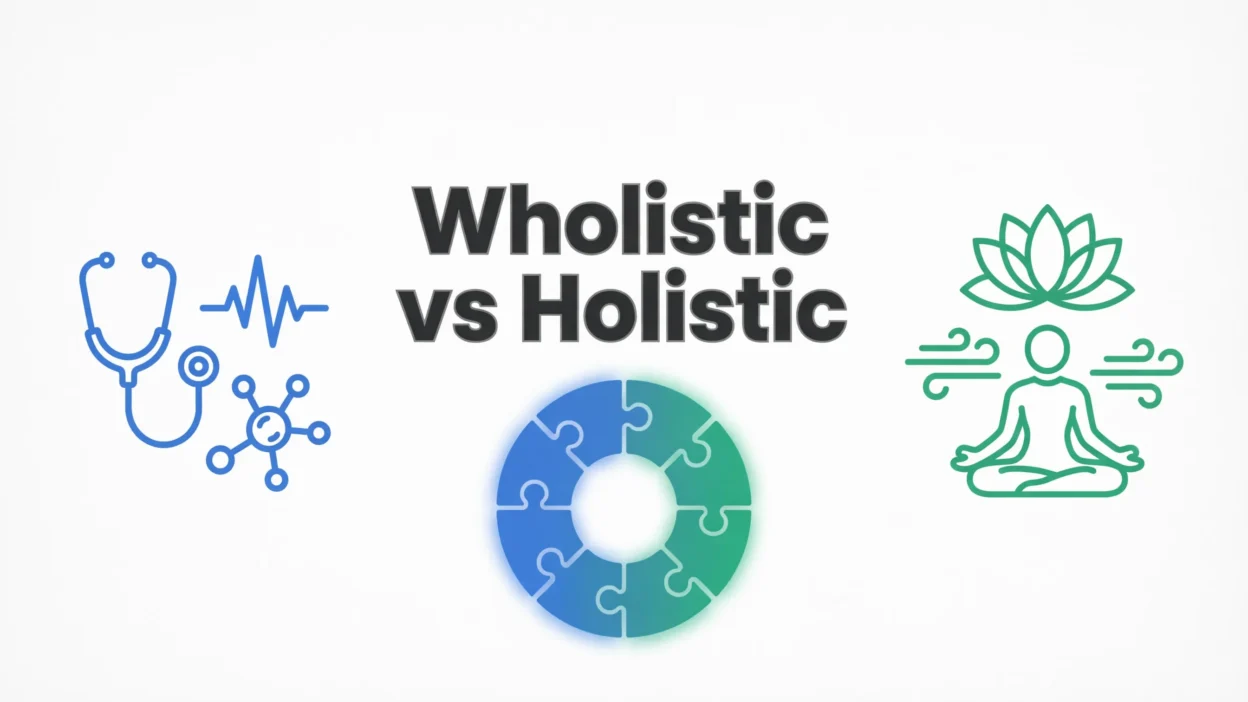
If you’ve come across the terms wholistic and holistic, you may have wondered whether they mean different things or if one spelling is simply a variation of the other.
These words frequently appear in discussions about health, wellness, education, personal development, and business strategies, making the confusion even more common.
The good news is that both wholistic and holistic are used in English, but one spelling is far more widely accepted and recognized.
Understanding the distinction can help you communicate more clearly, write more professionally, and choose the right term for your audience.
In this guide, we’ll break down wholistic vs holistic, explain their meanings, provide examples, highlight common mistakes, and explore American and British English usage.
Quick Answer
Holistic is the standard and widely accepted spelling in both American and British English. Wholistic is considered a variant spelling that emphasizes the concept of “whole” but carries the same meaning. In most professional, academic, and everyday writing, holistic is the preferred choice.
What Does “Holistic” Mean?
Holistic describes an approach that considers the whole person, system, or situation rather than focusing only on individual parts.
The term is commonly used in:
- Healthcare
- Wellness
- Education
- Psychology
- Business management
- Personal development
A holistic approach looks at how different elements interact and influence one another.
Examples
- The doctor recommended a holistic treatment plan.
- A holistic education focuses on intellectual, emotional, and social growth.
- The company adopted a holistic strategy for long-term success.
- Holistic wellness includes physical and mental health.
- We need a holistic view of the problem before making a decision.
What Does “Wholistic” Mean?
Wholistic generally means the same thing as holistic. The spelling emerged because some people felt that the word should visually reflect the concept of “whole.”
While wholistic is used by certain wellness practitioners, coaches, and organizations, it is much less common than holistic.
Examples
- She follows a wholistic lifestyle.
- The clinic promotes wholistic healing practices.
- Their program takes a wholistic approach to wellness.
In most cases, readers interpret wholistic and holistic as having the same meaning.
Wholistic vs Holistic: Key Differences
The primary difference is spelling and frequency of use rather than meaning.
| Feature | Wholistic | Holistic |
|---|---|---|
| Meaning | Whole-person or whole-system approach | Whole-person or whole-system approach |
| Popularity | Less common | Much more common |
| Dictionary Recognition | Recognized variant | Standard spelling |
| Academic Usage | Rare | Common |
| Professional Writing | Less preferred | Preferred |
| Everyday Recognition | Moderate | High |
For most situations, holistic is the recommended spelling.
Which Spelling Is Correct?
Both spellings are understood, but holistic is considered the standard form.
Most dictionaries, universities, medical institutions, publishers, and professional organizations use holistic.
Use “Holistic” When:
- Writing blog posts
- Publishing articles
- Creating academic content
- Writing professional documents
- Communicating with a broad audience
Use “Wholistic” When:
- Following a brand’s preferred terminology
- Referring to an organization that uses the spelling
- Emphasizing the concept of wholeness
- Matching existing content style
For general writing, holistic is usually the safest choice.
Why Do People Confuse Wholistic and Holistic?
The confusion exists because both words share the same meaning and pronunciation.
Similar Pronunciation
Both are typically pronounced as:
hoh-LIS-tik
Because they sound nearly identical, readers often assume both spellings are equally common.
Emphasis on “Whole”
Some writers prefer wholistic because they feel it better reflects the idea of treating the entire person or system as a whole.
Industry Preferences
Certain wellness communities, alternative medicine practitioners, and coaching programs intentionally use wholistic for branding purposes.
American vs British English Differences
Unlike words such as color/colour or center/centre, there is no major regional difference between wholistic and holistic.
American English
In American English:
- Holistic is overwhelmingly preferred.
- Academic and medical institutions use holistic.
- Most publications follow the holistic spelling.
Examples:
- Holistic healthcare
- Holistic wellness
- Holistic education
British English
In British English:
- Holistic is also the dominant spelling.
- Professional and academic writing favors holistic.
- Wholistic appears occasionally but remains uncommon.
Examples:
- Holistic therapy
- Holistic learning
- Holistic treatment
In both regions, holistic is the standard choice.
Common Situations Where Holistic Is Used
Healthcare
Healthcare professionals often use holistic approaches to address physical, mental, and emotional well-being.
Example:
- The clinic offers holistic patient care.
Wellness and Alternative Medicine
Many wellness programs focus on holistic healing.
Example:
- Holistic wellness includes nutrition, exercise, and stress management.
Education
Educators may adopt holistic teaching methods.
Example:
- The school promotes holistic development.
Business and Leadership
Organizations use holistic strategies to improve performance.
Example:
- Management adopted a holistic view of company growth.
Common Mistakes to Avoid
Mistake 1: Assuming Wholistic and Holistic Have Different Meanings
In most contexts, they mean the same thing.
Incorrect:
- Wholistic and holistic are completely different concepts.
Correct:
- They generally refer to the same approach.
Mistake 2: Using Wholistic in Academic Writing Without Checking Style Guidelines
Most academic institutions prefer holistic.
Mistake 3: Mixing Spellings in the Same Article
Incorrect:
- Holistic health is important.
- Many wholistic practitioners agree.
Better:
- Choose one spelling and remain consistent.
Mistake 4: Assuming Wholistic Is the Standard Form
While accepted as a variant, holistic remains the dominant and preferred spelling.
Synonyms and Related Terms
Depending on the context, these related words may be useful:
- Comprehensive
- Integrated
- Whole-person
- Balanced
- Unified
- System-wide
- Inclusive
- Multidimensional
- All-encompassing
- Interconnected
These terms often appear alongside discussions of holistic approaches.
When Should You Use Holistic?
Choose holistic when:
- Writing for a general audience
- Publishing online content
- Creating academic materials
- Writing professional documents
- Following standard English conventions
Because it is the most familiar spelling, readers immediately recognize it.
When Should You Use Wholistic?
Choose wholistic when:
- Following a brand’s preferred language
- Referring to a specific organization
- Maintaining consistency with existing materials
- Deliberately emphasizing the concept of wholeness
Outside these situations, holistic is generally preferred.
FAQs About Wholistic vs Holistic
Is wholistic a real word?
Yes. Wholistic is a recognized variant spelling of holistic, though it is less common.
Which spelling is correct, wholistic or holistic?
Both are understood, but holistic is the standard and preferred spelling.
Do wholistic and holistic mean the same thing?
Yes. In most contexts, they have the same meaning.
Why do some people use wholistic?
Some people believe it better emphasizes the concept of treating the whole person or system.
Is holistic more professional?
Yes. Holistic is more widely accepted in professional, academic, and medical writing.
Is wholistic used in healthcare?
It can be, particularly by certain wellness practitioners, but holistic remains more common.
Is there a difference in pronunciation?
No. Both words are generally pronounced the same way.
Should writers use wholistic or holistic?
Most writers should use holistic because it is more recognizable and widely accepted.
Summary
When comparing wholistic vs holistic, the key difference lies in spelling rather than meaning. Both terms describe an approach that considers the whole person, system, or situation rather than focusing on individual parts. However, holistic is the standard spelling and is far more common in professional, academic, healthcare, and everyday communication.
Although wholistic is recognized as a variant spelling and may be preferred by certain organizations or practitioners, most writers will benefit from using holistic. It is more familiar to readers, aligns with standard English usage, and helps ensure clarity across different audiences.
Actionable Takeaway
If you’re writing for a general audience, choose holistic. Reserve wholistic only when following a specific brand preference or style guide. Consistency is important, so select one spelling and use it throughout your content.

Shan Waston is a skilled writer at Symboliy.com, producing clear, engaging content on language, communication, and everyday expressions to help readers understand meaning and usage confidently in modern digital contexts.