Have you ever wondered whether you should use continually or continuously in your writing?
Although these two words are often treated as synonyms, they do not always mean the same thing. Using the correct word can make your writing clearer, more professional, and grammatically accurate.
In this guide, you’ll learn the exact difference between continually vs continuously, discover practical examples, avoid common mistakes, and understand when each word fits naturally. By the end, you’ll confidently choose the right word in any situation.
Quick Answer
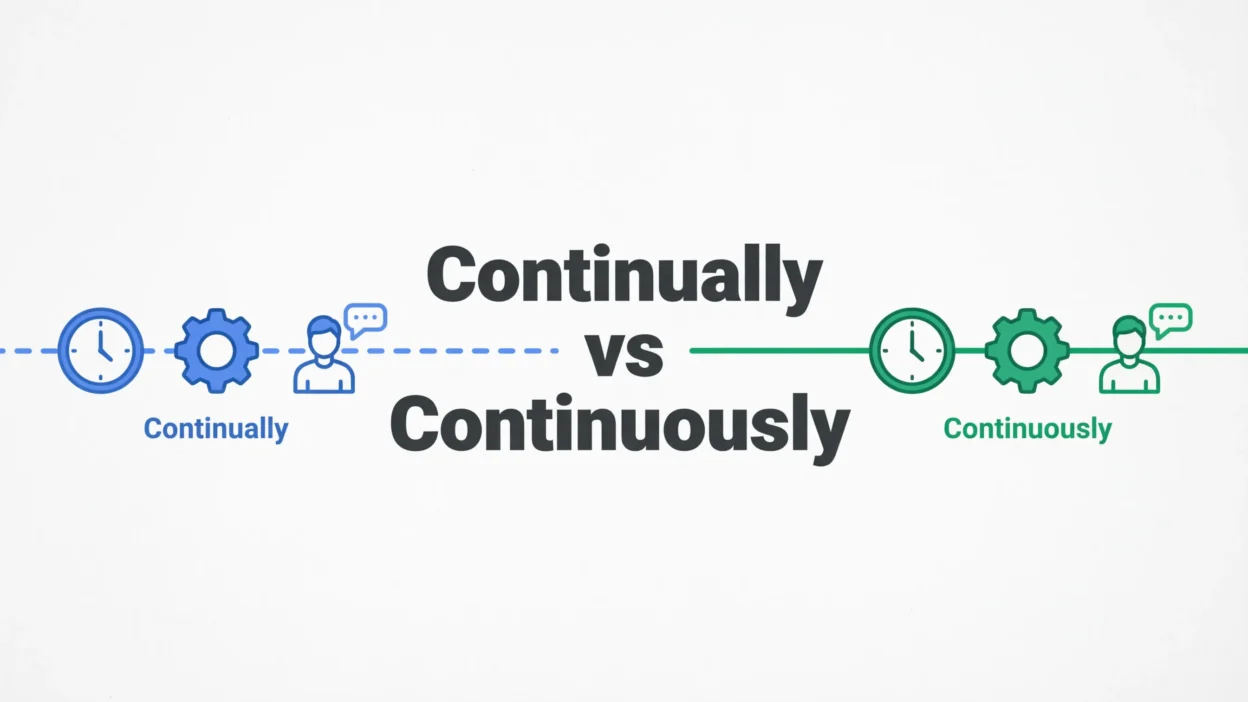
The main difference between continually and continuously is this:
- Continually means something happens repeatedly with breaks or interruptions.
- Continuously means something happens without stopping or any interruption.
Example:
- The baby cried continually throughout the night. (The crying stopped and started several times.)
- The machine ran continuously for 24 hours. (It never stopped.)
Understanding this small distinction helps make your writing more precise.
What Does Continually Mean?
Continually describes an action that happens again and again but includes pauses between occurrences.
Think of it as repeated but interrupted.
Examples
- She continually checked her phone during the meeting.
- It continually rained throughout the week, with short breaks.
- The teacher continually reminded students about the deadline.
- My dog continually barks whenever someone walks past the house.
In each example, the action happens many times but not without stopping.
When to Use Continually
Use continually when:
- An action repeats frequently.
- There are pauses between events.
- You want to emphasize repetition rather than nonstop activity.
LSI Keywords:
- repeatedly
- again and again
- frequently
- regularly
- over and over
What Does Continuously Mean?
Continuously refers to an action that happens without any interruption.
Think of it as constant and nonstop.
Examples
- The river flowed continuously.
- The security cameras record continuously.
- The engine operated continuously for ten hours.
- Oxygen is supplied continuously in the hospital.
Here, the action never stops.
When to Use Continuously
Choose continuously when:
- There are no breaks.
- Something remains constant.
- The process never stops.
Related Keywords:
- constantly
- nonstop
- uninterrupted
- ongoing
- without interruption
Continually vs Continuously: Comparison Table
| Feature | Continually | Continuously |
|---|---|---|
| Meaning | Happens repeatedly | Happens without stopping |
| Interruptions | Yes | No |
| Focus | Frequent repetition | Constant action |
| Best Used For | Human actions, reminders, interruptions | Machines, natural processes, continuous movement |
| Example | She continually interrupted him. | The fan ran continuously. |
Easy Examples to Remember
Continually
- He continually forgot his keys.
- Customers continually asked the same question.
- The child continually interrupted the conversation.
- My phone continually receives notifications.
Continuously
- The clock ticks continuously.
- The internet connection remained continuously active.
- Water flowed continuously through the pipe.
- The heart beats continuously throughout life.
Common Mistakes People Make
Many writers use these words interchangeably, but doing so can slightly change the meaning.
Mistake 1
❌ The printer printed continually for five hours.
✅ The printer printed continuously for five hours.
Since the printer never stopped, continuously is correct.
Mistake 2
❌ She continuously asked the same question.
✅ She continually asked the same question.
She paused between asking the question, making continually the better choice.
Mistake 3
Assuming both words always mean “constantly.”
Although they’re similar, continually emphasizes repeated occurrences, while continuously emphasizes uninterrupted duration.
Memory Trick
A simple trick can help you remember the difference.
- Continually = Comes back again and again.
- Continuously = Continues without stopping.
If something could pause and then happen again, choose continually.
If it never pauses, choose continuously.
Continually vs Continuously in Everyday Writing
At Work
- Employees continually attend training sessions.
- The production line runs continuously.
At School
- Students continually ask questions.
- The projector remained continuously on.
At Home
- My neighbor continually plays loud music.
- The refrigerator runs continuously.
In Technology
- Software updates continually improve security.
- Servers operate continuously.
American vs British English
When it comes to continually vs continuously, there is no significant difference between American English and British English.
Both varieties use the words with the same meanings:
- Continually = repeatedly with interruptions.
- Continuously = without interruption.
The distinction is based on meaning rather than regional spelling or grammar.
Why Choosing the Right Word Matters
Using the correct word improves:
- Clarity
- Professional writing
- Academic accuracy
- Business communication
- SEO content quality
For example:
Instead of saying:
The alarm rang continuously.
Ask yourself:
Did it ring nonstop?
Or did it ring, stop, and ring again?
Choosing the correct word removes ambiguity.
Related Words and Synonyms
Continually Synonyms
- Frequently
- Repeatedly
- Regularly
- Often
- Again and again
Continuously Synonyms
- Constantly
- Nonstop
- Uninterruptedly
- Persistently
- Without interruption
Remember that synonyms may not perfectly match every context, so always consider the intended meaning.
Frequently Asked Questions
1. What is the difference between continually and continuously?
Continually means repeatedly with breaks, while continuously means without any interruption.
2. Can continually and continuously be used interchangeably?
Sometimes, but not always. In precise writing, they have different meanings and should be chosen carefully.
3. Which word is more common?
Continuously is common in technical, scientific, and engineering contexts, while continually appears more often in everyday conversations involving repeated actions.
4. Is continually the same as constantly?
Not exactly. Constantly can sometimes mean either repeated or uninterrupted, depending on context, whereas continually specifically suggests repeated actions with pauses.
5. Which word should I use for machines?
If a machine never stops operating, use continuously.
Example:
- The conveyor belt moved continuously.
6. Which word describes repeated interruptions?
Use continually.
Example:
- He continually interrupted the speaker.
7. Is continuously more formal?
No. Both words are equally formal. The correct choice depends entirely on the meaning you want to express.
Summary
Understanding continually vs continuously is easier once you focus on one key idea: continually describes actions that happen repeatedly with pauses, while continuously describes actions that never stop. Although many people use them interchangeably in casual speech, choosing the correct word makes your writing clearer, more accurate, and more professional.
Whenever you’re unsure, ask yourself whether the action includes interruptions. If it does, use continually. If it happens without any break, choose continuously. This simple habit will improve your grammar, strengthen your communication, and help you write with greater confidence.
Actionable Takeaway
Before using continually or continuously, picture the action in your mind. If it starts and stops, write continually. If it keeps going without interruption, write continuously. Practicing this distinction in everyday writing will quickly make the correct choice feel natural.

Here is a professional 30-word author biography including your site name Symboliy.com:
Martin Hood is a professional writer at Symboliy.com, creating clear, informative content focused on language, communication, and meaningful expressions for everyday and professional use.