
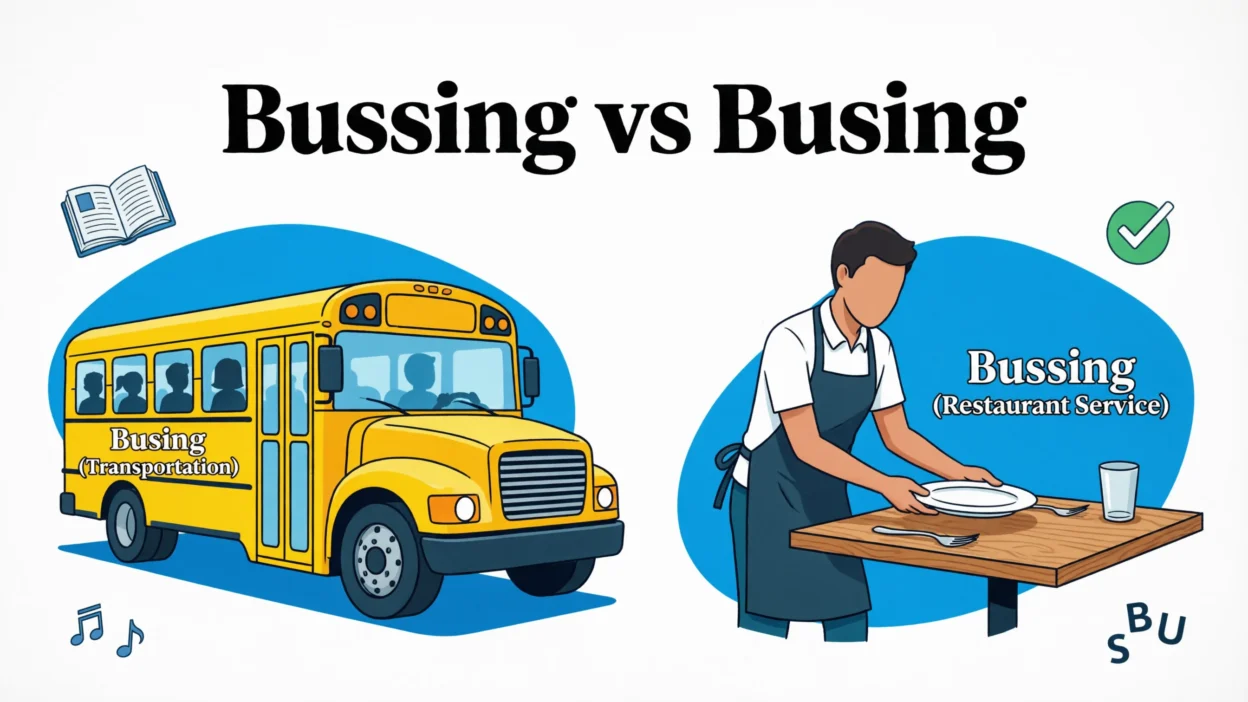
If you’ve ever wondered whether bussing or busing is the correct spelling, you’re not alone. These two spellings often confuse writers, students, editors, and even native English speakers.
At first glance, they seem interchangeable, but the difference depends on context, regional spelling preferences, and the meaning you want to express.
In this guide, you’ll learn the difference between bussing vs busing, discover when each spelling is appropriate, see practical examples, avoid common mistakes, and understand how American and British English treat these words. By the end, you’ll know exactly which spelling to use with confidence.
Quick Answer
Busing is the preferred spelling in American English when referring to transporting people by bus, such as school children or passengers.
Bussing is commonly used when referring to clearing tables in restaurants (busing tables) and is also accepted as a spelling of the verb bus. Many style guides and dictionaries recognize both spellings, but busing is generally more common for transportation, while bussing helps avoid confusion with the word using in restaurant-related contexts.
What Does “Bus” Mean?
The word bus can function as both a noun and a verb.
As a noun, it refers to a vehicle designed to transport multiple passengers.
Examples:
- We took the bus to school.
- The city bus arrived on time.
As a verb, to bus has two primary meanings:
- To transport people by bus.
- To remove dirty dishes from restaurant tables.
Because the verb has two different meanings, spelling variations have developed over time to improve clarity.
Bussing vs Busing: The Main Difference
Although both spellings come from the same verb, they are often used differently.
| Feature | Busing | Bussing |
|---|---|---|
| Transporting passengers | Preferred | Less common but acceptable |
| Clearing restaurant tables | Less common | Preferred |
| American English | Standard for transportation | Common in restaurant industry |
| British English | Less frequently used | Also accepted depending on context |
| Dictionary acceptance | Yes | Yes |
In everyday writing, busing usually refers to transportation, while bussing often refers to restaurant work.
What Is Busing?
Busing means transporting people by bus from one place to another.
It is commonly used in:
- School transportation
- Public transportation
- Employee shuttle services
- Educational policies involving school busing
Examples of Busing
- The district began busing students across town.
- The company is busing employees to the event.
- The city improved its busing system.
- Parents supported the new busing program.
These examples clearly involve transportation rather than restaurant work.
What Is Bussing?
Bussing most often refers to clearing dishes, glasses, and utensils from restaurant tables after customers finish eating.
A person who performs this task is commonly called a busser.
Examples of Bussing
- She spent the evening bussing tables.
- The restaurant hired two employees for bussing duties.
- He was bussing tables before becoming a server.
- Efficient bussing keeps restaurants clean and organized.
This spelling immediately signals the restaurant-related meaning.
Why Are There Two Spellings?
English spelling often evolves for clarity and pronunciation.
When forming verbs ending in -ing, words sometimes double the final consonant.
For example:
- Run → Running
- Sit → Sitting
- Hop → Hopping
However, bus is a special case.
Many dictionaries accept both:
- Busing
- Bussing
The spelling bussing became especially popular in the restaurant industry because it clearly distinguishes the word from using, which looks very similar to busing during quick reading.
American English vs British English
Regional English influences which spelling appears more often.
American English
American English generally prefers:
- Busing for transportation.
- Bussing for restaurant table clearing.
Examples:
- School busing remains a public policy issue.
- She is bussing tables tonight.
British English
British English uses the verb bus less frequently than American English.
Instead, writers often choose alternatives like:
- travelling by bus
- transported by bus
- taking the bus
When the verb does appear, both busing and bussing may be found depending on the publisher’s style guide.
Examples in Everyday Sentences
Busing Examples
- The school is busing children to a nearby campus.
- The company is busing guests to the conference.
- They started busing workers every morning.
- The city expanded its busing routes.
Bussing Examples
- He worked weekends bussing tables.
- She’s responsible for bussing dirty dishes.
- The restaurant improved its bussing procedures.
- Students often begin by bussing tables before becoming servers.
Common Mistakes to Avoid
Many writers accidentally use the wrong spelling because both words look correct.
Avoid these common errors:
- Using bussing when discussing school transportation in formal American writing.
- Using busing when describing restaurant table clearing if clarity matters.
- Assuming one spelling is completely incorrect.
- Confusing busing with using during proofreading.
- Ignoring your audience’s regional spelling preference.
Choosing the correct spelling makes your writing clearer and more professional.
Which Spelling Should You Use?
The best choice depends on your topic.
Use busing when discussing:
- School transportation
- Public transit
- Bus routes
- Passenger transportation
- Educational policies
Use bussing when discussing:
- Restaurant jobs
- Clearing tables
- Hospitality work
- Dining service
- Food service operations
Consistency is also important. Once you choose a spelling, use it throughout your document unless the meaning changes.
Related Words and LSI Keywords
Using related terms helps readers understand the topic while improving SEO naturally.
Relevant related keywords include:
- bus vs buss
- busing meaning
- bussing meaning
- school busing
- bussing tables
- transportation by bus
- restaurant busser
- busser duties
- English spelling differences
- American English spelling
- British English spelling
- grammar guide
- spelling rules
- verb forms
- bus transportation
These naturally support the primary keyword without unnecessary repetition.
When Style Guides Matter
Professional editors often follow a specific style guide.
Some publications consistently use busing for transportation because it aligns with dictionary recommendations.
Restaurants, hospitality companies, and job postings frequently prefer bussing because it instantly communicates the hospitality meaning.
If you’re writing for school, work, or publication, follow the organization’s preferred style for consistency.
FAQs
Is busing or bussing correct?
Both are correct. Busing is usually preferred for transportation, while bussing is commonly used for clearing restaurant tables.
Why is bussing spelled with two “s” letters?
Doubling the “s” helps distinguish restaurant-related bussing from the word using, making the intended meaning easier to recognize.
What does bussing tables mean?
It means removing used dishes, glasses, and utensils from restaurant tables after customers finish eating.
Is school busing spelled with one or two “s” letters?
In American English, school busing with one “s” is the standard spelling.
Which spelling is more common in American English?
American English generally uses busing for transportation and bussing for restaurant service.
Does British English prefer bussing or busing?
British English often avoids using the verb altogether, favoring phrases like travel by bus or transport by bus, although both spellings can appear.
Is a busser the same as a waiter?
No. A busser clears tables and assists servers, while a waiter primarily takes orders and serves food.
Summary
Understanding bussing vs busing is easier once you know the context. Both spellings are accepted, but they are commonly associated with different meanings. Busing is the preferred choice for transporting passengers, particularly in American English, while bussing is widely used in the restaurant industry to describe clearing tables and supporting dining service.
When choosing between the two, think about your audience and the subject you’re writing about. Using the appropriate spelling improves clarity, maintains professionalism, and ensures your message is immediately understood. Whether you’re writing about schools, public transportation, or restaurant operations, selecting the correct form will make your writing more accurate and polished.
Actionable Takeaway
Whenever you write about transporting people by bus, choose busing. When writing about restaurant table clearing, choose bussing for maximum clarity. If you’re following a publication or workplace style guide, stay consistent with its preferred spelling throughout your content.

Here is a professional 30-word author biography including your site name Symboliy.com:
Martin Hood is a professional writer at Symboliy.com, creating clear, informative content focused on language, communication, and meaningful expressions for everyday and professional use.