Have you ever paused while writing and wondered whether you should use ensure or insure? You’re not alone. These two words sound almost identical, and many people use them interchangeably.
However, they have different meanings, and using the wrong one can change the meaning of your sentence.
In this guide, you’ll learn the difference between ensure vs insure, when to use each word, practical examples, common mistakes to avoid, and whether American and British English treat these words differently. By the end, you’ll know exactly which word fits your sentence with confidence.
Quick Answer
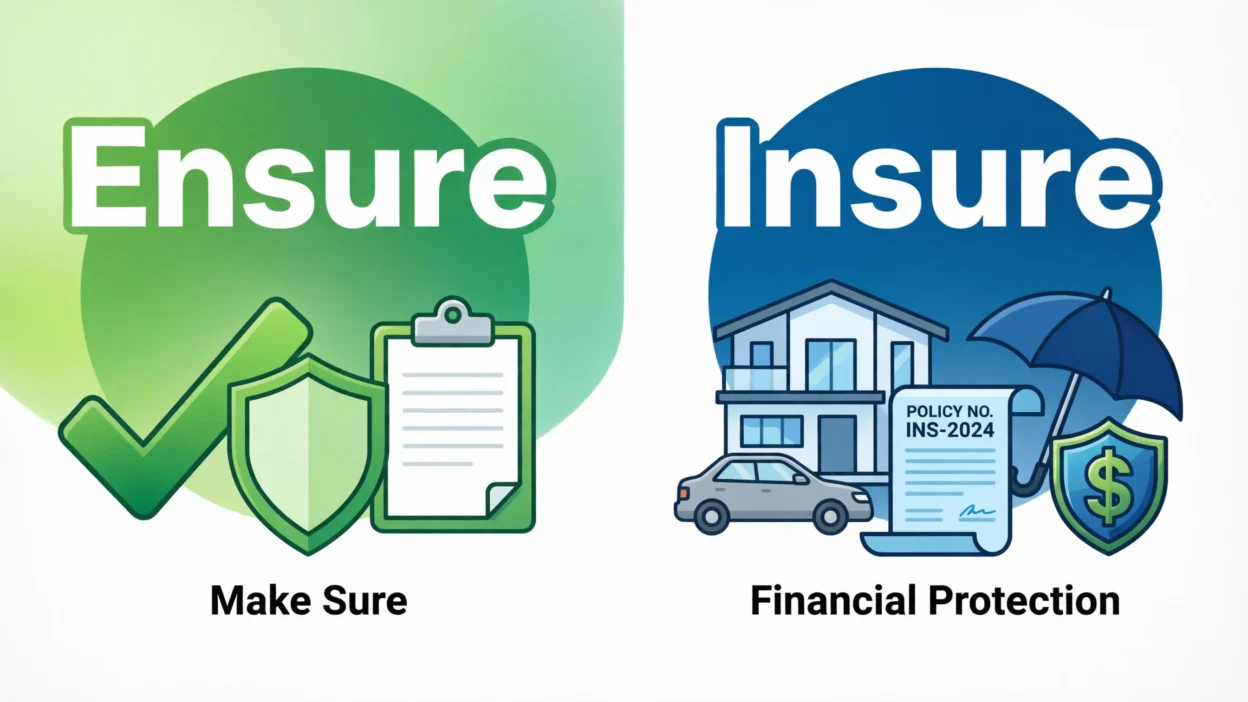
The difference between ensure and insure is simple:
- Ensure means to make certain that something happens or to guarantee a result.
- Insure means to protect someone or something with an insurance policy against financial loss.
Example:
- I checked the doors to ensure everyone’s safety.
- We insured our house against fire damage.
If you’re talking about making something certain, use ensure. If you’re talking about insurance coverage, use insure.
What Does Ensure Mean?
The verb ensure means to make sure, guarantee, or make certain that something will happen.
It focuses on achieving a desired outcome rather than financial protection.
Examples of Ensure
- Please double-check your application to ensure there are no mistakes.
- Drinking enough water helps ensure good health.
- We arrived early to ensure we got the best seats.
- Regular maintenance helps ensure your car runs smoothly.
- Teachers work hard to ensure every student understands the lesson.
Common Synonyms of Ensure
- Guarantee
- Make certain
- Secure
- Confirm
- Assure (in some contexts)
What Does Insure Mean?
Insure means to provide insurance coverage for a person, property, vehicle, business, or other valuable asset against possible financial loss.
It is commonly used in financial, legal, and insurance-related situations.
Examples of Insure
- We decided to insure our new car.
- The company insured the building against earthquakes.
- You should insure expensive electronics.
- Many homeowners insure their homes against flooding.
- Travelers often insure their trips before flying abroad.
Common Synonyms of Insure
- Cover
- Protect financially
- Provide insurance
- Underwrite
Ensure vs Insure: Key Differences
| Feature | Ensure | Insure |
|---|---|---|
| Meaning | Make certain or guarantee | Provide insurance coverage |
| Purpose | Achieve a desired result | Protect against financial loss |
| Used For | Actions, outcomes, safety, success | Cars, homes, health, businesses, travel |
| Example | Ensure everyone is informed. | Insure your vehicle before driving. |
The easiest way to remember the difference is this:
- Ensure = Make sure
- Insure = Buy insurance
Ensure vs Insure in Sentences
Here are more real-life examples.
Using Ensure
- Good planning will ensure success.
- Seat belts help ensure passenger safety.
- Follow the instructions carefully to ensure accurate results.
- We updated the software to ensure better security.
- Exercise regularly to ensure long-term health.
Using Insure
- The museum decided to insure the artwork.
- Farmers often insure their crops.
- Businesses insure their equipment.
- Always insure valuable jewelry.
- They insured the shipment before transport.
Common Mistakes People Make
Many English learners and even native speakers confuse these words because they sound similar.
Here are the most common mistakes.
Incorrect
- Please insure that everyone receives the email.
Correct
- Please ensure that everyone receives the email.
Reason: You’re making certain everyone gets the email—not buying insurance.
Incorrect
- We need to ensure our new house.
Correct
- We need to insure our new house.
Reason: A house receives insurance coverage.
Incorrect
- The company insured customer satisfaction.
Correct
- The company ensured customer satisfaction.
Customer satisfaction cannot be insured financially.
Easy Trick to Remember Ensure vs Insure
A simple memory trick makes these words easy to remember.
Ensure = Sure
Both words contain the idea of making something sure.
Insure = Insurance
Both words begin with ins, making it easy to connect them with insurance.
Whenever you see insurance, think insure.
Whenever you mean “make certain,” think ensure.
American vs British English
There is a small difference between American and British English.
American English
In American English:
- Ensure usually means make certain.
- Insure refers specifically to insurance coverage.
This distinction is widely followed in formal writing.
British English
In British English:
- Ensure is commonly used for making certain.
- Insure is generally used for insurance.
- Some older British texts may occasionally use insure to mean ensure, but modern style guides recommend keeping the meanings separate for clarity.
Therefore, regardless of whether you’re writing in American or British English, using ensure for certainty and insure for insurance is considered the clearest choice.
Related Words You Should Know
Learning these related terms can improve your vocabulary.
Assure
Assure means to remove someone’s doubt or give confidence.
Example:
- I assure you everything will be fine.
Ensure
Focuses on making something happen.
Example:
- Careful planning ensures success.
Insure
Focuses on financial protection.
Example:
- We insured our business.
Remember:
- Assure = Person
- Ensure = Result
- Insure = Insurance
Tips for Using Ensure and Insure Correctly
Keep these tips in mind whenever you’re writing.
- Use ensure when talking about certainty.
- Use insure when discussing insurance policies.
- Replace ensure with “make sure.” If the sentence still makes sense, ensure is correct.
- If money, property, or financial protection is involved, use insure.
- Proofread business documents carefully because these words can change the intended meaning.
Frequently Asked Questions (FAQs)
Is ensure the same as insure?
No. Ensure means to make something certain, while insure means to provide insurance protection against financial loss.
Can I use insure instead of ensure?
In modern English, especially in formal writing, it is best not to. Use ensure for certainty and insure only for insurance.
Which is more common in everyday writing?
Ensure appears more often because people frequently talk about making sure something happens. Insure mainly appears in financial and insurance contexts.
What is the difference between assure, ensure, and insure?
- Assure gives confidence to a person.
- Ensure guarantees a result.
- Insure provides insurance coverage.
Is insure only related to insurance?
Yes. In modern English, insure is primarily used for insurance policies and financial protection.
Which word should I use in academic writing?
Use ensure when discussing certainty, procedures, or outcomes. Reserve insure for insurance-related topics.
Is “ensure safety” correct?
Yes. “Ensure safety” means to make certain that people remain safe.
Is “insure safety” correct?
Usually no. Unless you’re discussing an insurance policy related to safety or liability, the correct phrase is ensure safety.
Summary
Understanding the difference between ensure vs insure is easier than it first appears. Ensure means to make certain something happens, while insure refers to protecting people or property through an insurance policy. Although the words sound alike, they serve very different purposes in writing and everyday communication.
Choosing the correct word improves clarity, strengthens your grammar, and makes your writing more professional. Whenever you’re unsure, remember this simple rule: ensure = make sure, and insure = insurance. With regular practice and attention to context, you’ll use both words accurately and confidently.
Actionable Takeaway
Before using either word, ask yourself one question:
“Am I talking about making something certain or about insurance coverage?”
- If you’re making something certain, choose ensure.
- If you’re talking about financial protection or an insurance policy, choose insure.
This one habit will help you avoid one of the most common English vocabulary mistakes.

Here is a professional 30-word author biography including your site name Symboliy.com:
Martin Hood is a professional writer at Symboliy.com, creating clear, informative content focused on language, communication, and meaningful expressions for everyday and professional use.