The difference between hung vs hanged is one of the most commonly misunderstood grammar rules in English.
Since both words are past forms of the verb hang, many people assume they can be used interchangeably.
However, each word has a specific meaning, and using the wrong one can make your writing sound incorrect or even unintentionally insensitive.
In this guide, you’ll learn the difference between hung vs hanged, understand when each word should be used, see real-life examples, avoid common mistakes, and discover an easy memory trick.
Whether you’re writing an essay, a blog post, or everyday emails, this article will help you use these words correctly and confidently.
Quick Answer
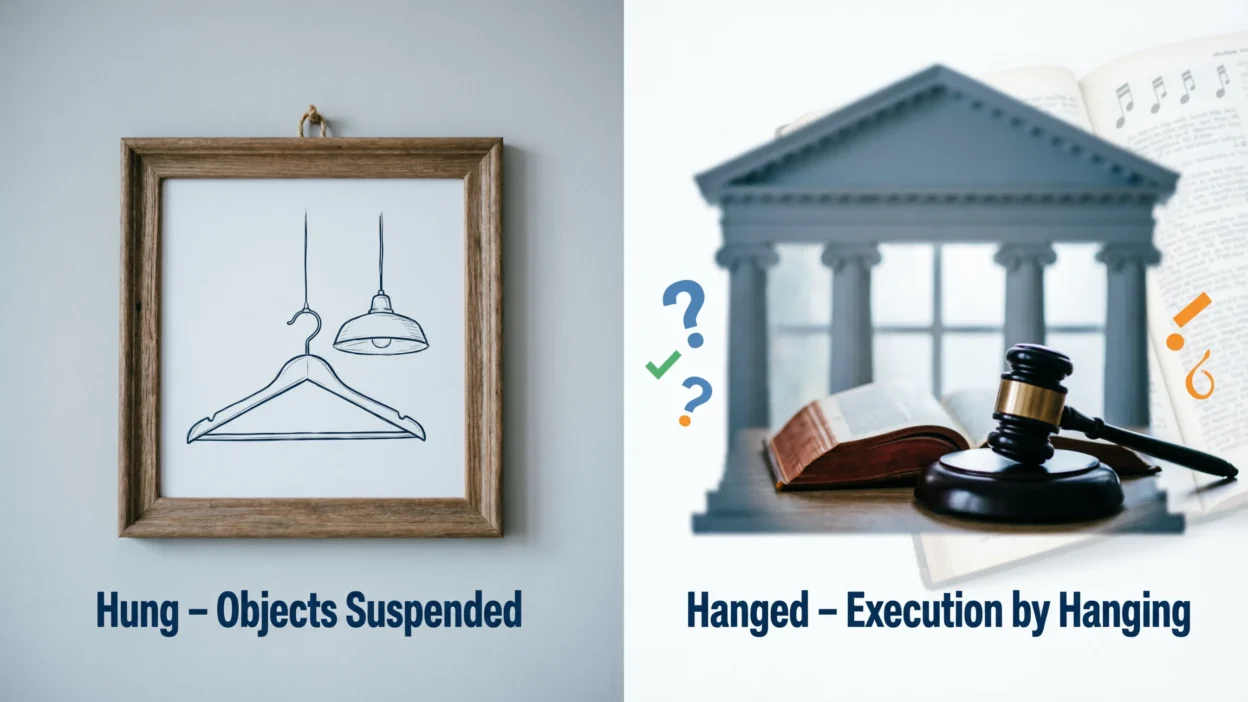
Hung is the correct past tense and past participle of hang when referring to placing or suspending objects, such as pictures, clothes, decorations, or curtains.
Hanged is used only when referring to execution by hanging or, in rare legal or historical contexts, death by hanging.
In short:
- Hung = Objects or things suspended.
- Hanged = A person executed by hanging.
What Does “Hung” Mean?
Hung is the standard past tense and past participle of hang in almost every everyday situation.
Use hung whenever you’re talking about placing, attaching, or suspending something.
It commonly refers to:
- Pictures
- Clothes
- Curtains
- Decorations
- Signs
- Artwork
- Lights
Examples of Hung
- She hung the family photo on the wall.
- We hung colorful lights around the garden.
- He hung his jacket in the closet.
- They hung new curtains in the living room.
- The painting was hung above the fireplace.
In all of these examples, hung refers to objects being suspended.
What Does “Hanged” Mean?
Hanged is a special past tense used only when referring to execution by hanging.
It appears mainly in:
- History books
- Legal writing
- Historical fiction
- Discussions of capital punishment
Examples of Hanged
- The prisoner was hanged in the nineteenth century.
- Several people were hanged after the trial.
- The criminal was hanged for treason under the old law.
Because this word is associated with capital punishment, it should not be used for ordinary situations involving objects.
Hung vs Hanged: The Main Difference
Although both words come from the verb hang, they are used in different contexts.
| Feature | Hung | Hanged |
|---|---|---|
| Meaning | Suspended or attached | Executed by hanging |
| Used for Objects | Yes | No |
| Used for People | Sometimes (if simply suspended, not executed) | Only for execution |
| Everyday Usage | Very common | Rare |
| Historical or Legal Context | Usually no | Yes |
The key difference is that hung is used for almost everything, while hanged is reserved for executions.
When to Use “Hung”
Use hung whenever the meaning involves placing or suspending something.
Common situations include:
- Hanging clothes
- Hanging artwork
- Hanging decorations
- Hanging curtains
- Hanging signs
- Hanging lights
More Examples of Hung
- She hung her backpack on the hook.
- We hung Christmas ornaments on the tree.
- The chef hung the pans neatly in the kitchen.
- A beautiful painting hung in the hallway.
These are all everyday uses of the verb hang.
When to Use “Hanged”
Use hanged only when referring to judicial or historical execution by hanging.
Examples include:
- Historical executions
- Court rulings involving capital punishment
- Legal records
- Historical novels
More Examples of Hanged
- The convicted pirate was hanged in 1724.
- The law stated that convicted traitors could be hanged.
- According to historical records, he was hanged after the verdict.
Outside these contexts, hanged is almost never appropriate.
American vs British English
There is no significant difference between American and British English in the use of hung and hanged.
Both varieties follow the same rule:
- Hung for objects and general use.
- Hanged only for executions.
Examples:
- American English: She hung the picture yesterday.
- British English: She hung the picture yesterday.
- American English: The prisoner was hanged.
- British English: The prisoner was hanged.
The distinction is consistent across both forms of English.
Common Mistakes to Avoid
Many learners use hanged whenever they see the verb hang, but that’s incorrect in most situations.
Avoid these common mistakes:
- Writing “I hanged my coat.”
- Saying “She hanged the picture.”
- Using hanged for decorations or clothing.
- Assuming hung is incorrect because hang is an irregular verb.
- Forgetting that hanged is limited to executions.
Correct:
- We hung the mirror in the bedroom.
Incorrect:
- We hanged the mirror in the bedroom.
Easy Memory Trick
A simple memory trick can help you remember the difference.
- Hung = Home (think of things hanging around your home, like pictures and curtains).
- Hanged = Human Execution (used only when referring to execution by hanging).
Another easy reminder:
- Objects are hung.
- People executed are hanged.
This rule works in almost every situation.
Related Terms and LSI Keywords
Using related vocabulary naturally improves understanding and SEO.
Relevant LSI keywords include:
- hung meaning
- hanged meaning
- hang past tense
- hang past participle
- grammar rules
- confusing English words
- English verb forms
- irregular verbs
- hung vs hanged examples
- English grammar guide
- common grammar mistakes
- past tense of hang
- writing tips
- correct English usage
- verb usage
These related terms strengthen the topic while supporting the primary keyword naturally.
Why Context Is Important
The meaning of your sentence determines which word is correct.
- She hung the painting in the dining room. ✔️
- She hanged the painting in the dining room. ❌
Likewise:
- The prisoner was hanged after the trial. ✔️
- The prisoner was hung after the trial. ❌ (In formal and historical usage.)
Choosing the correct form ensures your writing is both grammatically accurate and contextually appropriate.
FAQs
What is the difference between hung and hanged?
Hung refers to suspending objects, while hanged refers specifically to execution by hanging.
Is “hung the picture” correct?
Yes. Hung the picture is the correct expression because it refers to placing an object on a wall.
Can I say “hanged my clothes”?
No. The correct phrase is hung my clothes.
Why is “hanged” only used for executions?
English preserves hanged as a special past tense for legal and historical references to execution by hanging, while hung became the standard form for all other meanings.
Is “hung” grammatically correct for people?
Yes, if it simply means someone or something was suspended rather than executed. However, in the context of capital punishment, hanged is the correct term.
Do American and British English use these words differently?
No. Both American and British English follow the same distinction between hung and hanged.
What is the past participle of “hang”?
The past participle is usually hung, except when referring to execution, where hanged is used.
Summary
Understanding hung vs hanged is straightforward once you know the context. Hung is the standard past tense and past participle of hang for nearly all everyday situations, including pictures, clothes, decorations, curtains, and other objects. Hanged, however, is a special form reserved exclusively for executions by hanging and is mainly found in legal, historical, or literary contexts.
Whenever you’re unsure, think about what is being described. If you’re talking about suspending an object, choose hung. If you’re referring to capital punishment or a historical execution, use hanged. Following this simple distinction will help you write with greater accuracy, clarity, and confidence.
Actionable Takeaway
Remember this easy rule: Objects are hung, but people executed by hanging are hanged. In almost every everyday situation, hung is the correct choice.

Mike Poop is a dedicated writer at Symboliy.com, creating clear, practical content about language, communication, and everyday expressions to help readers understand meaning and usage confidently in professional contexts worldwide.