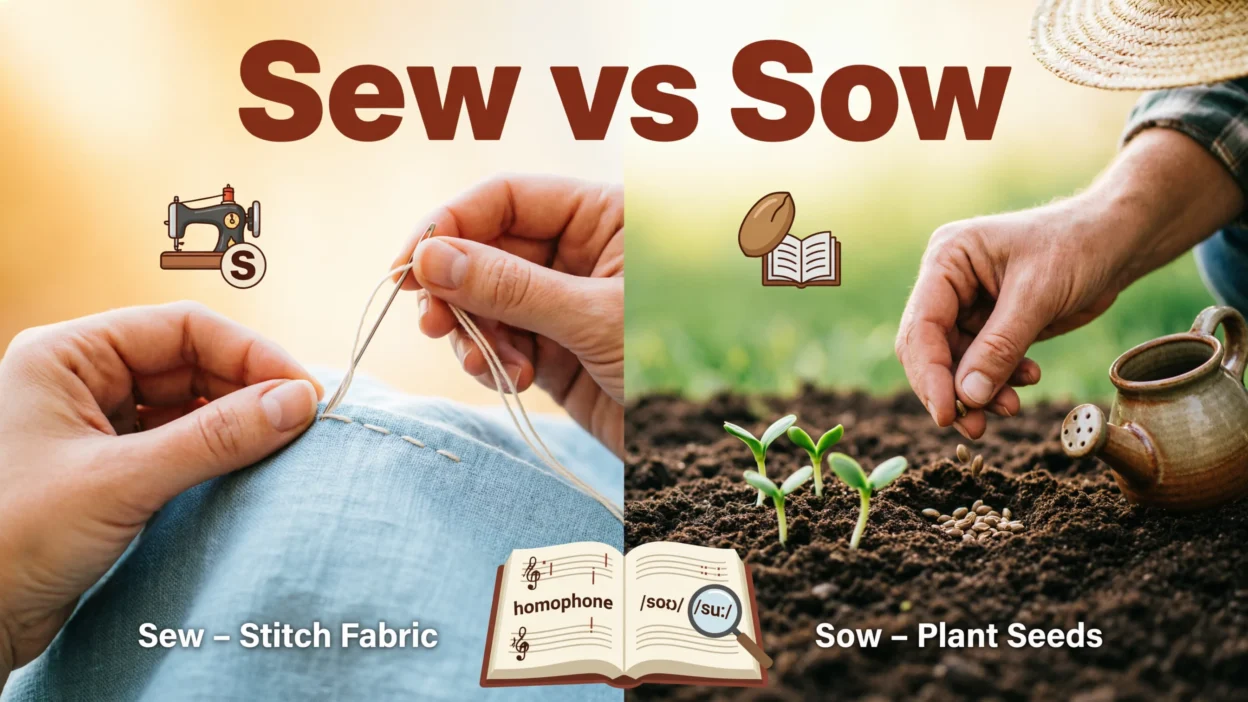
Many English words sound exactly alike but have completely different meanings, and sew vs sow is a perfect example.
Because both words are pronounced the same in most accents, it’s easy to confuse them in writing. However, they refer to entirely different actions and are used in very different contexts.
In this guide, you’ll learn the difference between sew vs sow, their meanings, pronunciation, examples, common mistakes, and when to use each word correctly.
Whether you’re improving your grammar, preparing for an exam, or writing professionally, this article will help you use both words with confidence.
Quick Answer
Sew means to join fabric or other materials together using a needle and thread or a sewing machine.
Sow means to plant seeds in the ground or, in a figurative sense, to spread or introduce something, such as ideas, doubt, or conflict.
Although sew and sow are pronounced alike in most varieties of English, they have different spellings, meanings, and uses.
What Does “Sew” Mean?
The verb sew refers to joining pieces of fabric or repairing clothing by using a needle and thread or a sewing machine.
It is commonly used in:
- Tailoring
- Fashion design
- Clothing repair
- Quilting
- Craft projects
- Home sewing
Examples of Sew
- My grandmother can sew beautiful dresses.
- I need to sew a button back onto my shirt.
- She learned to sew using a sewing machine.
- They sewed costumes for the school play.
In every example, sew involves stitching or joining materials together.
What Does “Sow” Mean?
The verb sow primarily means to plant seeds in soil so they can grow into crops, flowers, or plants.
It also has a figurative meaning: to spread or introduce something that develops over time, such as hope, fear, doubt, or kindness.
Examples of Sow
- Farmers sow wheat every spring.
- It’s time to sow vegetable seeds in the garden.
- His speech began to sow doubt among the audience.
- Teachers sow the seeds of curiosity in young minds.
In both the literal and figurative senses, sow refers to starting something that grows or develops.
Sew vs Sow: The Main Difference
Although these words sound the same, they have entirely different meanings.
| Feature | Sew | Sow |
|---|---|---|
| Meaning | Join fabric with thread | Plant seeds or spread ideas |
| Common Context | Clothing, tailoring, crafts | Gardening, farming, figurative language |
| Part of Speech | Verb | Verb |
| Past Tense | Sewed | Sowed |
| Past Participle | Sewn or Sewed | Sown or Sowed |
| Pronunciation | /soʊ/ | /soʊ/ |
The easiest way to remember the difference is that sew relates to stitching, while sow relates to planting or spreading.
Pronunciation
Both sew and sow are pronounced exactly like the word “so” in most English dialects.
Because they are homophones, you must rely on the sentence’s meaning rather than pronunciation to determine the correct spelling.
When to Use “Sew”
Choose sew whenever you’re talking about fabric, clothing, thread, or stitching.
Common situations include:
- Sewing clothes
- Repairing garments
- Making curtains
- Creating quilts
- Fashion and tailoring
- Needlework
More Examples of Sew
- Can you sew this torn pocket?
- She enjoys sewing handmade gifts.
- He sewed a patch onto his backpack.
- Learning to sew is a useful life skill.
When to Use “Sow”
Choose sow whenever you’re discussing planting seeds or spreading something that grows over time.
Common situations include:
- Farming
- Gardening
- Agriculture
- Planting flowers
- Spreading ideas
- Creating emotions or influence
More Examples of Sow
- We will sow grass seed this weekend.
- Farmers sow corn before the rainy season.
- Their actions sowed confusion among employees.
- Parents often sow values that last a lifetime.
American vs British English
There is no significant spelling difference between American and British English for sew and sow.
Both varieties of English use the same spellings and meanings.
Examples:
- American English: She learned to sew her own clothes.
- British English: She learned to sew her own clothes.
- American English: Farmers sow crops in spring.
- British English: Farmers sow crops in spring.
Only pronunciation may vary slightly depending on regional accents, but the spellings remain the same.
Common Mistakes to Avoid
Since sew and sow sound identical, writers sometimes choose the wrong spelling.
Avoid these common mistakes:
- Writing “I will sow my shirt.”
- Writing “Farmers sew seeds.”
- Assuming pronunciation determines spelling.
- Confusing sewing with planting because the words sound alike.
- Forgetting that context determines the correct word.
Always ask yourself whether you’re talking about fabric or seeds. The answer will guide your spelling.
Easy Memory Trick
A simple memory trick can help you remember the difference.
- Sew contains “ew”, which you can associate with needle and thread passing through fabric.
- Sow contains “ow”, reminding you of working outdoors in the soil to plant seeds.
Another easy reminder:
- Sew = Stitch
- Sow = Seeds
Related Words and LSI Keywords
Including related terms naturally improves understanding and SEO.
Relevant LSI keywords include:
- sew meaning
- sow meaning
- sew vs sow difference
- homophones in English
- sewing vocabulary
- planting seeds
- gardening terms
- sewing machine
- tailoring basics
- agriculture vocabulary
- English grammar guide
- confusing English words
- sew examples
- sow examples
- stitch vs plant
These related terms support the primary keyword while making the content more comprehensive.
Why Context Matters
Because sew and sow are homophones, context is the key to choosing the correct spelling.
For example:
- “She will sew a dress.” ✔️
- “She will sow a dress.” ❌
Likewise:
- “They will sow sunflower seeds.” ✔️
- “They will sew sunflower seeds.” ❌
Reading the sentence carefully makes the correct choice much easier.
FAQs
Is sew or sow correct?
Both are correct, but they have different meanings. Sew refers to stitching fabric, while sow refers to planting seeds or spreading ideas.
Are sew and sow pronounced the same?
Yes. In most English accents, both words are pronounced like “so.”
What does sew mean?
Sew means to join or repair fabric using a needle and thread or a sewing machine.
What does sow mean?
Sow means to plant seeds or to spread something, such as ideas, hope, doubt, or kindness.
Is sow only used for farming?
No. Besides planting seeds, sow is also commonly used figuratively, such as sow doubt, sow peace, or sow kindness.
What is the past tense of sew?
The past tense is sewed, while the past participle can be sewn or sewed, depending on the sentence.
What is the past tense of sow?
The past tense is sowed, and the past participle may be sown or sowed, with sown being more common.
Summary
Understanding sew vs sow is simple once you focus on their meanings rather than their pronunciation. Sew refers to stitching or repairing fabric with a needle and thread, while sow means planting seeds or spreading something that grows over time, such as ideas, hope, or doubt. Although they are pronounced the same, they are never interchangeable because they describe completely different actions.
The easiest way to choose the correct word is to consider the context. If the sentence involves clothing, fabric, or stitching, use sew. If it involves farming, gardening, or spreading something that develops over time, use sow. Mastering this distinction will make your writing clearer, more accurate, and more professional.
Actionable Takeaway
Remember this simple rule: Sew = Stitch Fabric and Sow = Plant Seeds or Spread Ideas. Whenever you’re unsure, identify the action in the sentence before choosing the spelling.

Mike Poop is a dedicated writer at Symboliy.com, creating clear, practical content about language, communication, and everyday expressions to help readers understand meaning and usage confidently in professional contexts worldwide.