
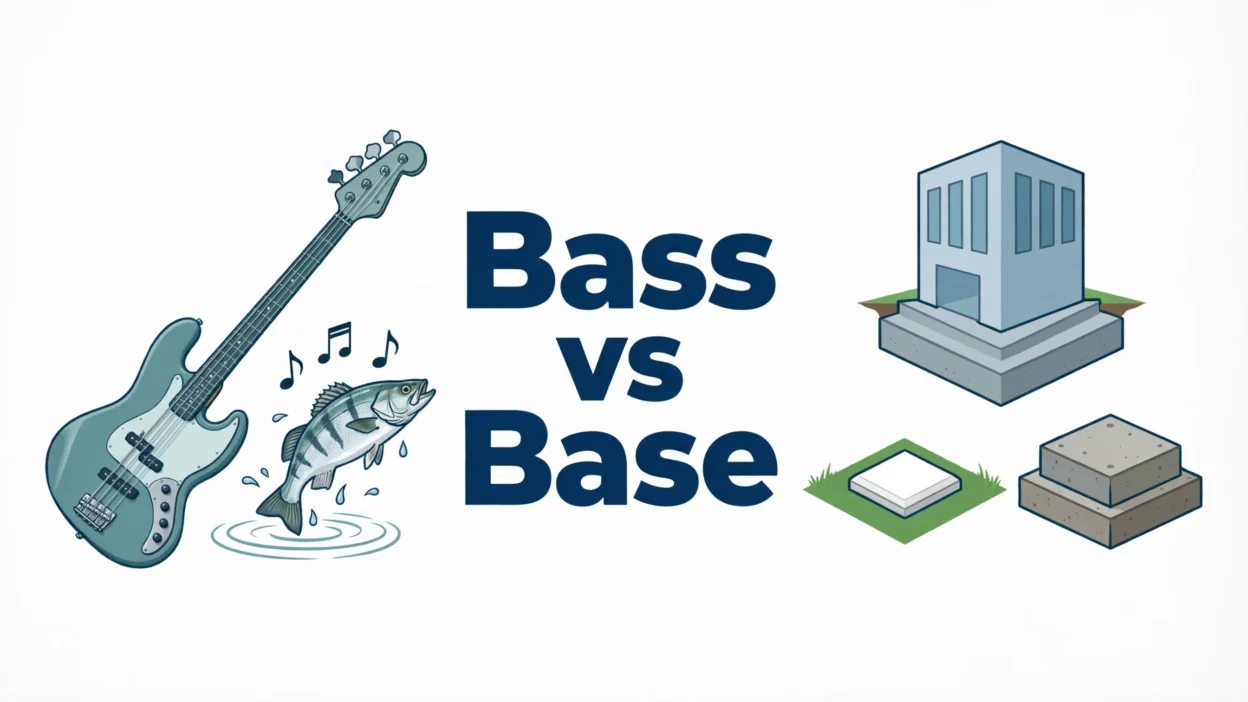
Have you ever come across the words bass and base and wondered which one to use? Although they sound similar in some situations, these words have completely different meanings and are often confused in writing.
Understanding the difference between bass vs base can help you communicate more clearly and avoid common English mistakes.
In this guide, you’ll learn the meanings of bass and base, when to use each one, real-life examples, common errors, pronunciation tips, and a simple trick to remember the difference.
Whether you’re a student, writer, or English learner, this article will make these confusing words easy to master.
Quick Answer
The difference between bass and base is straightforward:
- Bass refers to a low musical sound, a type of fish, or something with a low pitch.
- Base refers to a foundation, starting point, bottom part, or the main support of something.
Examples:
- She plays the bass guitar. ✅
- The lake is full of bass. ✅
- The statue stands on a strong base. ✅
- This theory forms the base of modern science. ✅
Even though they may sound alike in some accents, they have different meanings and should never be used interchangeably.
What Does “Bass” Mean?
Bass has multiple meanings depending on the context. It is most commonly used in music and fishing.
1. Bass in Music
In music, bass refers to the lowest range of musical notes or instruments that produce deep sounds.
Examples
- He plays the bass guitar in a rock band.
- The song has a powerful bass line.
- Turn up the bass on the speakers.
- She sings in a bass choir.
- The concert featured impressive bass sounds.
2. Bass as a Fish
Bass is also the name of several species of freshwater and saltwater fish.
Examples
- We caught three bass during our fishing trip.
- The restaurant serves grilled sea bass.
- Anglers love fishing for largemouth bass.
- The lake is known for its healthy bass population.
Pronunciation Tip
Interestingly, bass has two pronunciations:
- In music: pronounced like “base.”
- As a fish: pronounced like “bass” (rhymes with glass).
The meaning depends on the context.
What Does “Base” Mean?
Base generally refers to the bottom, foundation, support, or starting point of something. It is also used in science, sports, mathematics, and everyday English.
Examples
- The lamp has a heavy base.
- Education is the base of personal growth.
- The soldiers returned to their military base.
- The baseball player ran to first base.
- This recipe uses tomatoes as its base.
When to Use “Base”
Use base when referring to:
- A foundation or support
- A starting point
- The bottom part of an object
- Military locations
- Baseball positions
- Chemistry (a substance opposite to an acid)
- Mathematics and geometry
Bass vs Base: Key Differences
| Feature | Bass | Base |
|---|---|---|
| Meaning | Low musical sound or a type of fish | Foundation, bottom, support, or starting point |
| Part of Speech | Noun (sometimes adjective) | Noun (sometimes verb or adjective) |
| Common Contexts | Music, fishing, audio | Construction, sports, science, education |
| Pronunciation | “Base” (music), “Bass” (fish) | “Base” |
| Example | The bass guitar sounds amazing. | The building has a solid base. |
Easy Trick to Remember
Here’s a simple memory trick:
- Bass has two S letters—think of Strings and Sea, which both start with S. Bass is used for music and fish.
- Base contains the word “base” like the base of a building or the base in baseball.
Remember:
- Bass = Music or Fish
- Base = Foundation or Bottom
Common Mistakes
Many people confuse these words because bass (music) and base are pronounced the same.
Mistake 1: Using “Base” for Music
❌ He bought a new base guitar.
✅ He bought a new bass guitar.
The instrument is called a bass guitar.
Mistake 2: Using “Bass” for Foundation
❌ The building has a strong bass.
✅ The building has a strong base.
Here, you’re talking about a foundation.
Mistake 3: Mixing Up Fish and Foundation
❌ We caught several base in the river.
✅ We caught several bass in the river.
Fish are called bass, not base.
More Examples of Correct Usage
Using “Bass”
- The DJ increased the bass before the concert.
- She enjoys playing the bass guitar.
- We spotted a giant bass near the dock.
- Sea bass is popular in many seafood dishes.
- The movie soundtrack had deep bass effects.
Using “Base”
- The vase has a round base.
- They built the house on a concrete base.
- The team returned to base after the mission.
- The scientist used previous research as a base for the experiment.
- He safely reached third base.
American vs British English
There is no major difference between American and British English in the use of bass and base.
Both varieties follow the same spelling and grammar rules.
The only slight variation may be in pronunciation depending on regional accents, but the meanings remain identical.
Examples:
American English
- Turn up the bass.
- The chair has a sturdy base.
British English
- Turn up the bass.
- The chair has a sturdy base.
The usage is the same in both forms of English.
Related Grammar Topics (LSI Keywords)
Understanding bass vs base also helps with related English topics, such as:
- commonly confused words
- homophones and near-homophones
- English vocabulary
- word choice
- English grammar rules
- pronunciation differences
- confusing English words
- music vocabulary
- fishing terminology
- foundation meaning
- writing tips
- English language learning
Learning these related concepts can improve both your writing and speaking skills.
Why This Difference Matters
Using the correct word makes your writing more precise and professional. Although bass and base can sound alike in certain contexts, choosing the wrong one may confuse readers or completely change your meaning.
For example, writing “base guitar” instead of “bass guitar” can make your writing appear inaccurate. Likewise, saying a building has a “bass” instead of a “base” is grammatically incorrect. Understanding the distinction helps you communicate clearly in academic, professional, and everyday situations.
Frequently Asked Questions
1. What is the difference between bass and base?
Bass refers to low musical sounds or a type of fish, while base refers to a foundation, support, or starting point.
2. Is it bass guitar or base guitar?
The correct term is bass guitar.
3. Is bass pronounced the same as base?
In music, yes. Bass is pronounced like base. When referring to the fish, it is pronounced differently, rhyming with glass.
4. Can base refer to a military location?
Yes. A military installation is commonly called a base.
5. Why do people confuse bass and base?
They are often confused because bass (in the musical sense) and base share the same pronunciation in English.
6. Are bass and base interchangeable?
No. They have different meanings and should be used only in their appropriate contexts.
7. Is there an American vs British English difference?
No. Both American and British English use bass and base in the same way.
8. How can I remember the difference?
Think of bass for music and fish, and base for foundation, support, or bottom.
Summary
Understanding bass vs base is simple once you connect each word to its meaning. Bass is used for low musical sounds and certain types of fish, while base refers to a foundation, support, starting point, or bottom part of something. Although the musical pronunciation of bass matches base, their meanings are entirely different.
Whenever you’re unsure, remember the context. If you’re talking about music or fishing, choose bass. If you’re referring to a foundation, structure, sports, or a starting point, choose base. Using the correct word will make your writing more accurate, professional, and easier for readers to understand.
Actionable Takeaway
Before writing bass or base, ask yourself: Am I referring to music or fish, or am I talking about a foundation or support? This quick check will help you choose the correct word every time and avoid one of the most common vocabulary mistakes in English.

Mike Poop is a dedicated writer at Symboliy.com, creating clear, practical content about language, communication, and everyday expressions to help readers understand meaning and usage confidently in professional contexts worldwide.