
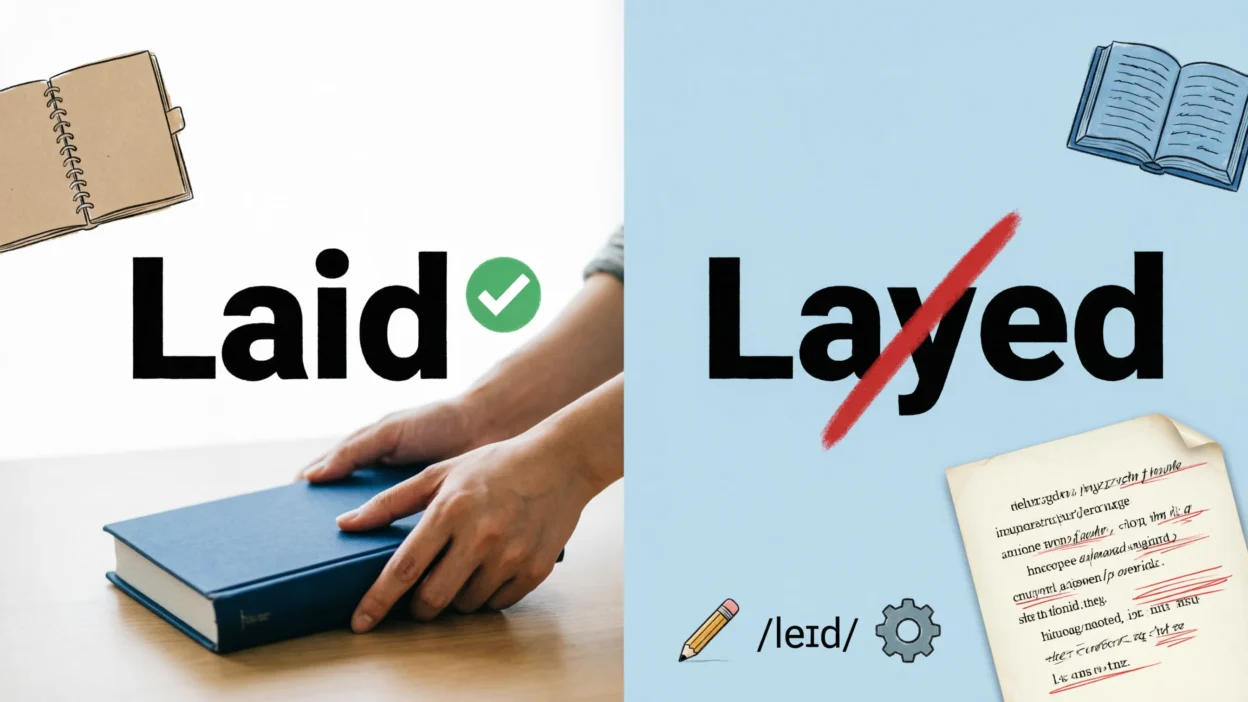
If you’ve ever wondered about laid vs layed, you’re not alone. Many English learners and native speakers mistakenly write layed when they actually mean laid. Since both words look similar, it’s easy to assume they are interchangeable, but that’s not the case.
The good news is that the rule is simple. Laid is the correct past tense and past participle of the verb lay, while layed is generally considered incorrect in standard English.
This guide explains the difference, provides examples, highlights common mistakes, and helps you remember the correct spelling with ease.
Quick Answer
“Laid” is the correct spelling in standard English.
“Layed” is generally incorrect and should not be used.
- ✅ Correct: She laid the book on the table.
- ✅ Correct: The hen has laid three eggs.
- ❌ Incorrect: She layed the book on the table.
Whenever you need the past tense of lay, always use laid.
What Does “Laid” Mean?
Laid is the past tense and past participle of the verb lay, which means to put or place something down.
It can also mean:
- To place an object somewhere
- To produce eggs (for birds)
- To establish or prepare something
- To set something in position
Examples of “Laid”
- She laid the keys on the kitchen counter.
- He laid the baby in the crib.
- The chicken laid five eggs this week.
- Workers laid new tiles in the hallway.
- They laid the foundation for the new building.
In each sentence, laid correctly describes a completed action.
Is “Layed” a Real Word?
In standard English, layed is not accepted as the past tense of lay.
Many people mistakenly assume that adding -ed forms the past tense, but lay is an irregular verb.
The correct verb forms are:
- Present: Lay
- Past: Laid
- Past Participle: Laid
Therefore:
- ✅ Lay
- ✅ Laid
- ❌ Layed
If you’re writing for school, work, business, or online, avoid using layed.
Laid vs Layed: Comparison Table
| Feature | Laid | Layed |
|---|---|---|
| Correct English | ✅ Yes | ❌ No |
| Standard Grammar | ✅ Yes | ❌ No |
| Past Tense of “Lay” | ✅ Yes | ❌ No |
| Dictionary Accepted | ✅ Yes | ❌ No (for standard usage) |
| Professional Writing | ✅ Recommended | ❌ Avoid |
| Academic Writing | ✅ Yes | ❌ Incorrect |
Why Do People Write “Layed”?
The confusion comes from regular verb patterns.
Most English verbs become past tense by adding -ed.
For example:
- Walk → Walked
- Play → Played
- Jump → Jumped
Many people assume:
Lay → Layed
However, lay is an irregular verb, so its past tense changes to laid instead.
Learning irregular verbs is one of the trickiest parts of English grammar, which is why this mistake is so common.
Common Mistakes
Here are some sentences people often write incorrectly.
Mistake 1
❌ She layed the phone on the desk.
✅ She laid the phone on the desk.
Mistake 2
❌ The bird layed an egg.
✅ The bird laid an egg.
Mistake 3
❌ He has layed the carpet.
✅ He has laid the carpet.
Mistake 4
❌ They layed the bricks yesterday.
✅ They laid the bricks yesterday.
Replacing layed with laid makes each sentence grammatically correct.
Understanding the Verb “Lay”
The verb lay means to place or put something somewhere. It usually takes a direct object, meaning something is being placed.
Examples:
- Please lay the blanket on the bed.
- She lays her phone on the table every evening.
- Yesterday she laid the phone on the table.
- The hen has laid another egg.
A helpful way to remember this is that lay requires something to be placed.
Laid vs Lie: Don’t Confuse Them
Many people also confuse lay and lie because their verb forms overlap.
| Verb | Meaning | Past Tense |
|---|---|---|
| Lay | To put something down | Laid |
| Lie | To recline or rest | Lay |
Examples:
- I lay the notebook on the desk every morning.
- Yesterday I laid the notebook there.
But:
- I lie down after work.
- Yesterday I lay down after work.
Although they sound similar, these are different verbs with different meanings.
American vs British English
Both American English and British English use laid as the correct past tense of lay.
There is no spelling difference between the two.
Examples:
American English
- She laid the groceries on the counter.
British English
- He laid the tools in the garage.
Both varieties consider layed incorrect in standard grammar.
Grammar Tip to Remember
Use this simple rule:
Lay → Laid
Never:
Lay → Layed
Think of these examples:
- Lay the book down.
- Yesterday I laid the book down.
- The hen laid an egg.
You’ll never need layed in standard English.
Related Words and Synonyms
Here are related words that naturally connect with laid:
- Placed
- Put
- Positioned
- Set
- Arranged
- Installed
- Established
- Deposited
- Set down
- Put down
These terms often appear in writing about actions involving placement or preparation.
Tips for Using “Laid” Correctly
Follow these simple tips:
- Remember that lay is an irregular verb.
- Always use laid for the past tense.
- Never use layed in professional or academic writing.
- Proofread your documents for common grammar mistakes.
- If you’re unsure, check whether you’re referring to a completed action of placing something.
Frequently Asked Questions
Is “layed” a real word?
No. In standard English, layed is not the correct past tense of lay and should generally be avoided.
Which is correct: “laid” or “layed”?
Laid is the correct spelling.
Why do people write “layed”?
People often assume all past-tense verbs end in -ed, but lay is an irregular verb whose past tense is laid.
Is “laid” the past tense of “lay”?
Yes. Both the past tense and past participle of lay are laid.
Is “laid” used in both American and British English?
Yes. Both American and British English use laid with the same spelling and meaning.
Can I write “the hen layed an egg”?
No. The correct sentence is:
“The hen laid an egg.”
How can I remember the correct spelling?
Remember this simple rule:
Lay → Laid
Never Lay → Layed.
Is “laid” appropriate in professional writing?
Yes. Laid is the correct and accepted spelling in business, academic, and everyday writing.
Summary
Understanding laid vs layed is simple once you know the grammar rule. Laid is the correct past tense and past participle of lay, meaning to put or place something down. Whether you’re describing placing an object, a bird producing eggs, or laying a foundation, laid is always the right choice in standard English.
Although layed may occasionally appear online, it is considered a spelling mistake in everyday, academic, and professional writing. By remembering the rule “Lay becomes laid, not layed,” you can avoid one of the most common English grammar errors and write with greater confidence.
Actionable Takeaway
Whenever you’re tempted to write “layed,” replace it with “laid.” Keep the simple rule Lay → Laid in mind, and you’ll use the correct form every time in emails, assignments, resumes, and everyday conversations.

Shan Waston is a skilled writer at Symboliy.com, producing clear, engaging content on language, communication, and everyday expressions to help readers understand meaning and usage confidently in modern digital contexts.