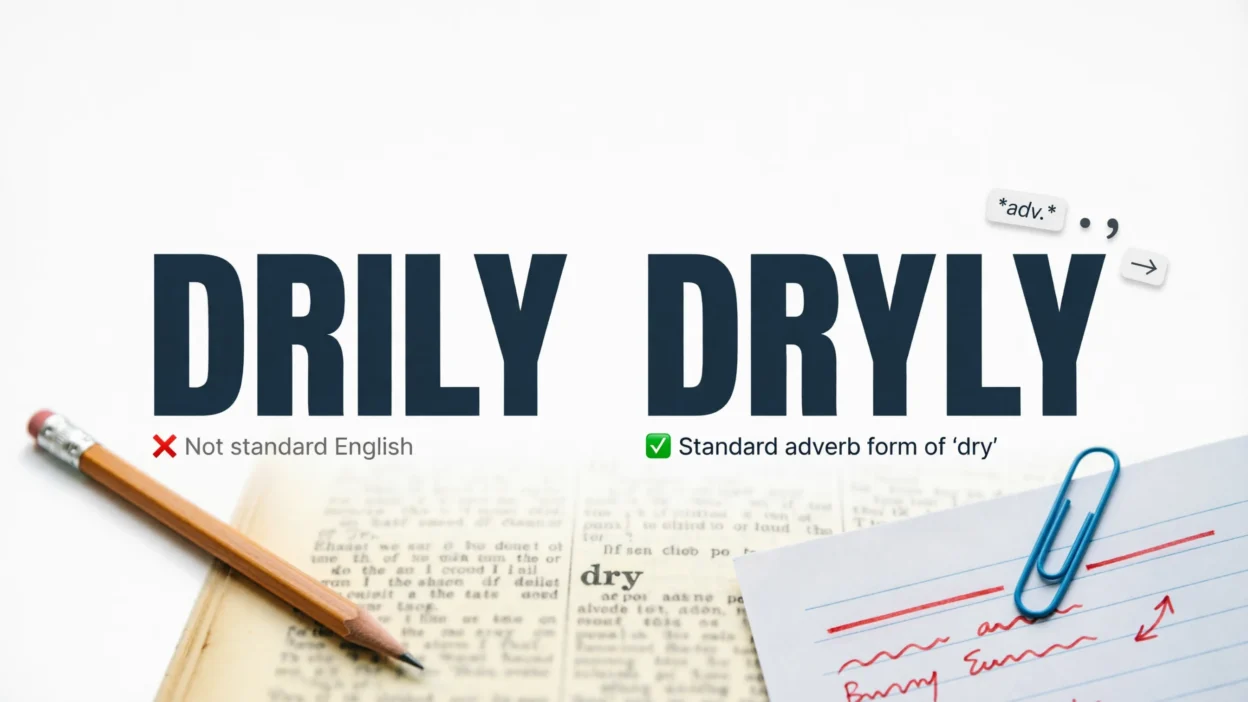
If you’ve ever paused while writing and wondered whether drily or dryly is the correct spelling, you’re not alone. These two words look different, sound identical, and often appear interchangeably in books, articles, and everyday writing. The confusion leaves many writers questioning which version is actually right.
The good news is that both drily and dryly are correct spellings. However, their usage varies depending on style preferences, dictionaries, and regional writing conventions. In this guide, you’ll learn the meaning of both words, how they differ, examples of proper usage, common mistakes to avoid, and which spelling may be best for your audience.
Quick Answer
Drily and dryly have the same meaning and pronunciation. Both are accepted spellings of the adverb form of dry when used to describe speech, humor, or remarks made in a restrained, ironic, or unemotional way.
- Drily is traditionally preferred by some dictionaries and style guides.
- Dryly is also widely accepted and commonly used in modern English.
- There is no difference in meaning between the two spellings.
Example:
- She drily remarked that the meeting could have been an email.
- She dryly remarked that the meeting could have been an email.
Both sentences are correct.
What Does Drily Mean?
The word drily is an adverb that describes speaking, writing, or reacting in a way that is subtle, unemotional, ironic, or slightly humorous.
When someone says something drily, they often express humor without showing strong emotion.
Examples:
- He drily noted that arriving two hours late was not ideal.
- The professor drily observed that the test results were less than impressive.
- She drily thanked her brother for his “helpful” advice.
In these examples, the speaker conveys irony or understated humor rather than enthusiasm.
What Does Dryly Mean?
Dryly carries exactly the same meaning as drily. It is simply an alternative spelling of the same adverb.
Examples:
- The manager dryly commented that deadlines still matter.
- He dryly replied, “Well, that went according to plan.”
- She dryly pointed out the obvious flaw in the proposal.
Readers understand both spellings in the same way.
Drily vs Dryly: Is There Any Difference?
The short answer is no.
There is no difference in:
- Meaning
- Pronunciation
- Grammatical function
- Tone
- Context of use
The distinction is purely a matter of spelling preference.
Comparison Table: Drily vs Dryly
| Feature | Drily | Dryly |
|---|---|---|
| Meaning | In a restrained or ironic manner | In a restrained or ironic manner |
| Pronunciation | Same | Same |
| Grammatical Role | Adverb | Adverb |
| Accepted in Dictionaries | Yes | Yes |
| Common in Modern Writing | Yes | Yes |
| Difference in Meaning | None | None |
For most writers, choosing one spelling and using it consistently is the best approach.
Why Are There Two Spellings?
English spelling often develops multiple accepted forms over time. The variation between drily and dryly comes from different approaches to forming adverbs from adjectives ending in -y.
Typically, adjectives ending in -y become adverbs by changing the y to i and adding -ly.
Examples:
- Happy → Happily
- Easy → Easily
- Angry → Angrily
Following this pattern, dry becomes drily.
However, because dry is a short and unique word, the spelling dryly also emerged and gained widespread acceptance. Over time, both forms became standard English.
American English vs British English
One of the most common questions is whether drily and dryly differ between American and British English.
The answer is that both spellings are accepted in both varieties of English.
American English
In American publications, you’ll often see both spellings, though dryly tends to appear slightly more frequently in modern writing.
Example:
- The journalist dryly observed the irony of the situation.
British English
British writers also use both forms, although some traditional British dictionaries have historically favored drily.
Example:
- The author drily described the political controversy.
Because usage varies, consistency matters more than regional preference.
When Should You Use Drily?
You may choose drily if:
- You follow a style guide that prefers it.
- You want to align with traditional adverb formation rules.
- Your publication consistently uses this spelling.
Examples:
- He drily remarked that technology does not always simplify life.
- She drily acknowledged the obvious mistake.
When Should You Use Dryly?
You may choose dryly if:
- It looks more natural to you.
- Your audience is accustomed to modern spelling conventions.
- Your organization or editor prefers it.
Examples:
- The comedian dryly delivered the punchline.
- The teacher dryly noted the missing homework.
Both choices are grammatically correct.
Common Mistakes to Avoid
Many writers make errors when using drily and dryly. Here are the most common ones.
Assuming One Spelling Is Wrong
A common misconception is that only one version is correct.
Incorrect belief:
- Drily is correct and dryly is wrong.
- Dryly is correct and drily is wrong.
Reality:
- Both are accepted spellings.
Switching Spellings in the Same Document
Consistency improves readability.
Avoid:
- He drily commented on the issue.
- Later she dryly responded.
Instead, choose one spelling and use it throughout the document.
Confusing Dry Humor With Boring Humor
Dry humor does not mean dull humor.
Dry humor refers to:
- Subtle wit
- Understatement
- Irony
- Deadpan delivery
Example:
- After the computer crashed again, he dryly said, “At least it’s consistent.”
Examples of Drily and Dryly in Sentences
Here are additional examples to help you understand their usage.
Examples With Drily
- She drily observed that the weather forecast had been completely wrong.
- The lawyer drily summarized the lengthy argument.
- He drily thanked his friend for stating the obvious.
Examples With Dryly
- The actor dryly delivered the sarcastic line.
- She dryly commented that traffic was moving at record speed.
- The editor dryly pointed out the typo.
Related Words and Synonyms
If you’re looking for alternatives to drily or dryly, consider these related words:
- Ironically
- Wryly
- Sardonically
- Deadpanly
- Casually
- Matter-of-factly
- Understatedly
- Cynically
- Humorously
- Subtly
These words may fit similar contexts depending on the tone you want to create.
How to Remember the Difference
A simple memory trick is:
- Drily = traditional spelling
- Dryly = modern-looking spelling
Since both are correct, the goal is not choosing the “right” one but choosing one and remaining consistent.
If you’re unsure, check your organization’s style guide or dictionary preference.
FAQs
Is drily a real word?
Yes. Drily is a standard English word recognized by major dictionaries and style references.
Is dryly grammatically correct?
Yes. Dryly is also fully correct and widely used in modern English.
Which spelling is more common, drily or dryly?
Usage varies by publication and region, but dryly often appears slightly more frequently in contemporary writing.
Do drily and dryly have different meanings?
No. Both words have exactly the same meaning and function.
Which spelling should I use in academic writing?
Either spelling is acceptable. Follow your institution’s style guide and remain consistent throughout the document.
Is drily British and dryly American?
Not strictly. Both spellings are used in British and American English, although preferences may vary among publishers.
Can I use drily and dryly interchangeably?
Yes. They are interchangeable because they share the same meaning and pronunciation.
What does speaking dryly mean?
Speaking dryly means speaking with understated humor, irony, or a calm and unemotional tone.
Summary
The debate over drily vs dryly is less about correctness and more about spelling preference. Both forms are recognized, accepted, and widely used by writers, editors, and publishers. They share the same pronunciation, meaning, and grammatical role, making them interchangeable in virtually all contexts.
When deciding between drily and dryly, focus on consistency rather than finding a single “correct” answer. Choose the spelling that matches your style guide, audience, or personal preference, and use it throughout your writing. Doing so will keep your content professional, polished, and easy to read.
Actionable Takeaway
If you’re writing for a publication, check its style guide and follow its preferred spelling. If no guideline exists, choose either drily or dryly and stay consistent across the entire piece. Readers will understand both forms equally well.

Here is a professional 30-word author biography including your site name Symboliy.com:
Martin Hood is a professional writer at Symboliy.com, creating clear, informative content focused on language, communication, and meaningful expressions for everyday and professional use.